Introduction
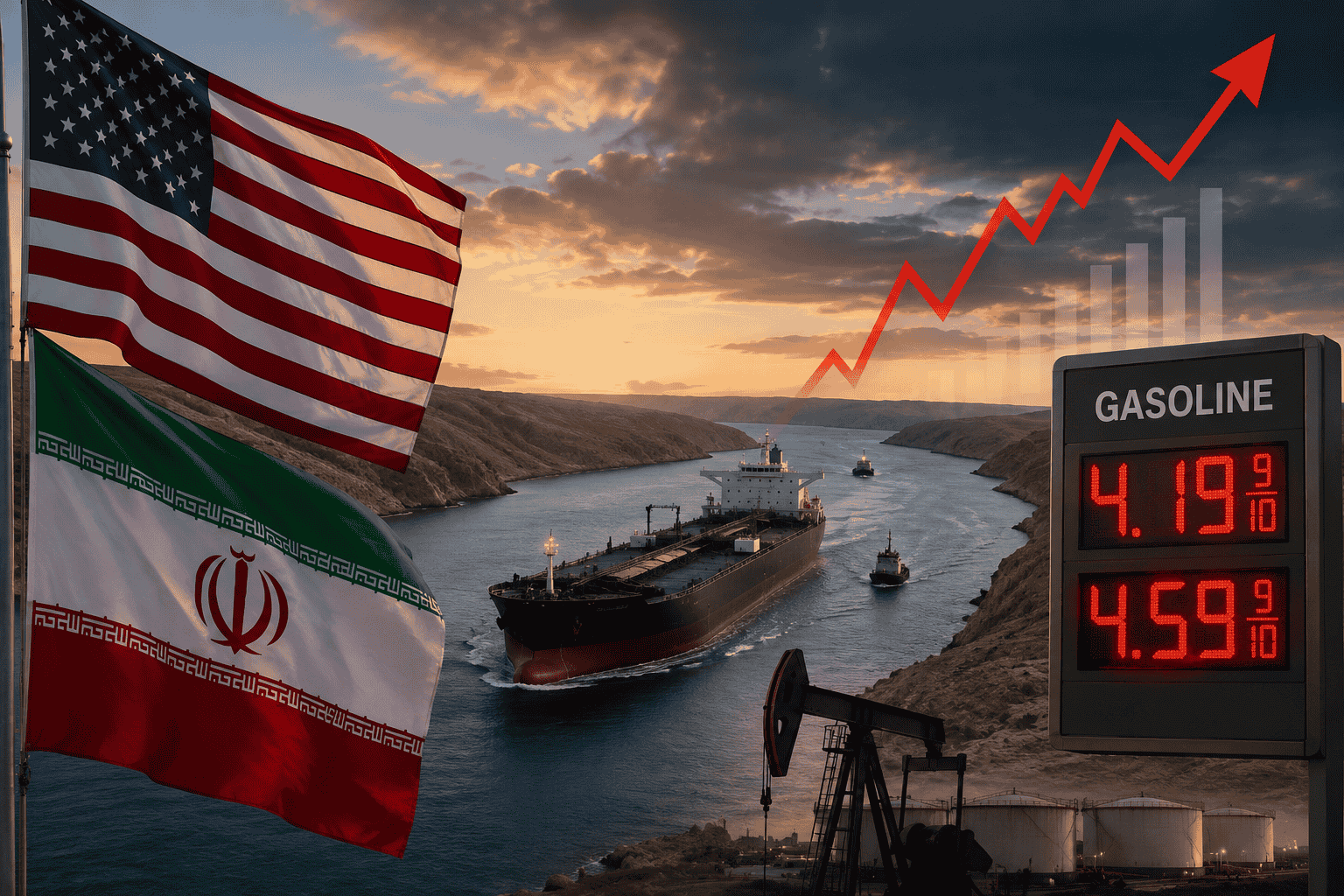
Gas Prices: The U.S.-Iran conflict has entered another dangerous phase, with renewed American strikes on Iranian targets and retaliatory attacks by Tehran raising fears of a prolonged energy and economic shock.
The Strait of Hormuz is at the center of the crisis. The narrow waterway connects the Persian Gulf with the Gulf of Oman and is one of the world’s most important energy routes. In the first half of 2025, about 20.9 million barrels of oil per day moved through the strait, equivalent to roughly 20% of global petroleum liquids consumption.
For Americans, the biggest concern is simple: Could the conflict push gasoline prices higher and reignite inflation?
Recent market movements suggest that risk is already being priced in.
U.S.-Iran Conflict Escalates Around Strait of Hormuz
On September 1, 2026, the United States launched another round of strikes against Iranian targets. U.S. officials said the attacks followed attempted Iranian attacks involving commercial shipping in the Strait of Hormuz and U.S. military personnel in the region.
The latest escalation followed U.S. strikes on Iran’s Larak Island, where American officials said Iranian forces were preparing rocket launches and possible sea-mine deployments. Iran subsequently responded with missile and drone attacks in the region.
President Donald Trump has warned that additional Iranian retaliation could trigger stronger U.S. military action. The developments have increased uncertainty around commercial shipping and energy supplies.
The result has been immediate pressure on global oil markets.
Oil Prices Surge Above $90
Oil and gas prices reacted sharply to the renewed fighting.
On September 1, Brent crude settled at $94.65 per barrel, gaining 4.6%, while U.S. West Texas Intermediate crude reached $90.22, up 5.2%. Both benchmarks moved to their highest levels in about five weeks.
The increase matters because crude oil is a major input for gasoline, diesel, aviation fuel, transportation and manufacturing.
The situation is especially concerning because energy markets are already dealing with refinery and supply disruptions. U.S. diesel futures recently reached a 52-month high, while refining margins climbed sharply.
If the conflict remains contained, prices could stabilize. But a prolonged disruption around Hormuz could create a much larger supply shock.
Could U.S. Gas Prices Rise Again?
American drivers are already paying significantly more for gasoline than they were a year ago.
AAA reported a national average price of approximately $4.10 per gallon for regular gasoline on September 1, 2026, compared with about $3.19 a year earlier. Diesel was averaging approximately $5.63 per gallon.
That means another major oil and gas prices increase could quickly become a problem for households and businesses.
Gasoline prices do not move one-for-one with crude oil and gas prices, because refining costs, transportation, taxes, seasonal demand, and regional supply also matter. However, sustained increases in crude prices generally put upward pressure on pump prices.
The impact could be particularly painful for households that depend heavily on cars for commuting and daily activities.
Why the Strait of Hormuz Is So Important
The Strait of Hormuz is only a relatively narrow maritime passage, but its economic importance is enormous.
Major oil producers in the Persian Gulf rely on the waterway to reach international markets. Saudi Arabia, Iraq, Kuwait, the United Arab Emirates and other producers have historically used routes connected to Hormuz for major portions of their energy exports.
The Strait of Hormuz crisis has already demonstrated how vulnerable global trade can become when shipping through the strait is disrupted.
Recent reports have described a dramatic decline in commercial traffic, while attacks and threats involving tankers have increased insurance costs and shipping risks.
Even if oil production continues, the inability to transport crude efficiently can create a shortage in international markets.
How Higher Oil & Gas Prices Could Increase U.S. Inflation
Oil affects inflation in two major ways.
First, higher gasoline and diesel prices directly increase household expenses. Consumers have less money available for restaurants, entertainment, retail purchases and other discretionary spending.
Second, higher energy costs increase expenses for businesses.
Trucking companies pay more for diesel. Airlines face higher fuel costs. Manufacturers spend more on transportation and energy. Retailers may face higher shipping expenses.
Those costs can eventually be passed to consumers through higher prices.
Research from the Federal Reserve Bank of Dallas has already highlighted the inflationary impact of the 2026 Iran conflict. Its analysis found that a major oil and gas price shock could significantly increase headline inflation, with energy costs also potentially affecting inflation expectations. This creates a difficult situation for policymakers.
The Federal Reserve Faces a Difficult Choice
The Federal Reserve has a challenging balancing act.
Normally, when inflation rises, the central bank can increase interest rates to slow demand. But an oil shock is different because it can raise prices while simultaneously weakening economic growth.
Higher interest rates would not produce more oil or reopen the Strait of Hormuz.
However, the Fed must consider whether temporary energy inflation becomes broader and more persistent.
Markets have already become more cautious about interest rates as oil and gas prices and Treasury yields rise. U.S. manufacturing data also showed continued input-price pressure in August, with the ISM prices-paid index remaining elevated at 71.1.
That makes the September policy outlook particularly important for investors and businesses.
Impact on the U.S. Economy
A prolonged U.S.-Iran conflict could affect more than gasoline prices.
Higher energy costs can reduce consumer purchasing power, increase transportation expenses and pressure corporate profit margins.
Small businesses could be especially vulnerable because they often have less flexibility to absorb higher fuel and logistics costs.
The stock market can also experience increased volatility. Energy companies may benefit from higher oil & gas prices, while airlines, transportation companies, manufacturers, and consumer businesses can face greater cost pressures.
Bond markets could also react if investors expect inflation to remain elevated for longer.
This combination creates a difficult economic environment: higher inflation combined with weaker growth.
What Happens If Hormuz Remains Disrupted?
The biggest variable is duration.
A short-term disruption could produce a temporary spike in oil and gas prices followed by stabilization if shipping resumes.
A prolonged disruption would be much more serious.
If large volumes of crude remain blocked from reaching international markets, oil and gas prices could move significantly higher. The United States and other countries could respond through strategic reserves, alternative supply routes, increased domestic production, and diplomatic efforts to protect shipping.
But replacing millions of barrels of daily supply immediately would be extremely difficult.
What Americans Should Watch Next
The most important indicators over the coming weeks will be:
- Brent crude and WTI oil & gas prices
- U.S. national gasoline and diesel prices
- Shipping traffic through the Strait of Hormuz
- Iranian and U.S. military activity
- U.S. inflation data
- Federal Reserve interest-rate decisions
- U.S. consumer spending
- Treasury bond yields
If oil & gas prices remain above $90 for an extended period, pressure on consumers and businesses could intensify.
Conclusion
The U.S.-Iran conflict in 2026 has moved beyond a geopolitical crisis and become a major economic risk.
The Strait of Hormuz remains one of the world’s most important energy chokepoints, and renewed military activity has already pushed Brent crude toward $95 per barrel and WTI above $90.
For American consumers, the immediate concern is gasoline and diesel. But the bigger issue is whether higher energy prices become embedded into broader inflation.
If the conflict de-escalates and shipping through Hormuz normalizes, oil and gas prices could retreat. If fighting continues and energy transportation remains disrupted, Americans could face higher fuel prices, more expensive goods, increased inflation pressure and a more difficult Federal Reserve policy environment.
For now, the Strait of Hormuz remains one of the most important economic flashpoints to watch in the global economy.