Introduction
Apple has entered a new era.
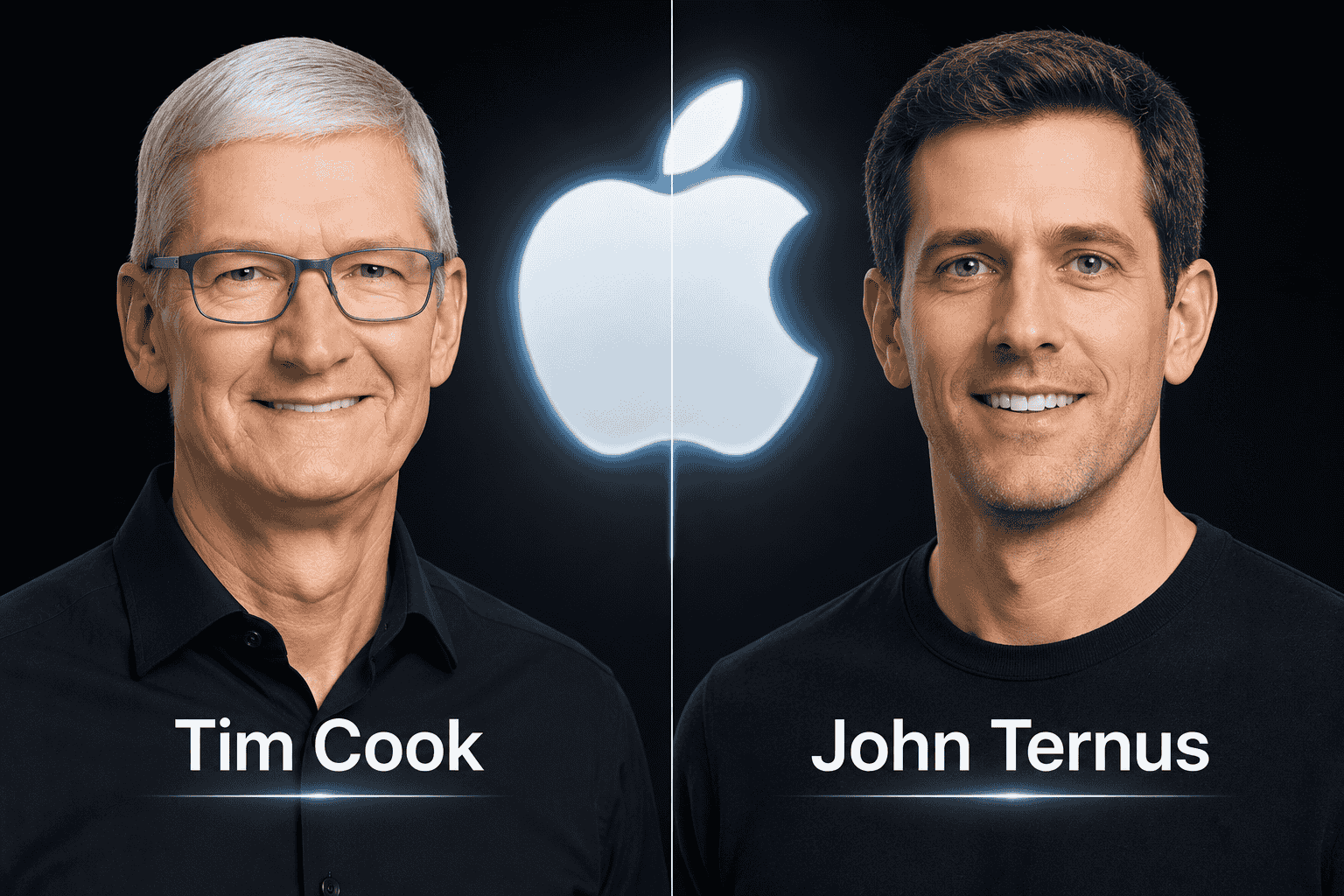
Apple CEO, After nearly 15 years at the company’s helm, Tim Cook has stepped down as Apple CEO, handing the leadership role to longtime hardware executive John Ternus on September 1, 2026. Cook will remain connected to the company as executive chairman, while Ternus takes responsibility for Apple’s next stage of growth.
The leadership transition comes at a critical moment for Apple.
Artificial intelligence has become one of the biggest competitive battlegrounds in technology, with Google, Microsoft, OpenAI, Nvidia and other companies investing heavily in AI models, chips, cloud infrastructure and intelligent assistants.
For Ternus, the biggest question is not simply how to maintain Apple’s success. It is whether he can help Apple strengthen its position in artificial intelligence while creating the company’s next major technology platform.
Tim Cook Steps Down as Apple CEO After 15 Years
Tim Cook became Apple CEO in 2011 after succeeding co-founder Steve Jobs.
His leadership style was different from Jobs’. Cook focused heavily on operations, supply chains, global manufacturing, services and financial growth.
The results were extraordinary.
Apple expanded from a company valued at roughly $350 billion when Cook became CEO to more than $4.5 trillion in 2026. Annual revenue reached approximately $416 billion in 2025, with profits of around $112 billion.
Under Cook, Apple also expanded beyond the iPhone.
The Apple Watch, AirPods, Apple Music, Apple TV+, iCloud and Apple Pay helped create additional revenue streams and strengthened Apple’s broader ecosystem.
However, artificial intelligence has become a major challenge during the later years of Cook’s tenure.
Who is John Ternus, the new Apple CEO?
John Ternus is not an outsider entering Apple.
He joined Apple in 2001 and spent more than two decades working across the company’s hardware organization. He eventually became senior vice president of Hardware Engineering, overseeing major product-development programs.
Ternus has been involved with important Apple products, including the iPhone, iPad, Mac, Apple Watch, AirPods and Vision Pro.
His engineering background makes the leadership transition particularly significant.
Instead of moving from one business-focused Apple CEO to another, Apple has selected an experienced product and engineering leader to run the company.
This could influence Apple’s approach to artificial intelligence, hardware innovation and future products.
Why Apple’s AI Strategy Is John Ternus’ Biggest Challenge
Artificial intelligence is arguably the biggest strategic challenge facing Apple.
Google and Microsoft have moved aggressively into generative AI, while OpenAI has helped popularize AI assistants integrated into consumer devices. Nvidia has also become a central player by supplying the computing infrastructure behind the AI boom.
Apple has taken a somewhat different approach.
Its AI strategy emphasizes privacy, on-device processing and integration across its existing ecosystem rather than competing solely on massive cloud-based AI models.
That strategy has advantages, but Apple has faced criticism over the pace of some AI developments.
Under Ternus, Apple will need to demonstrate that it can combine its hardware expertise with advanced AI capabilities.
Can John Ternus Transform Apple’s Siri and AI Strategy?
Siri could become one of Ternus’ most important early tests.
Apple has an enormous installed base of iPhones, iPads and Macs. If the company can integrate powerful AI into those devices while maintaining its privacy-focused ecosystem, it could potentially reach hundreds of millions of users.
The opportunity goes far beyond answering simple voice commands.
An advanced AI assistant could help users manage messages, emails, calendars, documents, applications and everyday tasks.
Consumers increasingly expect AI assistants to understand context and complete multiple tasks.
Apple therefore needs Siri to become more than a traditional voice assistant. It needs to become a genuine AI-powered personal assistant.
How Apple Silicon Could Strengthen Apple’s AI Future
Ternus brings something particularly valuable to Apple’s AI strategy: deep hardware expertise.
Apple designs its own processors, including its Apple Silicon family of chips.
This gives Apple an important advantage because artificial intelligence increasingly depends on specialized computing hardware.
The company can optimize its processors, operating systems and applications together, potentially improving AI performance, battery efficiency and privacy.
More AI processing could also happen directly on Apple devices rather than entirely in the cloud.
This could make AI services faster while reducing the amount of personal information that needs to leave a user’s device.
Could Apple’s Next Big Product Be an AI-Powered Device?
The biggest opportunity for Ternus may not be the iPhone.
Apple could use AI to expand into a new generation of intelligent hardware, including smarter AirPods, advanced wearables, smart glasses and other connected devices.
Apple already has an ecosystem connecting the iPhone, Apple Watch, AirPods, Mac and other products.
Adding AI across that ecosystem could create an experience that competitors may find difficult to replicate.
Imagine an assistant that understands what a user is doing across multiple devices and provides relevant assistance without requiring traditional apps or menus.
That could represent a major evolution in personal computing.
Apple Faces Growing Competition in the AI Race
Ternus is taking over at a time when Apple’s competitors are moving quickly.
Google has powerful AI models and enormous data-center resources. Microsoft has integrated AI throughout its software ecosystem. OpenAI continues to develop advanced AI products, while Nvidia supplies much of the computing infrastructure powering the industry.
Apple therefore faces an important strategic decision.
Should it build more AI technology internally, continue partnering with external AI companies, or combine both strategies?
The answer could influence Apple’s technology strategy for the next decade.
What Tim Cook’s New Role Means for Apple
Although Cook is stepping down as Apple CEO, his influence will not disappear.
As executive chairman, Cook, Apple CEO, can provide continuity during the leadership transition.
His experience with global operations, international relationships, supply chains and Apple’s financial strategy could remain valuable.
Apple CEO is also navigating complicated global manufacturing and geopolitical challenges.
Ternus will therefore inherit not only an AI challenge but also a massive international business that requires careful management.
What John Ternus’ Leadership Could Mean for Apple Investors
Ternus’ arrival could produce a subtle but important shift in Apple’s culture.
Cook transformed Apple into an operational and financial powerhouse. Ternus could put greater emphasis on engineering, product development and technological innovation.
That does not mean Apple CEO will abandon Cook’s successful strategy.
Instead, the company could combine Cook’s operational discipline with Ternus’ hardware and engineering expertise.
Investors will likely watch Apple’s AI spending, new product pipeline, services growth and ability to turn AI into a meaningful source of future revenue.
FAQs
What Does John Ternus Becoming Apple CEO Mean for AI?
John Ternus’ appointment could signal greater emphasis on integrating artificial intelligence with Apple’s hardware and software ecosystem.
His engineering experience could help Apple accelerate AI development while using custom chips, operating systems and devices to create tightly integrated AI experiences.
Will John Ternus Improve Apple Intelligence?
Improving Apple’s AI capabilities will be one of Ternus’ biggest challenges.
Apple has strong advantages in hardware, software integration and its global ecosystem, but it must demonstrate that these strengths can translate into competitive AI products.
The performance of Apple Intelligence and future AI features will therefore be closely watched by consumers and investors.
Is Apple Falling Behind Google and OpenAI in AI?
Apple faces strong competition from Google and OpenAI, which have moved aggressively into generative AI and AI assistants.
However, Apple has important advantages, including its enormous device ecosystem, custom silicon, operating-system integration and privacy-focused approach.
Apple’s AI ambitions are unfolding as NVIDIA’s record earnings highlight the enormous scale of investment in AI infrastructure, chips and data centers.
The key challenge is turning those advantages into useful AI products quickly enough.
What Will Happen to Siri Under John Ternus?
Siri is expected to remain an important part of Apple’s AI strategy.
A more advanced Siri could understand context, interact with applications and perform more complex tasks on behalf of users.
The success of the next generation of Siri could become one of the clearest indicators of Ternus’ AI strategy.
Will Apple Create New AI-Powered Devices?
Apple has significant opportunities to introduce AI into future hardware.
Smarter AirPods, advanced wearables, smart glasses and other connected devices could become important areas of growth.
Apple’s ability to combine AI with its existing hardware ecosystem could create new product categories and revenue opportunities.
What Will Investors and Consumers Watch Next?
Several developments will reveal Ternus’ priorities:
- Apple’s next-generation Siri and AI features
- Development of AI-powered hardware
- Apple’s relationships with AI technology partners
- Growth of Apple Silicon
- Future iPhone and wearable products
- Apple’s services business
- AI-related investment and research spending
- Apple’s ability to monetize artificial intelligence
Conclusion: A New Era Begins for Apple
Tim Cook’s departure marks the end of one of the most successful CEO eras in technology history, but it could also represent the beginning of Apple’s most important technological transition in years.
John Ternus inherits a company worth more than $4.5 trillion, supported by an enormous global customer base and a powerful hardware-and-services ecosystem.
But artificial intelligence has changed the competitive landscape.
Apple cannot rely solely on the iPhone, services and operational excellence forever. The company needs to establish a stronger position in the AI economy.
Ternus’ engineering background could give Apple an advantage in AI-powered devices, Apple Silicon and tightly integrated hardware and software.
The biggest question is whether Apple can move quickly enough.
If Ternus succeeds, Apple’s next decade could be defined by AI just as the Cook-led Apple CEO era was defined by the iPhone, services and global expansion. If Apple falls further behind its AI competitors, however, this leadership transition could become a major turning point for one of the world’s most influential technology companies.