Introduction
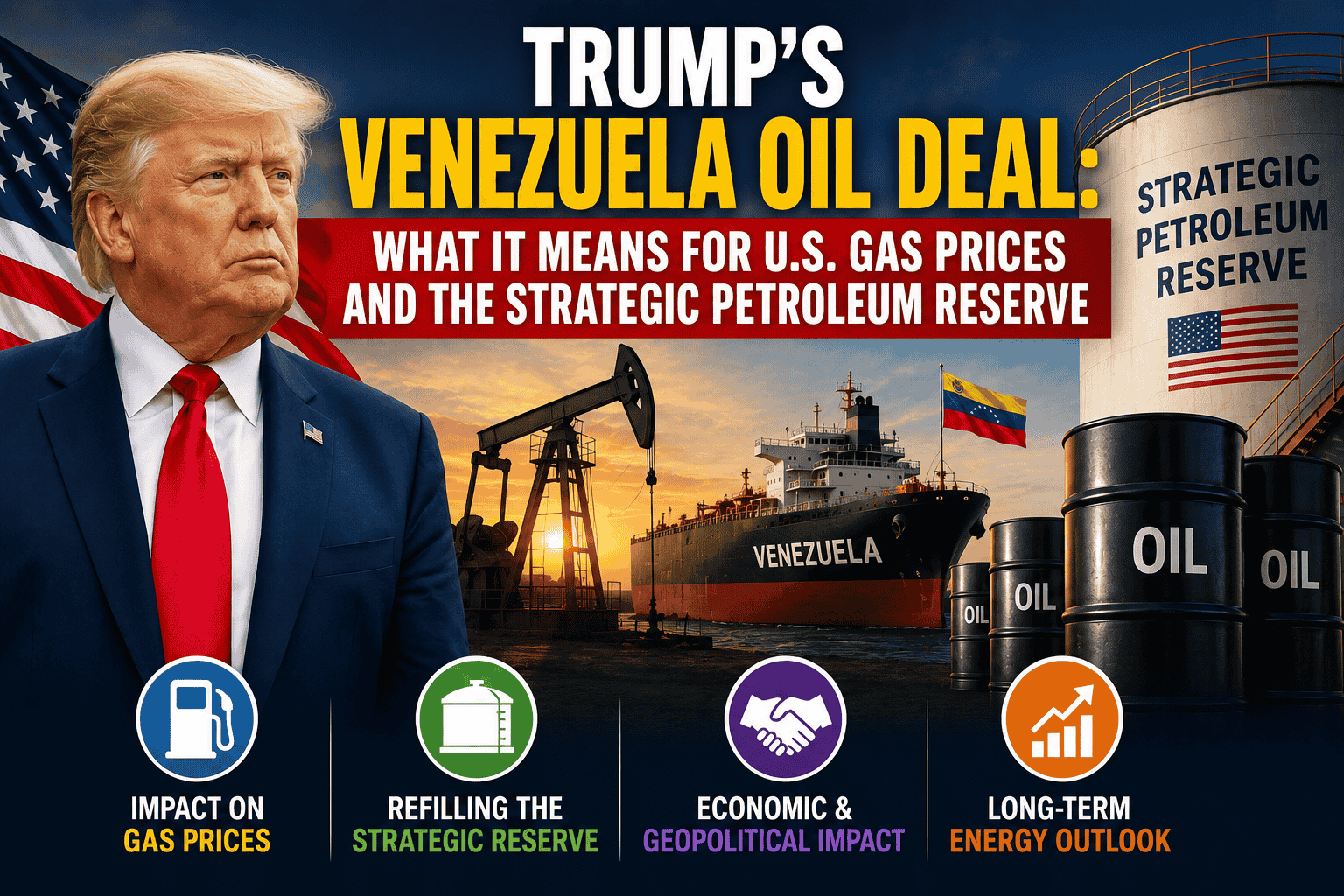
President Donald Trump’s new oil agreement with Venezuela is creating major interest across the energy, business and financial markets. The deal could give the United States greater access to Venezuela’s enormous oil resources while helping rebuild the country’s damaged petroleum industry.
One of the most important parts of the announcement is Trump’s plan to use Venezuelan crude to replenish the U.S. Strategic Petroleum Reserve (SPR). The emergency stockpile has fallen sharply in recent years and is currently near a decades-low level.
Trump has said the process of rebuilding the reserve will begin soon. However, the deal is unlikely to immediately reduce gasoline prices for American drivers. Increasing Venezuelan oil production will require investment, infrastructure repairs and time.
What Is Trump’s Venezuela Oil Deal?
The agreement represents a major shift in U.S.-Venezuela energy relations.
Venezuela possesses some of the world’s largest proven oil reserves, but years of economic problems, underinvestment, sanctions and deteriorating infrastructure have severely damaged its petroleum industry.
Under the new arrangement, U.S.-linked companies are expected to play a significant role in developing Venezuelan oil fields. The agreement could unlock substantial investment and increase Venezuela’s crude production over time.
For Washington, the deal offers potential access to a huge source of oil. For Venezuela, it could provide much-needed investment, production capacity and government revenue.
The agreement also has major geopolitical implications because Venezuela has historically maintained close energy relationships with countries such as China and Russia.
Why Does the Strategic Petroleum Reserve Matter?
The Strategic Petroleum Reserve is America’s emergency crude oil stockpile. Its primary purpose is to provide additional supplies during major disruptions to global or domestic oil markets.
The reserve can be particularly important during wars, natural disasters, supply shortages or other events that threaten energy markets.
The U.S. SPR currently holds roughly 290 million barrels, close to its lowest level in more than four decades. Large releases in recent years have reduced the stockpile substantially.
Rebuilding the reserve is therefore an important energy-security priority for the United States.
A larger reserve could give Washington more flexibility during future energy crises and reduce concerns about having limited emergency supplies.
Could Venezuelan Oil Lower U.S. Gas Prices?
This is one of the biggest questions surrounding the deal.
The short answer is that Venezuelan oil is unlikely to cause an immediate major decline in U.S. gasoline prices.
Gasoline prices are influenced by several factors, including global crude prices, refinery capacity, transportation costs, seasonal demand, geopolitical conflicts and international oil production.
Even if Venezuelan crude becomes more widely available, it will take time for Venezuela’s damaged oil infrastructure to return to higher production levels.
Oil fields, pipelines, refineries, ports and other infrastructure require significant investment and maintenance.
As production increases over several years, additional Venezuelan crude could contribute to global oil supply. If the increase is large enough, it could put downward pressure on crude prices.
However, the effect on gasoline prices would depend on the broader global oil market.
Venezuela’s Oil Industry Needs Major Investment
The Venezuela oil industry has enormous potential, but its infrastructure has suffered from years of underinvestment and economic instability.
Increasing production is not simply a matter of opening oil fields. Companies need functioning wells, pipelines, storage facilities, export terminals and refineries.
International investors will also want greater clarity about regulations, contracts, political stability and long-term ownership rights.
If billions of dollars flow into Venezuela’s energy sector, production could eventually rise significantly.
That would make Venezuela an increasingly important supplier to the global oil market and potentially strengthen America’s position in the Western Hemisphere’s energy system.
What Does the Deal Mean for U.S. Energy Security?
Energy security is one of the strongest arguments behind the agreement.
The United States remains one of the world’s largest oil producers, but the global oil market is interconnected. A major disruption in the Middle East, Europe or another producing region can quickly influence crude prices around the world.
Additional access to Venezuelan crude could give the United States another major source of supply.
Rebuilding the Strategic Petroleum Reserve would provide an additional layer of protection.
If the reserve returns to a healthier level, the U.S. government would have greater capacity to respond to future supply disruptions without immediately placing additional pressure on consumers and businesses.
Impact on the U.S. Economy
Oil prices influence almost every part of the American economy.
When crude prices rise, transportation becomes more expensive. Businesses can face higher shipping costs, while consumers may pay more for gasoline, airline tickets, food and other products.
Lower and more stable energy prices can have the opposite effect.
For this reason, the Venezuela oil agreement could eventually have economic benefits if it leads to significantly higher oil production and greater global supply.
Oil prices influence almost every part of the American economy. When crude prices rise, transportation becomes more expensive. Businesses can face higher shipping costs, while consumers may pay more for gasoline, airline tickets, food and other products.
Lower and more stable energy prices can have the opposite effect. For this reason, the Venezuela oil agreement could eventually have economic benefits if it leads to significantly higher oil production and greater global supply.
American companies involved in oil production, engineering, transportation, refining and energy services could also find new business opportunities in Venezuela.
Oil prices influence almost every part of the American economy. When crude prices rise, transportation becomes more expensive. Businesses can face higher shipping costs, while consumers may pay more for gasoline, airline tickets, food and other products.
At the same time, companies are facing growing financing needs as technology and infrastructure investments expand. The broader AI debt boom is another example of how massive corporate borrowing and investment can influence financial markets and the economy.
Lower and more stable energy prices can have the opposite effect. For this reason, the Venezuela oil agreement could eventually have economic benefits if it leads to significantly higher oil production and greater global supply.
However, investors should remember that the potential benefits depend heavily on how quickly the country’s oil industry can recover.
What Could Happen to Global Oil Markets?
The agreement could have consequences beyond the United States.
Venezuela has the world’s largest proven oil reserves, meaning that a successful recovery of its petroleum sector could eventually add significant production to the international market.
More Venezuelan oil could increase competition among major oil-producing countries.
It could also affect countries that currently supply crude to the United States and other international markets.
If Venezuelan production rises substantially, global buyers could gain another source of crude, potentially reducing the market’s dependence on certain suppliers.
That could become particularly important during periods of geopolitical uncertainty.
Political and Economic Risks
Despite its potential benefits, the Venezuela oil agreement also faces significant challenges.
Political uncertainty remains a major concern. Investors committing billions of dollars to oil projects need confidence that agreements will remain valid over the long term.
There are also questions surrounding Venezuela’s damaged infrastructure, financing requirements and the ability of companies to rapidly increase production.
Another important issue is how the economic benefits will be distributed.
Venezuela needs oil revenue to support economic recovery, while the United States wants greater energy security and access to crude. Balancing these interests could become an important part of the relationship between Washington and Caracas.
What It Means for American Consumers
For American consumers, the most important question is whether the deal will eventually translate into lower gasoline prices.
That outcome is possible, but it should not be expected immediately.
The first major benefit may be rebuilding America’s emergency oil stockpile rather than reducing prices at the gas pump.
Over the longer term, higher Venezuelan production could increase global supply and potentially help moderate oil prices.
However, gasoline prices will continue to depend on many other factors, including international conflicts, OPEC decisions, refinery operations and consumer demand.
Conclusion
Trump’s Venezuela oil deal represents a major development in U.S. energy policy. By gaining greater access to Venezuelan crude and using some of that oil to replenish the Strategic Petroleum Reserve, Washington is seeking to strengthen America’s long-term energy security.
The agreement could also provide Venezuela with investment and an opportunity to rebuild its damaged oil industry.
For American drivers, however, the effects are unlikely to be immediate. The deal could eventually contribute to greater global oil supply and potentially lower energy costs, but rebuilding Venezuela’s petroleum infrastructure will take substantial time and investment.
The biggest story may therefore be the long-term transformation of the global energy market. If Venezuela successfully increases production, its oil could become an increasingly important factor in U.S. energy security, international oil prices and the future of the American economy.