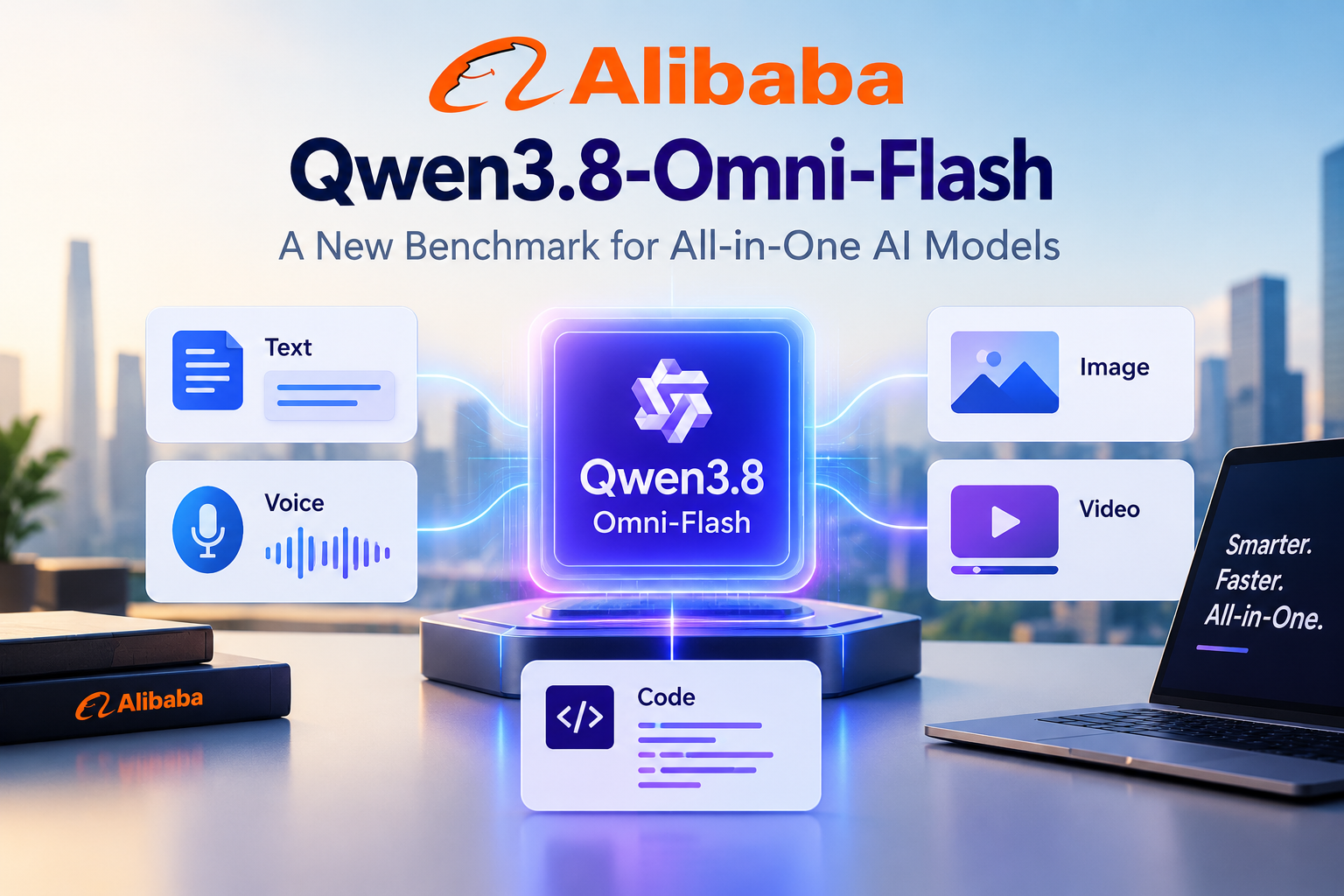
Alibaba’s Qwen team has released its most capable “omnimodal” AI model yet. Launched on September 18, 2026, Qwen3.8-Omni-Flash processes text, images, audio, and video together in a single system, backed by a massive 1-million-token context window. Early benchmarks show it outperforming its predecessor by more than 26% on average — a jump significant enough to reshape how developers think about building multimedia AI applications.
Here’s a full breakdown of what Qwen3.8-Omni-Flash actually does, how it performs, and why it matters for anyone building with AI.
What Is Qwen3.8-Omni-Flash?
A True Omnimodal Model, Not a Bundle of Separate Tools
Unlike AI systems that stitch together separate models for text, vision, and audio, Qwen3.8-Omni-Flash is built as a single native omnimodal system. That means it can jointly process text, images, audio, and video within one unified workflow, rather than routing different data types through different specialized sub-models. Built on the earlier Qwen3.8-Flash-Next foundation, the model also supports reasoning and tool calling, making it suitable for coding tasks, knowledge work, and complex multimedia analysis — not just simple description or captioning.
A 1-Million-Token Context Window
One of the model’s headline specs is its 1-million-token context window. In practical terms, this means the model can hold and reason over extremely large amounts of information at once — including long videos, extended audio recordings, and lengthy documents — without losing track of earlier context. That scale of context is what enables some of the model’s more advanced use cases, like full meeting analysis and long-video research, described below.
How Qwen3.8-Omni-Flash Performs: The Benchmark Data
A 26%+ Average Improvement Across 30 Evaluations
Alibaba reports that Qwen3.8-Omni-Flash improved its average score by more than 26% across roughly 30 public and internal benchmarks compared to its predecessor, Qwen3.5-Omni-Plus. The gains were not evenly distributed — they were especially pronounced in agentic, audio-video, and long-context tasks, the areas Alibaba appears to have prioritized most in this release.
Standout Results in Agentic and Audio-Video Tasks
Some of the most notable benchmark jumps include:
- WildClawBench-MM: scored 71.0, a 36.5-point increase over Qwen3.5-Omni-Plus
- UniClawBench: reached 69.6
- AgenticVBench: rose by 22.3 points
- LongAudioSpan (long-audio understanding): scored 82.7, up 8.3 points
- OmniVideoBench (audio-video collaborative reasoning): scored 63.4, up 9.6 points
- AliMeeting (multi-speaker, multi-channel Chinese meeting transcription): scored 89.7, with diarization error rate dropping dramatically from 88.11 to just 3.35
According to independent reporting, the model also outperformed Google’s Gemini 3.8 Flash on several audio-focused benchmarks — a notable claim, since Gemini 3.8 Flash has been positioned as one of the strongest comparably-priced multimodal models on the market.
Smarter, Not Just Bigger: Agentic Video Processing
Rather than scanning every single frame of a video indiscriminately, Qwen3.8-Omni-Flash can selectively decide what to watch and listen to, concentrating its processing power on the most relevant segments. On the OmniVideoBench benchmark, this agentic approach lifted accuracy from 63.4 to 67.8 while cutting token usage by roughly 45.7% — a meaningful efficiency gain that translates directly into lower compute costs for real-world deployments.
Standout Features Beyond the Benchmarks
Spatial Audio: Locating Sound in Physical Space
One of the more unusual capabilities Alibaba highlighted is spatial audio detection. The company claims Qwen3.8-Omni-Flash is the first omnimodal model able to locate a sound source by combining directional audio with visual information, estimating both the direction and distance of the source. This kind of capability could prove useful in robotics, security monitoring, and immersive media applications where understanding where a sound is coming from matters as much as recognizing what it is.
Broad Language and Dialect Support
Qwen3.8-Omni-Flash supports speech recognition across 74 languages and 39 Chinese dialects — including Mandarin, Cantonese, Sichuanese, Shanghainese, and Southern Min — with speech generation covering 29 languages and 7 dialects. For businesses working in localization, dubbing, or multilingual customer support, this level of dialect-specific coverage is a meaningful differentiator, since most competing “Flash-class” models publish language counts without this kind of dialect-level granularity.
Fast Response Times for Real-Time Use
Alibaba reports a time-to-first-audio-packet of under 1.4 seconds, even for 20-second audio-visual inputs — a strong result for use cases requiring near-instant responsiveness, such as live translation, voice assistants, or interactive media tools.
Meeting and Long-Video Workflows
The model can accept up to one hour of combined audio-video input for tasks like speaker separation, transcription, meeting minutes generation, and follow-up actions such as drafting emails or triggering coding tasks through connected tools. This positions Qwen3.8-Omni-Flash less as a simple captioning or transcription tool and more as a full agent stack capable of handling extended real-world workflows from start to finish.
New Supporting Tools: Qwen-MM-Plugins and Qwen-Live Harness
Alongside the model itself, Alibaba expanded its Qwen-MM-Plugins toolkit, adding on-demand perception, tool usage, and workflow execution capabilities specifically designed for long audio and video content. The company also open-sourced Qwen-Live Harness, a comprehensive framework built for real-time, continuous multimodal interaction, based on the model’s realtime variant.
Alibaba noted that existing agent frameworks generally don’t natively support these kinds of extended audio-video modalities, and that model capability, harness tooling, and runtime infrastructure all need to evolve together to make long-context multimodal agents genuinely practical — a rationale for releasing these supporting tools alongside the model itself, rather than the model alone.
Pricing and Availability
Where to Access It
Qwen3.8-Omni-Flash is generally available now through the Qianwen AI Platform and routes through Alibaba Cloud Model Studio, with endpoints available in Beijing and Singapore. The model is also accessible via third-party AI gateways using an OpenAI-compatible Chat Completions and Responses API format. There is no free consumer tier described in the official release notes, though some third-party platforms offer limited free credits for testing.
Two Variants for Different Needs
- qwen3.8-omni-flash — the standard model, designed for general omnimodal processing, reasoning, and tool use
- qwen3.8-omni-flash-realtime — a streaming variant served over WebSocket and WebRTC, built for continuous, low-latency audio-visual interaction, accent-aware oral practice, and spatial audio cues
Sharp Price Cuts for Audio Processing
Alibaba reports major reductions in audio-related processing costs compared to its predecessor: hourly audio-input pricing dropped by more than 98%, and hourly audio-visual input pricing dropped by more than 93%. That said, audio and audio-visual inputs still carry a price premium over plain text input — the gap has simply narrowed substantially rather than disappeared entirely.
Why This Release Matters
Raising the Bar for “Flash-Class” Models
Qwen3.8-Omni-Flash arrives amid a wave of competitively priced, high-performance “Flash-class” AI models, including Qwen3.8-Flash-Next, GLM-5.3-Flash, Gemini 3.8 Flash, and models from DeepSeek. By combining a 1-million-token context window, native omnimodal processing, and benchmark results that beat Gemini 3.8 Flash on several audio tasks, Alibaba is positioning Qwen3.8-Omni-Flash as a serious contender in a fast-moving and increasingly crowded segment of the AI market.
A Shift Toward Agent-Ready Multimodal AI
Perhaps the most important signal from this release isn’t any single benchmark score — it’s the direction Alibaba is pushing the model in. Rather than simply improving how well the model describes an image or transcribes audio, Qwen3.8-Omni-Flash is built to plan, use tools, and complete multi-step tasks across long audio and video inputs. That reflects a broader industry shift: multimodal AI is increasingly being designed not just to understand media, but to act on it.
Final Thoughts
Qwen3.8-Omni-Flash represents a significant step forward for Alibaba’s Qwen family and for omnimodal AI more broadly. Its combination of a massive context window, competitive benchmark performance, spatial audio capabilities, and sharply reduced processing costs makes it a compelling option for developers building applications around long-form audio, video, and multimodal agent workflows. As competition among Flash-class models intensifies, releases like this one suggest the next phase of the AI race will be defined less by raw model size and more by how efficiently models can understand — and act on — the messy, multimodal reality of real-world data.