OpenAI Expands Into AI-Powered Smartphone Cameras
OpenAI is making another major move beyond software.
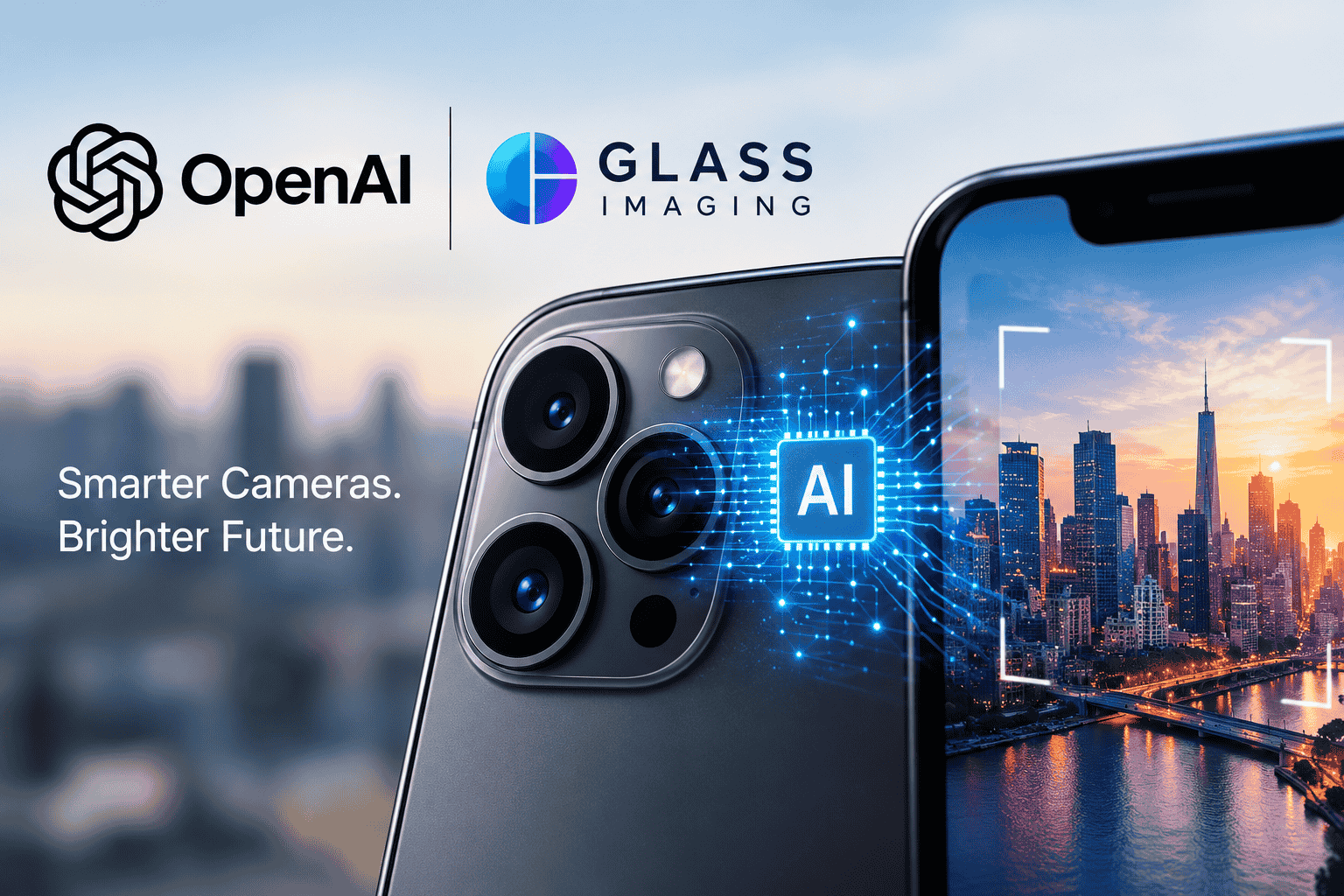
The company has reportedly acquired Glass Imaging, a startup developing artificial intelligence technology for improving smartphone camera performance, in a deal valued at more than $300 million.
The acquisition was first reported by The Wall Street Journal, which cited people familiar with the transaction. Neither OpenAI nor Glass Imaging had publicly confirmed the deal at the time of the latest reporting, making some details of the transaction subject to further confirmation.
The reported acquisition adds an important new capability to OpenAI’s expanding hardware strategy: advanced computational photography.
It also brings OpenAI a team with direct experience in Apple’s smartphone-camera technology.
Who Is Glass Imaging?
Glass Imaging was founded in 2019 by Ziv Attar and Tom Bishop, two former Apple engineers who worked on computational photography and the technology behind Apple’s Portrait Mode.
The company’s central idea is relatively simple: smartphone cameras have physical limitations that cannot always be solved simply by adding larger sensors, additional lenses or more powerful optics.
Glass Imaging instead uses AI to extract more useful information from the camera hardware that already exists inside compact devices.
Its technology, known as GlassAI, uses neural networks to process raw camera information and address issues involving noise, optical imperfections and image detail.
That makes the company particularly interesting for OpenAI as the AI industry moves toward smaller, more integrated consumer devices.
Why OpenAI Paid More Than $300 Million
The reported purchase price represents a significant increase over Glass Imaging’s previous valuation.
The company raised approximately $29 million to $30 million before the reported acquisition.
Its most recent major funding round was a $20 million Series A in 2025, led by Insight Partners, following an approximately $9.3 million extended seed round in 2024. The company was valued at around $100 million during its 2025 funding round.
A reported acquisition value above $300 million would therefore represent roughly three times that previous valuation.
For OpenAI, however, the attraction may not simply be Glass Imaging’s existing commercial business.
The bigger value could be its technology and specialized engineering team.
GlassAI Could Change Smartphone Photography
Modern smartphone cameras already depend heavily on computational photography.
When a user takes a photograph, the final image is typically the result of extensive software processing rather than simply the raw information captured by the camera sensor.
AI can play a major role in that process.
Glass Imaging’s approach focuses on processing raw sensor data with neural networks trained around specific camera hardware.
The company has argued that this can help recover detail, reduce noise and compensate for optical limitations without simply generating artificial information.
That distinction is particularly important.
The goal is not necessarily to create an image that looks impressive regardless of the underlying photograph. Instead, the technology attempts to extract more useful information from the camera’s actual sensor and optics.
Former Apple Camera Engineers Join OpenAI’s Ecosystem
One of the most strategically important parts of the acquisition is the people behind Glass Imaging.
Attar and Bishop previously worked at Apple, where they were involved with technology behind Portrait Mode.
Attar also previously founded LinX Imaging, an Israeli camera startup that was acquired by Apple in 2015.
That gives the Glass Imaging team experience at the intersection of smartphone hardware, computational photography and machine learning.
For OpenAI, acquiring that expertise could accelerate its efforts to build consumer hardware.
OpenAI’s Bigger Hardware Strategy
The Glass Imaging deal comes as OpenAI continues expanding beyond ChatGPT.
OpenAI previously acquired io Products, the hardware company founded by former Apple design chief Jony Ive, in a transaction valued at approximately $6.5 billion.
The partnership between OpenAI and Ive has been focused on developing new consumer hardware designed around artificial intelligence.
OpenAI has not publicly confirmed exactly what its future consumer device will look like.
However, the combination of OpenAI’s AI technology, Ive’s hardware-design expertise and Glass Imaging’s camera technology creates an intriguing foundation for AI-powered devices.
Importantly, there is currently no confirmed announcement that Glass Imaging’s technology will appear in a specific upcoming OpenAI smartphone or device.
That remains speculation until OpenAI provides more details.
Could OpenAI Build an AI-First Smartphone?
The acquisition has naturally renewed speculation about OpenAI’s hardware ambitions.
A conventional smartphone is already packed with cameras, sensors, microphones and computing power.
An AI-first device could use those components differently.
Instead of treating the camera simply as a tool for taking photographs, an AI device could potentially use cameras as a continuous source of visual information.
That could allow an AI assistant to understand objects, environments, documents and people in real time.
For example, an AI-powered camera could potentially help users:
- Understand what they are looking at
- Translate text through the camera
- Analyze documents
- Identify objects
- Improve photographs automatically
- Understand visual surroundings
- Interact with an AI assistant through visual input
These possibilities remain potential applications rather than confirmed OpenAI product features.
Why Camera Technology Matters to AI
Cameras could become one of the most important sensors in the next generation of AI devices.
Today’s AI assistants primarily interact with users through text and voice.
Visual information provides another dimension.
An AI system that can understand what a user sees could become considerably more useful in everyday environments.
This makes camera technology strategically valuable.
The Glass Imaging acquisition therefore fits into a broader shift in AI: companies are increasingly trying to move AI from the cloud and computer screen into physical devices.
Glass Imaging Already Has Smartphone Experience
The acquisition also gives OpenAI access to technology that has already moved beyond the research stage.
Glass Imaging’s technology has been associated with smartphone applications, including camera technology used in Honor’s 600-series devices.
The company has also explored applications beyond smartphones, including drones and wearable devices.
This is important because OpenAI would not necessarily need to develop an AI imaging pipeline entirely from scratch.
Instead, it could acquire technology that has already been engineered around compact camera hardware.
The Smartphone Camera Market Is Changing
Smartphone manufacturers have spent years competing on camera specifications.
Megapixel counts, optical zoom, sensor sizes and additional lenses have become major selling points.
AI is changing that competition.
The future battle may increasingly focus on what software can accomplish with a given camera sensor.
A smaller sensor combined with sophisticated AI processing could potentially produce results that previously required larger or more expensive hardware.
That could give manufacturers another way to differentiate their devices.
What the Acquisition Means for OpenAI
For OpenAI, Glass Imaging potentially provides three strategic advantages.
AI Imaging Expertise
The company gains access to specialized expertise in neural image processing and computational photography.
Hardware Experience
The former Apple engineers behind Glass Imaging have experience developing technology for mass-market consumer devices.
Consumer Device Potential
Camera technology could become an important component of future AI hardware, particularly devices designed to understand the user’s physical environment.
Together, these capabilities could support OpenAI’s broader transition from an AI software company toward a company with a larger consumer-hardware presence.
What Investors Should Watch
The reported acquisition is also significant from an investment perspective.
OpenAI remains one of the most heavily funded private technology companies, while its hardware ambitions could create new markets beyond conventional AI software.
Investors and technology companies will be watching several developments:
First, whether OpenAI officially confirms the Glass Imaging acquisition.
Second, whether Glass Imaging’s technology appears in future OpenAI hardware.
Third, whether OpenAI develops its own camera architecture rather than relying on existing smartphone manufacturers.
Fourth, whether the company uses its imaging technology in wearables, smart glasses or other AI devices.
Finally, whether OpenAI’s hardware strategy becomes a meaningful competitor to established consumer-electronics companies.
OpenAI Is Moving Closer to the Physical World
The Glass Imaging acquisition illustrates a broader transformation taking place inside the AI industry.
The first wave of generative AI was dominated by chatbots and software.
The next wave is increasingly focused on AI agents, robotics, wearables, cameras and consumer devices.
AI needs sensors to understand the physical world.
Cameras are among the most powerful sensors available.
That makes Glass Imaging’s technology potentially valuable far beyond smartphone photography.
Conclusion
OpenAI’s reported acquisition of Glass Imaging for more than $300 million marks another significant development in the company’s expansion beyond ChatGPT.
Glass Imaging brings specialized AI camera technology and a team of former Apple engineers with experience in computational photography.
The deal also arrives as OpenAI expands its consumer-hardware ambitions alongside Jony Ive.
There is still considerable uncertainty about exactly how OpenAI will use Glass Imaging’s technology. The companies had not publicly confirmed all details of the transaction as of the latest reports, and there is no confirmed OpenAI smartphone announcement tied directly to the acquisition.
But the strategic direction is becoming increasingly clear.
AI is moving from the screen into the camera, the device and eventually the physical world around us.
The next major AI competition may therefore not be fought only between chatbots.
It could be fought through the cameras, sensors and devices people carry every day.
About the Author
Anam Younas
Editor of Daily Press Release
I write about technology, AI, business, finance, and global news, bringing readers clear insights into the latest trends and developments.
For more informative content Follow the Daily Press Release channel on WhatsApp: https://whatsapp.com/channel/0029Vb8gRyoIHphMqA6T2w0U