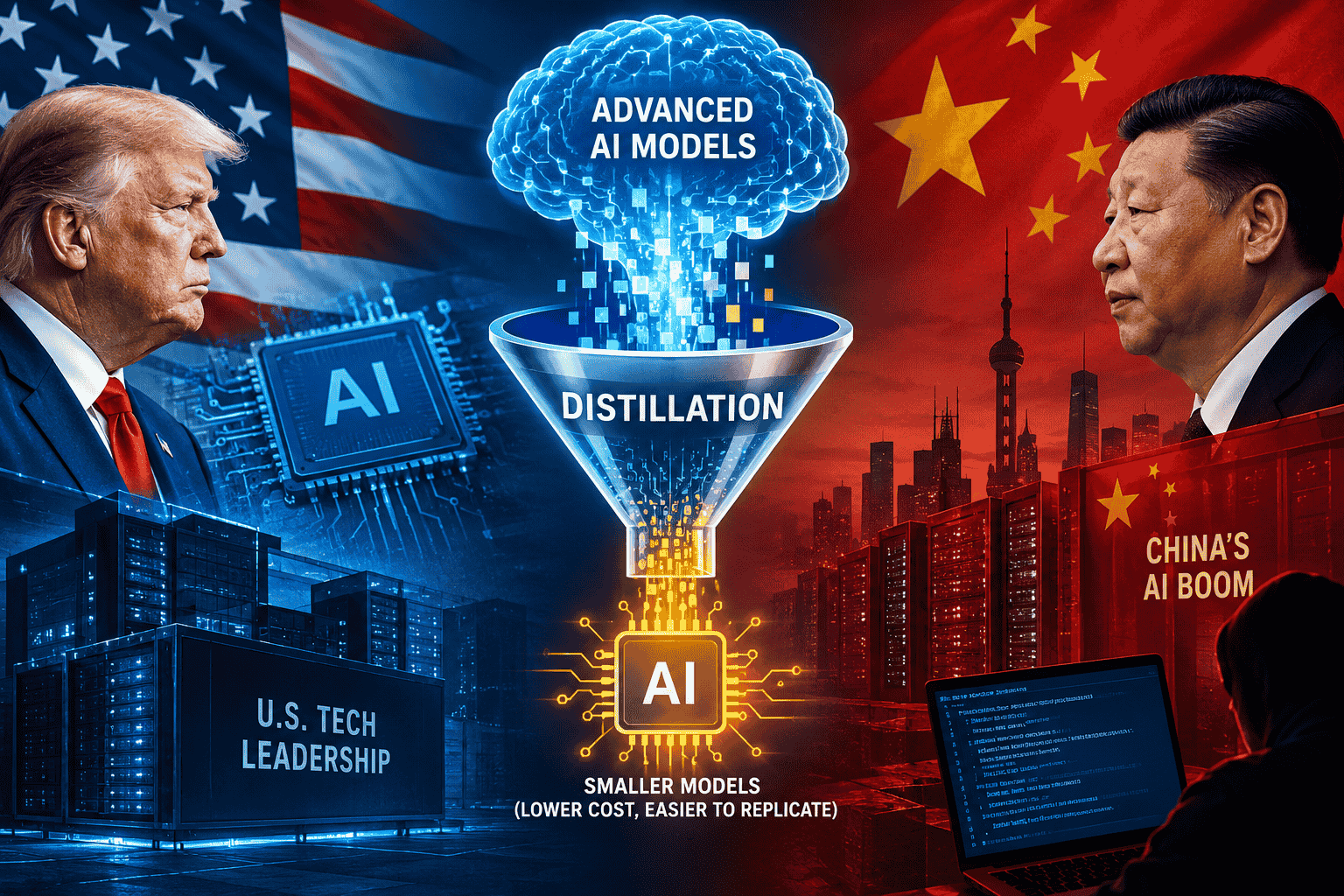
China’s rapid rise in artificial intelligence has become one of the most contested storylines in global tech in 2026. Washington’s answer for how Chinese labs caught up so fast has increasingly centered on one word: distillation. But a growing number of AI executives, researchers, and analysts say that explanation is far too simple — and CNBC’s own reporting has explicitly called the U.S. narrative “not that clear cut.”
Here’s a full breakdown of what distillation actually is, what the U.S. government is claiming, who’s pushing back, and why this fight matters well beyond the tech industry.
What Is AI Model Distillation?
A Legitimate Technique With a Controversial Use Case
Distillation is a well-established machine learning method where a smaller “student” model is trained to mimic the outputs and behavior of a larger, more capable “teacher” model. It’s a technique used throughout the AI industry — including by major U.S. labs — to build faster, cheaper models without needing the enormous compute clusters required to train a frontier system from scratch.
The technique itself isn’t controversial. What is controversial is when distillation is done without authorization against a rival company’s proprietary model, essentially extracting the value of another lab’s expensive training process without permission. U.S. officials and executives argue that’s exactly what’s been happening — at scale.
What the U.S. Government Is Claiming
A Formal Government Advisory
On September 8, 2026, the FBI, the National Security Agency (NSA), and the Cybersecurity and Infrastructure Security Agency (CISA) issued their most comprehensive joint advisory yet on the topic. It accused Chinese AI developers of extracting capabilities from leading U.S. models through what the advisory called “aggressive, malicious, and targeted distillation activities.” The advisory specifically named six Chinese companies — including DeepSeek and Alibaba — accused of distilling models originally built by Anthropic, Google, and OpenAI.
The advisory went further than prior statements, arguing: “The sheer scale of these campaigns and their sophistication indicate that distillation is not a supplement to these companies’ AI model development, but the critical core of it.”
Treasury Secretary Weighs In
The same day, U.S. Treasury Secretary Scott Bessent commented publicly on the issue, stating bluntly that “the Chinese distill our models and they can never get ahead of us.” His remark framed distillation not just as a security concern, but as evidence that China’s AI industry is fundamentally dependent on, and therefore behind, U.S. innovation.
Anthropic’s Central Role in the Allegations
Anthropic, the maker of Claude, has been one of the most vocal companies pressing the distillation narrative. The company first went public with claims in late February 2026, accusing unnamed Chinese labs of what reporting described as “mining Claude.” CNBC’s coverage at the time named three specific companies: DeepSeek, Moonshot, and MiniMax.
More recently, Anthropic’s head of threat intelligence, Jacob Klein, has continued to sound the alarm. Separately, cybersecurity researchers reviewing over 141,000 test sessions involving Anthropic’s frontier models identified a campaign researchers labeled “GTG-16005,” describing 151 million exchanges observed between May and July 2026 — what Anthropic characterized as “the largest distillation attack we have ever measured.”
OpenAI’s Earlier Warning to Congress
The dispute didn’t start in September. As far back as February 12, 2026, OpenAI sent a memo titled “Updated Stakes for American-Led, Democratic AI” to the U.S. House Select Committee on Strategic Competition between the U.S. and the Chinese Communist Party. According to reporting on the memo, OpenAI accused DeepSeek employees of developing methods to bypass access restrictions — including “obfuscated third-party routers” — and writing code specifically designed to access U.S. AI models and harvest their outputs for distillation.
Why Experts Say It’s “Not That Clear Cut”
Voices Casting Doubt
Despite the weight of the U.S. government’s advisory, a number of prominent industry voices argue the distillation narrative oversimplifies a much more complex reality.
Sriram Krishnan, a former White House AI policy adviser, pointed out that services like ChatGPT and Claude were themselves built by training on vast amounts of human-generated content from the internet — and that distillation, more broadly, is a core, widely used technique in computer science. Krishnan added that even if Chinese labs are using distillation, it remains unclear exactly how much it’s actually contributing to their overall progress.
Cohere CEO Aidan Gomez echoed a similar view, telling CNBC that Chinese AI models are now “world-class” and that the performance gap held by leading U.S. labs is shrinking quickly. Gomez acknowledged that some distillation is likely occurring but said it “can’t explain all of China’s progress on AI models” — a direct challenge to the idea that distillation is the primary driver of China’s advances.
China’s Chip Constraints Tell a Different Story
Analysts point to another major factor largely absent from the distillation narrative: China’s continued lack of access to cutting-edge chips. Export restrictions on advanced semiconductors from companies like Nvidia have pushed China to aggressively build out its own domestic chip industry. While most experts agree Chinese-made semiconductors still don’t match the performance of top U.S. chips, Chinese firms have developed workarounds and optimization techniques to make the most of what they have — arguably a sign of genuine engineering innovation, not shortcut copying.
Some analysts frame China’s AI progress within a broader pattern: the country has increasingly moved past its long-standing “copycat” reputation, pointing to real innovation emerging from its tech sector in areas ranging from electric vehicles to robotics and semiconductors.
China’s Official Response
“Groundless and Legally Unsound”
Beijing has firmly rejected the U.S. allegations. A spokesperson for China’s Ministry of Commerce (MOFCOM) called the claims of “industrial-scale” distillation “groundless and legally unsound.” China’s Foreign Ministry has separately described the accusations as “groundless in fact and law,” arguing the U.S. is politicizing what it considers a normal technical and commercial practice used throughout the global AI industry.
Notably, none of the six Chinese companies named in the September advisory has issued a detailed technical rebuttal of the specific methods described. Instead, Beijing’s response has come entirely through official government channels.
An Unexpected Twist: China Turns the Accusation Around
In a striking reversal, a Chinese humanoid robotics startup called JoyIn flipped the distillation accusation back onto OpenAI. Announcing a new robotics model called Aether, the company suggested its own techniques may have influenced approaches later adopted by U.S. labs. CNBC noted it was unable to independently verify these counter-claims, and OpenAI did not immediately respond to a request for comment. The episode illustrates how murky and mutually contested these accusations have become on both sides.
The Bigger Picture: A Diplomatic Flashpoint
From Tech Dispute to Diplomatic Standoff
What began as disagreements between individual AI labs has steadily escalated into a formal standoff between the U.S. and Chinese governments. The timeline — from OpenAI’s February memo to Congress, to Anthropic’s public claims, to the FBI/NSA/CISA joint advisory in September — shows a dispute that has moved well beyond Silicon Valley boardrooms.
This distillation fight is also unfolding alongside broader U.S.-China tech tensions, including chip export controls, entity-list additions, and data-security rules. Notably, the debate has intensified just as President Trump has indicated that AI will be a discussion topic when he hosts Chinese leader Xi Jinping in Washington, D.C.
An Open Regulatory Question
The controversy has also sparked debate over how — or whether — governments should regulate distillation at all. Y Combinator’s Garry Tan has taken a hands-off stance, telling CNBC “I would do nothing” regarding new distillation restrictions on U.S. labs, while also suggesting “there should be an American distillation regime” to formalize norms around the practice. Others frame the core unresolved question more simply: at what point does “learning” from another model become “copying” it?
Key Takeaways
- Distillation is a real, widely used AI technique — the controversy is about unauthorized, large-scale use against rival labs’ proprietary models, not the method itself.
- U.S. agencies (FBI, NSA, CISA) named six Chinese firms, including DeepSeek and Alibaba, in a September 8, 2026 advisory calling the practice “the critical core” of their AI development.
- Anthropic has been the most vocal accuser, citing a campaign involving 151 million exchanges it called its largest distillation attack ever measured.
- Industry voices like Cohere’s Aidan Gomez and former White House adviser Sriram Krishnan argue distillation alone doesn’t explain China’s AI progress.
- China’s chip restrictions and domestic semiconductor push are seen by many analysts as a bigger — and often overlooked — factor behind its AI advances.
- China has categorically denied the allegations, calling them politically motivated and legally baseless.
- The dispute has become a diplomatic issue, surfacing ahead of a planned Trump-Xi meeting and tying into wider chip-export and technology tensions between the two countries.
Final Thoughts
The distillation debate captures something bigger than a single technical dispute — it’s a proxy fight over who’s really leading the global AI race, and why. Washington’s narrative offers a simple explanation for China’s progress, but as CNBC and multiple industry leaders have pointed out, the reality involves chip constraints, genuine homegrown innovation, and a technique used industry-wide — making “distillation” a far less clear-cut explanation than official statements suggest.
About the Author
Anam Younas
Editor of Daily Press Release
I write about technology, AI, business, finance, and global news, bringing readers clear insights into the latest trends and developments.
For more informative content Follow the Daily Press Release channel on WhatsApp: https://whatsapp.com/channel/0029Vb8gRyoIHphMqA6T2w0U


