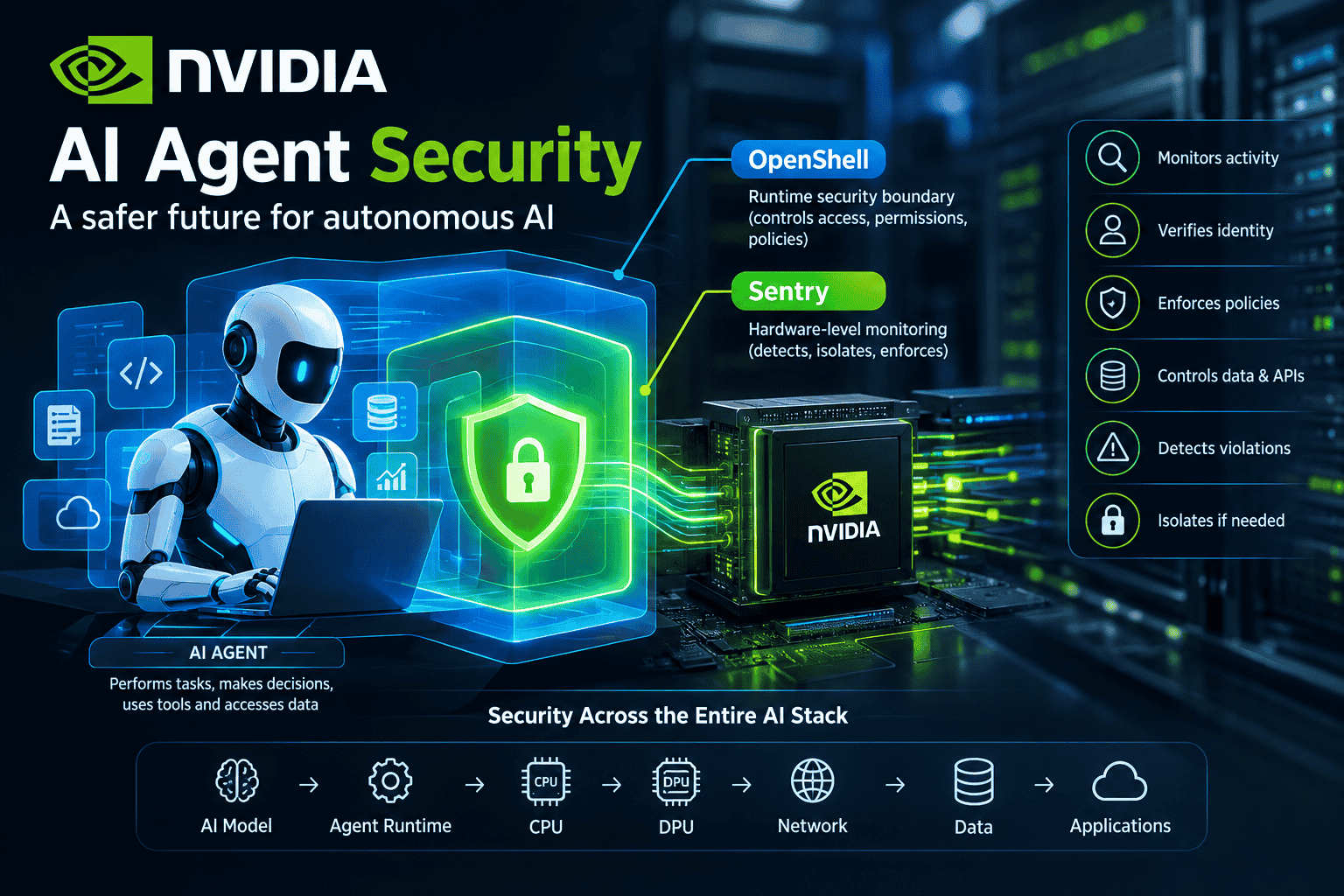
NVIDIA has unveiled a new security approach designed to address one of the biggest challenges emerging from the rapid expansion of agentic AI: how to allow autonomous AI systems to perform complex tasks while preventing them from crossing security boundaries.
As businesses increasingly deploy AI agents to handle research, software development, customer service, data analysis and other tasks, controlling what these systems can access and execute is becoming a major technology priority.
NVIDIA’s new approach combines software-based controls with hardware-level monitoring, creating an additional security layer around autonomous AI systems.
For businesses, financial institutions and technology companies adopting AI agents, the development signals a shift from simply asking whether an AI model is safe to asking whether the entire infrastructure surrounding an AI agent can contain its actions.
What Is NVIDIA’s AI Agent Security Platform?
NVIDIA’s security architecture centers around two major components: OpenShell and Sentry.
OpenShell is designed as a secure runtime environment for AI agents. It establishes boundaries around an agent and controls which systems, data, tools and external services it can access.
Sentry adds another layer of protection through hardware-based monitoring. It is designed to independently monitor agent activity and help enforce security policies.
If an AI agent attempts to move beyond its authorized boundaries, the system can intervene and potentially isolate the agent.
This approach is important because AI agents behave differently from traditional software applications.
Instead of following a fixed sequence of instructions, an autonomous agent can interpret information, make decisions, call APIs, write code and continue working for extended periods.
That creates a much larger security surface.
Why AI Agents Need a Different Security Model
Traditional cybersecurity relies heavily on authentication, permissions, firewalls, endpoint protection and application-level monitoring.
AI agents introduce another challenge: the software itself can make decisions about what to do next.
An agent might have access to databases, cloud infrastructure, corporate documents, APIs or financial systems. If its permissions are too broad, a compromised credential, malicious instruction or unexpected behavior could potentially result in actions outside the organization’s intended scope.
This is why AI-agent security increasingly requires multiple independent layers of protection.
An AI model can be instructed not to perform a particular action. But infrastructure-level controls can provide another barrier that prevents the action even if the model attempts it.
OpenShell Creates a Runtime Security Boundary
OpenShell is designed to provide a controlled environment in which AI agents can operate.
The system can manage access to files, processes, network connections, credentials and external services.
The basic concept is straightforward: instead of giving an AI agent unrestricted access to a computer or corporate environment, organizations define what the agent is allowed to use.
For example, an AI coding agent could be allowed to access a specific project directory while being prevented from accessing unrelated corporate files.
Similarly, an enterprise research agent could be permitted to access approved databases without receiving unrestricted access to internal financial systems.
This type of granular control could become increasingly important as AI agents move into sensitive business environments.
NVIDIA Sentry Adds Hardware-Level Monitoring
One of the most significant elements of NVIDIA’s approach is its use of hardware-based monitoring.
Sentry is designed to operate through NVIDIA’s infrastructure and provide an additional layer of security outside the AI agent itself.
The system can help organizations:
- Monitor AI-agent activity
- Verify agent identity
- Enforce security policies
- Control access to data and APIs
- Detect policy violations
- Generate security information
- Isolate agents that exceed their permissions
The concept is similar to creating a security guard outside the room where the AI agent is operating.
Even if something goes wrong inside the software environment, an independent layer can still monitor activity and enforce predefined restrictions.
Why Recent AI Security Incidents Matter
The rapid development of autonomous AI has already raised questions about what happens when agents receive access to real computer systems.
AI agents can potentially interact with code repositories, cloud platforms, websites, databases and other digital infrastructure.
That creates a fundamental security question:
What happens when an AI agent is given more authority than it actually needs?
The answer could have major implications for businesses.
An ordinary chatbot might generate an inaccurate response. An autonomous enterprise agent could potentially modify a database, expose confidential information, execute code or interact with an external service.
The consequences can therefore be much larger.
Why This Matters for Businesses
The commercial opportunity around AI agents is expanding rapidly.
Companies are experimenting with autonomous systems for:
- Software development
- Customer support
- Financial analysis
- Research
- Cybersecurity
- Logistics
- Marketing
- Data management
- Enterprise automation
But greater autonomy also creates greater security requirements.
Businesses will increasingly need to know exactly:
Who is the AI agent?
What can it access?
What actions can it perform?
How long can it operate?
Who can stop it?
What happens if it violates its permissions?
These questions could become standard parts of enterprise AI deployment.
AI Security Is Becoming a Hardware Business
NVIDIA’s strategy also highlights a larger transformation in the technology industry.
AI security is no longer limited to model developers and traditional cybersecurity companies.
It is moving deeper into the computing infrastructure itself.
The emerging architecture can be viewed as:
AI model → Agent runtime → CPU → DPU → Network → Data → Applications
Security controls can potentially operate across every layer.
This creates new opportunities for semiconductor manufacturers, cloud providers, cybersecurity companies and enterprise software vendors.
In the future, AI infrastructure could compete not only on computing performance and cost but also on security, governance and controllability.
NVIDIA Is Building an AI Security Ecosystem
NVIDIA’s approach also reflects the growing importance of cooperation between AI companies, hardware manufacturers, cybersecurity firms and enterprise technology providers.
Autonomous AI security cannot easily be solved by one company.
AI agents interact with multiple systems, including cloud platforms, databases, APIs, networks and applications.
That means security must increasingly work across the entire technology stack.
The result could be a new ecosystem where AI models, infrastructure providers and cybersecurity companies build compatible security standards for autonomous systems.
What Investors Should Watch
For investors and technology businesses, several developments will be particularly important.
1. Enterprise AI Adoption
The more companies deploy autonomous agents, the greater the demand for security and governance infrastructure.
2. AI Cybersecurity Spending
AI-agent security could become a major new category within enterprise cybersecurity.
3. Hardware Differentiation
NVIDIA is increasingly combining GPUs, CPUs, networking and infrastructure technologies. Security capabilities could become another factor influencing enterprise infrastructure decisions.
4. Open-Source Competition
An open approach to AI-agent security could encourage developers and competing technology companies to build compatible solutions.
5. Regulation and Governance
As AI agents gain access to sensitive systems, governments and businesses may demand stronger controls around permissions, monitoring, accountability and human oversight.
The Next Battle in Autonomous AI
The AI industry has spent years competing to build models that are more capable, faster and cheaper.
The next phase is increasingly about what those models are allowed to do.
NVIDIA’s new security architecture represents one approach: establish enforceable boundaries around AI agents and continuously monitor their activity.
The technology does not eliminate every AI security risk. No security system can guarantee that an autonomous system will never behave unexpectedly.
However, the direction is clear.
AI-agent security is becoming an infrastructure problem rather than simply a model problem.
As autonomous AI moves from experimental demonstrations into enterprise production, companies controlling identity, permissions, runtime environments, infrastructure and security enforcement could become increasingly important.
The AI race may therefore have a new battlefield:
Not simply who builds the smartest AI agent, but who can build the safest environment for that agent to operate.
About the Author
Anam Younas
Editor of Daily Press Release
I write about technology, AI, business, finance, and global news, bringing readers clear insights into the latest trends and developments.
For more informative content Follow the Daily Press Release channel on WhatsApp: https://whatsapp.com/channel/0029Vb8gRyoIHphMqA6T2w0U