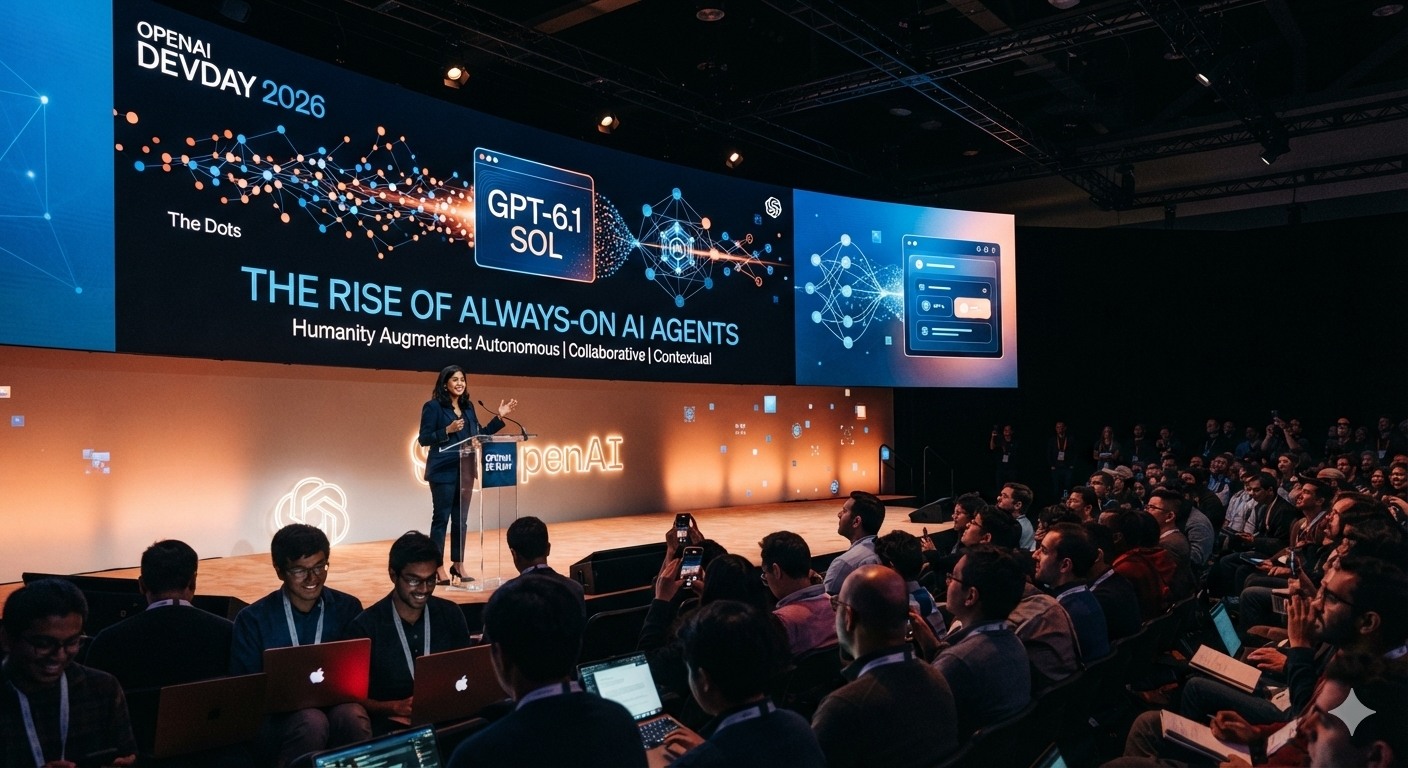
OpenAI’s DevDay 2026 has marked another major step in the company’s push to transform AI from a tool users interact with occasionally into an active digital worker.
Held in San Francisco on September 29, the event featured more than 20 announcements spanning ChatGPT, Codex, APIs, AI agents and new developer tools.
One of the biggest announcements was Dots, a new class of always-on AI agents designed to work continuously on behalf of users.
OpenAI also introduced GPT-6.1 Sol, new agent-development tools and additional capabilities designed to bring autonomous AI deeper into business workflows.
What Are OpenAI Dots?
Dots are designed to operate more like persistent digital assistants than traditional chatbots.
Instead of waiting for a user to open ChatGPT and ask a question, a Dot can remain available and work on tasks over time.
The system can interact with users through ChatGPT and workplace platforms while maintaining context about ongoing work.
OpenAI says Dots can perform tasks such as investigating problems, conducting research and building applications.
The company has also demonstrated scenarios in which an agent identifies an issue, prepares work and requests approval before completing a consequential action.
AI Agents Get Their Own Computers
One of the most important developments is that Dots can operate through cloud computers.
This changes the role of an AI assistant.
Instead of simply generating text, an AI agent can interact with a computer environment and use software in a way that resembles a human digital worker.
That could allow agents to:
- Research information
- Work with files
- Use applications
- Analyze data
- Write software
- Investigate problems
- Prepare business documents
- Perform repetitive digital tasks
For businesses, this could be one of the most important developments in enterprise AI.
GPT-6.1 Sol Targets Lower-Cost AI Workloads
OpenAI also introduced GPT-6.1 Sol, positioning it as a model that provides high-end capabilities at substantially lower token costs than its more expensive frontier systems.
The company says Sol approaches Astra-level performance in areas including agentic coding, computer use and professional work while targeting significantly lower pricing.
Lower inference costs could be particularly important for autonomous AI.
An ordinary chatbot might require a few interactions to answer a question.
An AI agent working for hours can generate substantially more model calls.
Therefore, reducing the cost of each interaction could directly improve the economics of deploying AI agents at scale.
Why Lower AI Costs Matter
The economics of AI agents depend heavily on inference costs.
Suppose a company wants thousands of agents working continuously.
The cost is not determined only by the price of the AI model.
Businesses must also account for:
- Compute
- Cloud infrastructure
- Storage
- Networking
- Security
- Data access
- Software tools
- Monitoring
Lower model costs could therefore make autonomous AI more practical for businesses.
Codex Moves Deeper Into the Cloud
OpenAI also expanded Codex, its coding-focused AI system.
The company is increasingly positioning Codex as an autonomous software-development environment capable of handling coding work in the cloud.
This could accelerate a major shift in software development.
Instead of programmers writing every line manually, developers may increasingly delegate specific engineering tasks to AI agents.
Human developers can then focus more heavily on architecture, product decisions, quality control and reviewing AI-generated work.
The New Agents API
OpenAI also announced additional tools for developers building AI agents.
The goal is to make it easier for companies to create applications in which AI systems can use tools, interact with computers and complete multi-step tasks.
This is important because the next phase of AI adoption may not come exclusively through consumer chatbots.
It could come through thousands of specialized agents embedded inside business software.
For example, an insurance company could build an agent for claims processing.
A financial company could use an agent for research.
A retailer could deploy agents for inventory analysis.
A software company could use agents for testing and debugging.
ChatGPT Becomes More Collaborative
OpenAI also introduced new ways for humans and AI agents to work together.
Its vision increasingly involves AI systems operating alongside people rather than simply answering questions.
The concept of a shared workspace could allow humans to review AI activity, provide feedback and approve important actions.
That model could become critical for enterprise adoption.
Businesses are unlikely to give autonomous AI unlimited authority.
Instead, they may use systems where agents operate independently for low-risk tasks but request human approval before taking high-impact actions.
The Rise of Always-On AI
Dots represent a significant change in how people may interact with AI.
Traditional AI:
User → Prompt → AI → Answer
Agentic AI:
Goal → AI plans → AI acts → AI monitors → AI reports → Human reviews
This is a much more powerful model.
It also creates significantly greater security and privacy challenges.
An always-on agent could potentially have access to personal information, company systems, communication platforms and business data.
That means permission management will become increasingly important.
Why Businesses Are Paying Attention
For businesses, the biggest opportunity is automation.
AI agents could eventually perform many repetitive knowledge-work tasks that currently require employees to switch between different software platforms.
Instead of asking employees to collect information from five systems and prepare a report, an AI agent could potentially perform the entire workflow.
That could reduce administrative workload and accelerate decision-making.
However, companies will still need humans to supervise high-impact decisions and establish rules around what agents can and cannot do.
What Investors Should Watch
OpenAI’s DevDay announcements point toward several major technology trends.
Agentic AI
AI agents are becoming a central part of the industry’s next growth cycle.
AI Infrastructure
More autonomous agents will require more computing, cloud infrastructure and networking capacity.
Enterprise Software
AI could fundamentally change how businesses interact with traditional software applications.
Cybersecurity
More autonomous systems will create new security requirements.
AI Economics
Lower inference costs could make large-scale agent deployment more financially attractive.
The Bigger Picture
OpenAI’s DevDay 2026 shows that the AI industry is moving beyond the chatbot era.
The next generation of AI is increasingly designed to work continuously, use tools, operate computers and complete tasks independently.
Dots represent the always-on assistant concept.
GPT-6.1 Sol represents the push toward more economical high-capability models.
Codex and the new agent tools represent the developer ecosystem needed to turn these capabilities into business applications.
Together, they point toward an emerging AI economy in which companies may deploy fleets of specialized digital workers.
The biggest question now is not whether AI agents can perform useful tasks.
It is how quickly businesses can deploy them safely, reliably and economically at scale.