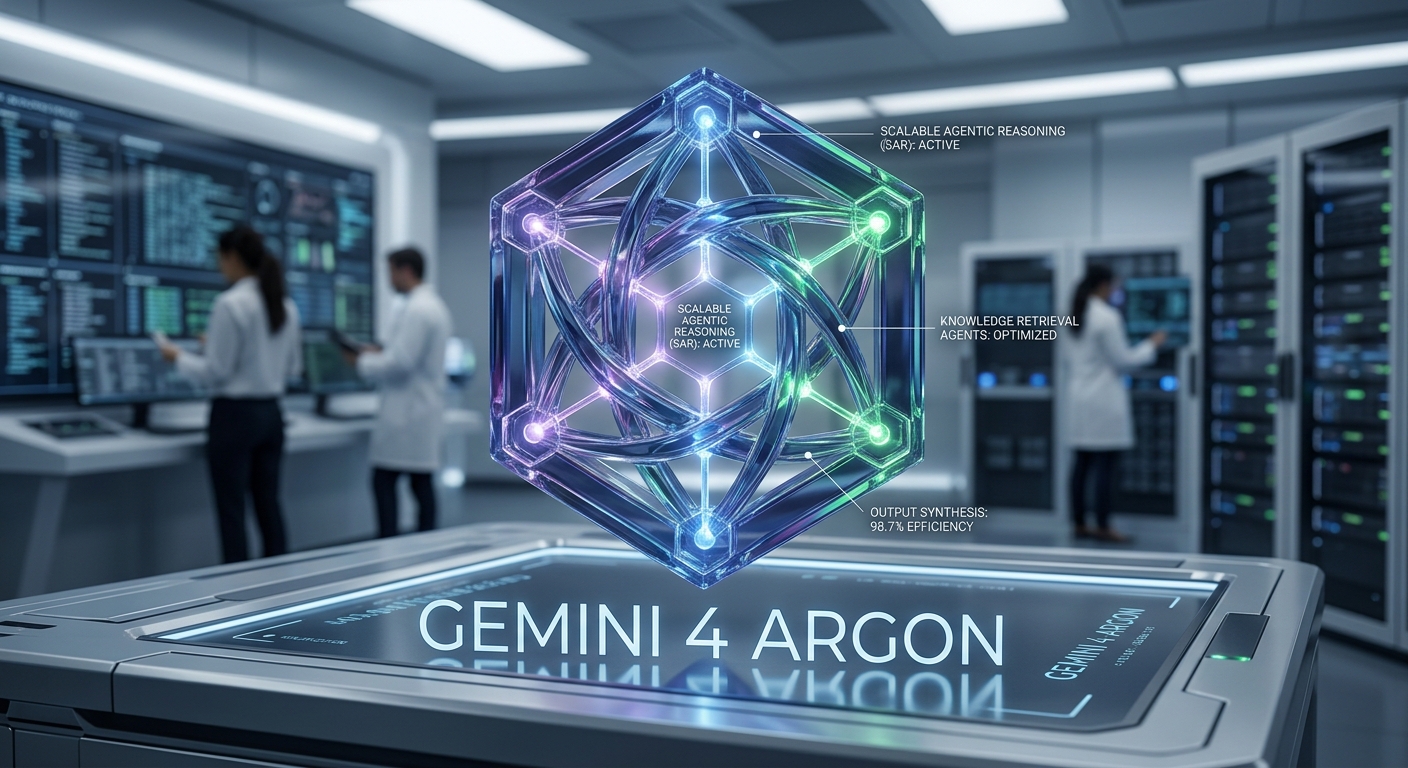
Google has intensified competition in the artificial intelligence industry with the launch of Gemini 4 Argon, its latest advanced AI model designed for complex reasoning, software engineering, scientific research, cybersecurity, and professional business tasks. According to Google’s official announcement, the model became globally available on October 13, 2026, through selected Google products and developer platforms.
The launch highlights a broader shift in the AI industry, where companies are competing to develop systems capable of completing complex, multi-step tasks rather than simply answering questions. For businesses and investors, Gemini 4 Argon represents another development in the race to turn advanced AI capabilities into measurable productivity and commercial growth.
What Is Google Gemini 4 Argon?
Gemini 4 Argon is Google’s advanced reasoning model within its Gemini AI family. It supports text, images, audio, video, and PDF inputs, alongside tools for code execution, function calling, file search, and computer-use capabilities in preview. Its context window supports approximately one million tokens, allowing it to process extensive information within a single task.
This combination makes the model particularly relevant to users who need to analyze large document collections, understand complex codebases, or connect information across multiple sources.
For example, a financial analyst could use an AI model to review company filings, compare financial statements, and prepare an initial valuation analysis. A software engineering team could use it to investigate errors across a large application and propose changes spanning multiple files.
However, these capabilities do not eliminate the need for human review. Financial conclusions, legal interpretations, scientific findings, and production software still require appropriate verification.
Key Features of Gemini 4 Argon
Google is positioning Gemini 4 Argon as a model for complex professional work rather than simple conversational assistance. Its principal capabilities include:
- Advanced reasoning: Works through challenging mathematical, scientific, and analytical problems.
- Software engineering: Helps analyze large codebases, identify performance issues, and implement changes across multiple files.
- Business and financial analysis: Processes extensive documents and supports research, calculations, and structured analysis.
- Cybersecurity defense: Assists security teams in investigating vulnerabilities and developing potential fixes.
- Multimodal processing: Accepts text, images, audio, video, and PDF documents.
- Multi-step AI agents: Supports workflows that use tools and execute sequences of tasks with less manual intervention.
These capabilities make Gemini 4 Argon relevant to organizations seeking to move beyond basic AI chatbots toward systems that can assist with more complex workflows.
Gemini 4 Argon Pricing and Availability
Google announced Gemini 4 Argon’s broader availability on October 13, 2026, following an initial phase that provided access to selected cybersecurity professionals. The model is available through Google’s AI products and developer platforms, with access depending on the product and subscription.
Its introductory API pricing is particularly important for companies evaluating whether to adopt the model.
| API usage | Introductory price |
|---|---|
| Input tokens | $2 per million |
| Output tokens | $10 per million |
Google has announced that standard prices will rise to $4 per million input tokens and $20 per million output tokens after November 30, 2026.
These charges are separate from subscription fees and other operating expenses. Businesses should also account for infrastructure, employee oversight, data security, and integration costs when estimating the total cost of AI adoption.
The model is available through Google AI Studio and the Gemini API. Eligible Google AI Pro and Ultra subscribers can also access it through supported Gemini products, while developers and enterprise customers can explore integrations through Google’s AI platforms.
How Gemini 4 Argon Could Change Business Operations
The commercial opportunity extends beyond the technology industry. Companies in finance, consulting, healthcare, legal services, and scientific research increasingly want AI tools that can help complete entire workflows.
1. Financial Services and Investment Research
Financial institutions process large volumes of market reports, company filings, contracts, and economic data. An advanced reasoning model could help analysts organize information, compare business performance, and prepare preliminary financial assessments.
For investment firms, these capabilities may reduce time spent on repetitive research. However, AI-generated valuations and investment conclusions still require independent checks, particularly when financial decisions involve significant capital.
2. Software Development and Engineering
Software development is one of the most commercially important applications for Gemini 4 Argon. Advanced coding models can help engineers investigate bugs, modernize legacy systems, test software, and automate repetitive development tasks.
Google has reported productivity improvements from its internal use of Argon, including increased code submissions and fewer code rollbacks. These company-reported results suggest potential efficiency gains, although outcomes may differ across organizations and projects.
If similar benefits translate to external users, companies could potentially accelerate product development, simplify legacy systems, and reduce engineering bottlenecks.
3. Cybersecurity and Enterprise Protection
AI can help security professionals examine code, investigate vulnerabilities, and prioritize potential threats. Gemini 4 Argon’s focus on cybersecurity defense could make it useful for organizations managing increasingly complex digital infrastructure.
Nevertheless, the same capabilities that help defenders can create risks if misused. Companies will need strict access controls, testing environments, monitoring, and human approval for sensitive actions.
4. Scientific Research and Healthcare
Researchers may use advanced AI models to review scientific literature, analyze datasets, and explore possible solutions to difficult research problems. These applications could help accelerate early-stage research in areas such as molecular science, materials discovery, and drug development.
However, AI-generated scientific hypotheses must still be tested through appropriate experiments and independent validation. The technology should support qualified researchers rather than replace established scientific methods.
What Gemini 4 Argon Means for the Global AI Race
Google’s launch arrives as leading AI companies compete for enterprise contracts, developer adoption, and long-term investment. OpenAI and Anthropic remain important competitors, while other technology companies are investing in specialized models, AI infrastructure, and autonomous agents.
The competitive advantage increasingly depends on more than benchmark scores. Customers want models that can perform useful work reliably, integrate with existing systems, protect sensitive information, and justify their cost.
For Google, Gemini 4 Argon could strengthen the connection between its AI models, cloud infrastructure, developer tools, and consumer products. This integrated ecosystem may make it easier for businesses already using Google services to experiment with advanced AI.
However, the launch alone does not establish that Google has overtaken its competitors. Independent performance evaluations, enterprise adoption figures, customer retention, and real-world operating costs will provide a clearer picture over time.
Investment Outlook: Opportunities and Risks
Gemini 4 Argon highlights the economic potential of advanced AI, but investors should distinguish product announcements from financial results.
The opportunity lies in greater enterprise adoption, increased demand for AI services, and productivity improvements across knowledge-intensive industries. If businesses can use AI to complete complex work more efficiently, demand for reliable models and supporting infrastructure may continue to grow.
The risks are equally important. Developing advanced models requires substantial computing resources, while price competition could put pressure on profit margins. Businesses may also delay adoption because of data privacy concerns, regulatory requirements, unreliable outputs, or expensive integration projects.
Investors should therefore monitor measurable indicators such as enterprise revenue growth, AI service margins, customer adoption, infrastructure spending, and evidence of sustained productivity gains.
The central question is no longer simply which company has the most powerful AI model. It is which company can turn advanced AI capabilities into reliable, scalable, and profitable products.
What Comes Next for Google’s AI Strategy?
Gemini 4 Argon signals Google’s ambition to make AI a more active participant in professional work. Rather than limiting AI to answering questions, the company is developing systems that can analyze information, use tools, and help complete complicated assignments.
The next stage of competition will depend on reliability, safety, accessibility, and measurable business value. Companies that successfully integrate these systems into daily operations may gain an advantage, while those that adopt them without proper controls could face financial, operational, and security risks.
For the global technology industry, Gemini 4 Argon is another important development in the shift toward more capable AI agents. Its lasting impact will depend on how effectively organizations turn its technical capabilities into real-world results.
Frequently Asked Questions (FAQs)
What is Google Gemini 4 Argon?
Gemini 4 Argon is Google’s advanced AI reasoning model, designed for complex coding, scientific research, financial analysis, cybersecurity, and multi-step workflows.
When was Gemini 4 Argon released?
Google announced the model’s broader availability on October 13, 2026, following an earlier limited-access phase for selected cybersecurity professionals.
How much does Gemini 4 Argon cost?
Its introductory API price is $2 per million input tokens and $10 per million output tokens. Standard pricing is scheduled to increase after November 30, 2026.
Is Gemini 4 Argon available to businesses?
Yes. Developers and enterprises can access the model through Google’s API and platform offerings, while consumer access depends on eligible subscriptions and products.
How could Gemini 4 Argon affect businesses?
It could help organizations automate parts of software development, research, document analysis, and cybersecurity. Actual results depend on the task, implementation, and level of human oversight.
Will Gemini 4 Argon replace human workers?
Not necessarily. It may automate some tasks and change job responsibilities, but the overall effect on employment will depend on adoption, business needs, and the creation of new roles.
About the Author:
Anam Younas writes about business, finance, AI, technology, and global news for Daily Press.
Follow Daily Press on X for the latest news and updates: @dailypressit.