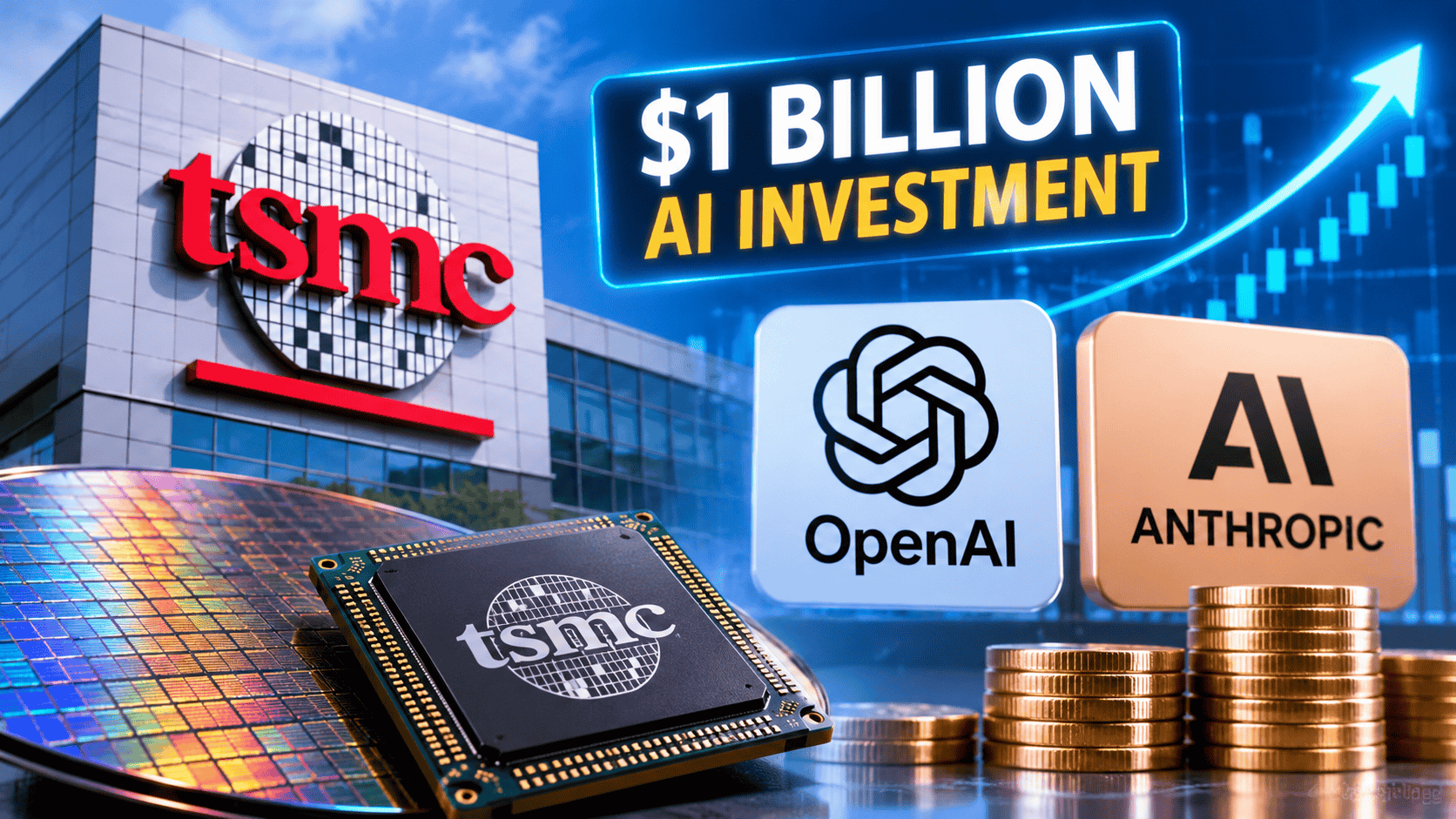
Taiwan Semiconductor Manufacturing Company (TSMC) has approved up to $1 billion in investments in OpenAI and Anthropic, marking a significant development in the global artificial intelligence industry. The move reflects the growing relationship between semiconductor manufacturers and AI developers as competition for advanced computing power, infrastructure and technological leadership intensifies.
The investment also signals a strategic shift for TSMC. Rather than benefiting exclusively from manufacturing advanced processors, the Taiwanese semiconductor giant is positioning itself to gain financial exposure to the companies driving demand for AI chips.
For global investors, technology businesses and financial markets, this development raises an important question: Is the AI industry entering a new phase in which semiconductor manufacturers become direct financial partners of the companies purchasing their products?
TSMC Approves $1 Billion Investment in OpenAI and Anthropic
On November 10, 2026, TSMC’s board approved investments of up to $500 million in OpenAI and another $500 million in Anthropic.
According to the company’s board resolutions, the proposed investments involve purchasing OpenAI preferred stock and Anthropic common shares at its initial public offering price.
The decision gives TSMC an opportunity to participate directly in the financial growth of two influential AI developers.
The investment comes at a time when both companies are expanding their computing infrastructure and competing to develop increasingly capable artificial intelligence systems.
OpenAI operates ChatGPT and continues to expand its AI products and infrastructure partnerships. Anthropic, meanwhile, has established itself as a major competitor through its Claude family of AI models, enterprise products and developer-focused services.
Both businesses require substantial computing resources to train, operate and improve their AI systems. These requirements create significant demand for advanced semiconductor manufacturing, placing TSMC in an important position within the AI supply chain.
Why TSMC Is Investing in AI Companies
TSMC has traditionally operated as a semiconductor manufacturer, producing advanced chips designed by companies such as Nvidia and other major technology businesses.
Its manufacturing capabilities are essential to the development of modern AI infrastructure. High-performance processors used in data centers require sophisticated fabrication technologies and advanced packaging capabilities.
By investing in OpenAI and Anthropic, TSMC is expanding its exposure beyond manufacturing.
The strategy offers several potential advantages.
First, TSMC could benefit financially if these AI developers achieve substantial commercial growth and higher market valuations.
Second, the investments strengthen its relationships with major participants in the AI ecosystem.
Third, the move provides another way to participate in the expansion of artificial intelligence beyond semiconductor production.
However, the strategy also introduces financial exposure to companies whose long-term profitability remains uncertain.
For TSMC, the opportunity is attractive, but its success will depend on whether the AI industry can convert growing demand for computing power into sustainable business revenues.
The AI Semiconductor Industry Is Entering a New Investment Phase
The global AI industry is no longer driven exclusively by software development. Its expansion increasingly depends on physical infrastructure, including semiconductor fabrication plants, high-performance processors, data centers, networking equipment and electricity generation.
This transformation has created enormous opportunities for semiconductor manufacturers.
Nvidia has become one of the most important suppliers of AI computing hardware, while TSMC manufactures many of the advanced processors that power modern AI systems.
As AI companies expand their operations, demand for advanced chips and semiconductor packaging continues to increase.
TSMC recently reported its sixth consecutive quarter of record profits, highlighting the financial benefits of the AI infrastructure expansion. The company has also forecast approximately 44% revenue growth for 2026, supported by strong demand for advanced semiconductor products.
Its October 2026 revenue increased approximately 60% compared with the same month last year.
These figures demonstrate that the AI investment cycle is generating substantial business opportunities for companies positioned at the center of semiconductor manufacturing.
However, continued growth will require significant investment in production capacity, research and development, and advanced manufacturing technologies.
Anthropic and OpenAI: Why Investors Are Paying Attention
TSMC’s investment decision also highlights the growing financial importance of OpenAI and Anthropic.
Both companies are attracting significant capital because investors increasingly view advanced AI models as potential foundations for future business applications.
OpenAI has established a strong position in consumer AI, enterprise software and developer services. Its products are being integrated into business operations, productivity platforms and digital services.
Anthropic has gained attention through its Claude models, particularly in enterprise applications, software development and AI-assisted professional workflows.
The companies are competing for customers, computing resources, infrastructure partnerships and long-term commercial opportunities.
Anthropic’s proposed IPO pricing range of $70 to $78 per share, announced in November, further demonstrates the scale of investor interest surrounding the AI sector. The company is also pursuing a separate $26 billion private placement involving major technology investors.
For TSMC, investing in both companies provides exposure to different approaches to the development and commercialization of artificial intelligence.
Nevertheless, investors should distinguish between strong market interest and proven long-term profitability. High valuations do not automatically guarantee attractive investment returns.
The Risk of Circular Financing in the AI Industry
One important concern surrounding TSMC’s investment is the growing financial interdependence between AI developers, semiconductor manufacturers and infrastructure providers.
Consider how the ecosystem operates.
AI developers require advanced chips to operate their models. Semiconductor manufacturers produce those chips. Investors provide capital to AI companies, which then use funding to purchase computing infrastructure and technology services.
When suppliers also become investors in their customers, financial relationships become increasingly interconnected.
This structure can accelerate innovation and provide companies with access to capital. However, it also creates potential risks.
If AI demand slows, infrastructure spending declines or major AI developers struggle to generate sufficient revenue, several interconnected businesses could face financial pressure simultaneously.
Investors may also find it more difficult to evaluate genuine market demand when supplier financing and strategic investment arrangements support the same ecosystem.
TSMC’s proposed $1 billion investment is relatively modest compared with the scale of its semiconductor operations. Nevertheless, it reflects a broader trend in which technology companies are becoming both suppliers and financial partners within the AI economy.
What the Investment Means for Global Investors
From an investor perspective, TSMC’s decision provides several important signals.
1. AI infrastructure remains a major investment priority.
TSMC’s commitment suggests that leading semiconductor companies continue to see substantial long-term opportunities in artificial intelligence, despite concerns about elevated valuations and infrastructure spending.
2. Semiconductor companies may benefit beyond chip sales.
Strategic investments could create additional financial opportunities for manufacturers that have established relationships with leading AI developers.
3. AI valuations require closer examination.
Investors should assess revenue generation, operating costs, infrastructure commitments and cash flow rather than relying entirely on projected market valuations.
4. Competition within the semiconductor industry will intensify.
Companies capable of producing advanced processors and packaging technologies are likely to remain strategically important as AI computing requirements expand.
For institutional investors, the development reinforces the importance of monitoring semiconductor capacity, AI infrastructure spending and the financial performance of major AI developers.
Is TSMC’s $1 Billion AI Bet a Smart Long-Term Strategy?
TSMC’s investment appears strategically logical because the company already benefits from the growing demand for AI computing hardware.
However, its decision should not automatically be interpreted as a guarantee that every major AI company will become profitable.
The biggest challenge facing the AI industry is moving from rapid technological development to sustainable commercial performance.
Companies are spending billions of dollars on computing infrastructure, research, talent and data centers. These investments can create significant future opportunities, but they also require consistent revenue growth to justify their costs.
In my view, TSMC is making a calculated move to strengthen its position in an industry that could shape the next decade of global technology investment.
The company’s strongest competitive advantage remains its semiconductor manufacturing expertise. Its investments in OpenAI and Anthropic provide additional exposure to the AI economy, but manufacturing leadership will continue to be the foundation of its business.
The more important question for investors is whether the AI companies receiving this capital can eventually generate enough cash flow to justify the enormous financial resources being committed to their development.
Conclusion: TSMC Is Expanding Its Influence Beyond Semiconductor Manufacturing
TSMC’s approval of up to $1 billion in investments in OpenAI and Anthropic represents more than a financial transaction. It demonstrates how closely connected the semiconductor and artificial intelligence industries have become.
As AI developers compete for computing power and manufacturers seek opportunities beyond traditional chip sales, strategic investments are becoming an increasingly important part of the technology business landscape.
For global investors, the opportunity is significant, but so are the risks associated with high valuations, capital requirements and interconnected financing.
One thing is becoming increasingly clear: The future of artificial intelligence will not be determined by software developers alone. Semiconductor manufacturers, infrastructure providers and energy companies will also play critical roles in deciding which businesses emerge as long-term winners.
Daily Press will continue monitoring the global semiconductor industry, AI investment trends and the financial developments shaping the next generation of technology businesses.
Frequently Asked Questions (FAQs)
1. How much is TSMC investing in OpenAI and Anthropic?
TSMC has approved up to $500 million for each company, bringing its combined proposed investment to $1 billion.
2. Why is TSMC investing in AI companies?
The company aims to expand its exposure to the AI industry beyond semiconductor manufacturing and potentially benefit from the financial growth of major AI developers.
3. What does TSMC manufacture for the AI industry?
TSMC manufactures advanced semiconductors and packaging technologies used in high-performance computing processors and AI infrastructure.
4. Is TSMC’s investment a sign of continued AI growth?
It signals confidence in the long-term AI market, although it does not guarantee that AI companies will achieve their expected valuations or profitability.
5. What does this investment mean for semiconductor investors?
It highlights the growing strategic importance of semiconductor manufacturers and the financial opportunities emerging from the expansion of AI infrastructure.
Author
ANAM YOUNAS|DailyPress
Follow Daily Press on X for the latest news and updates: @dailypressit.