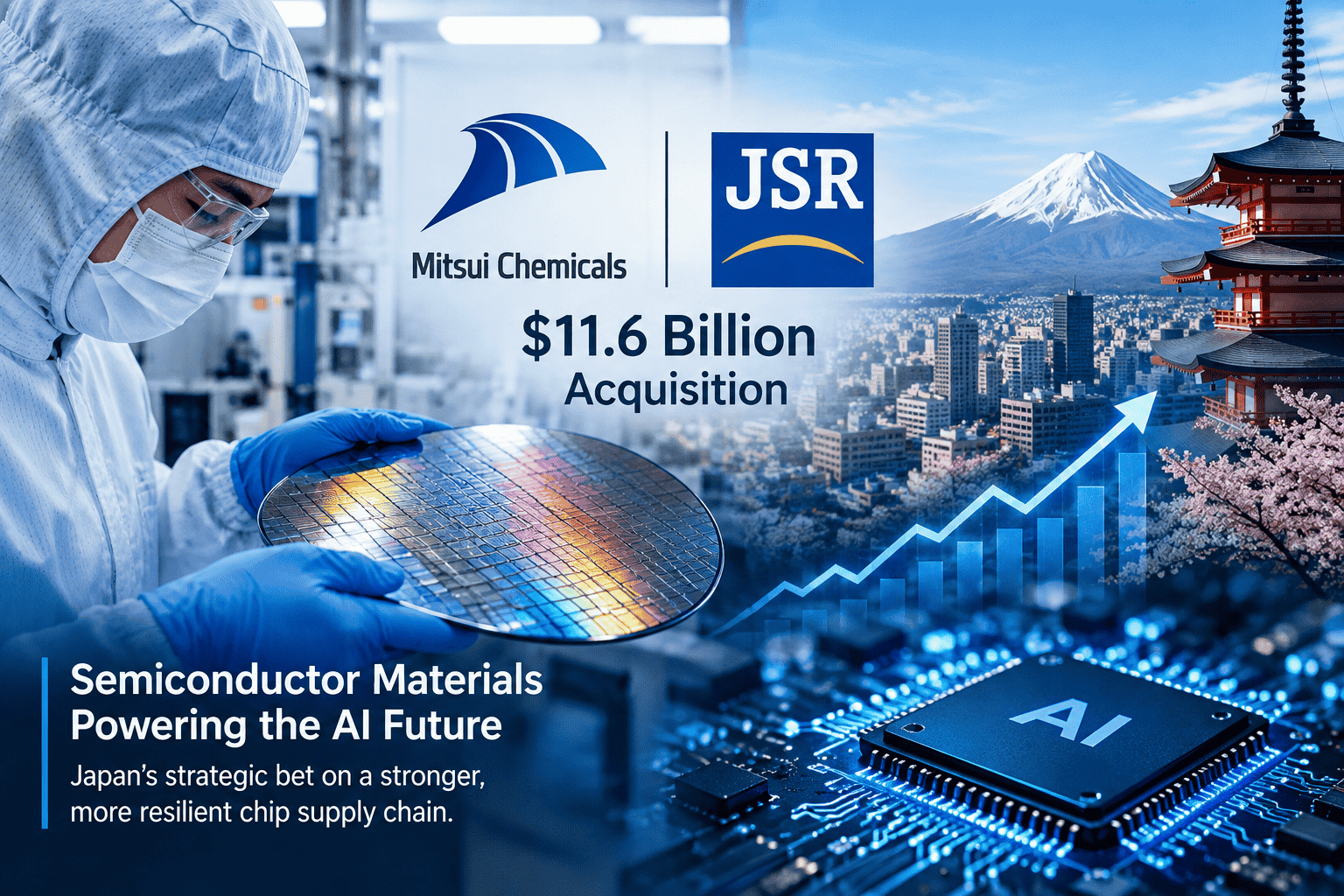
Japan’s semiconductor industry is entering a new phase of strategic expansion as Mitsui Chemicals moves to acquire chip-materials manufacturer JSR for approximately $11.6 billion. The transaction highlights how the global artificial intelligence race is creating investment opportunities beyond AI software, processors and data centers.
Japan Makes a Major Move in the Global Semiconductor Industry
The global semiconductor industry is experiencing a significant transformation as artificial intelligence increases demand for advanced computing infrastructure. Japan is positioning itself to strengthen its role in this rapidly expanding market through a major corporate acquisition.
On November 9, 2026, Mitsui Chemicals announced plans to acquire JSR Corporation for 1.84 trillion yen, equivalent to approximately $11.61 billion. The transaction represents one of Japan’s largest chemicals-sector acquisitions and reflects growing strategic interest in semiconductor manufacturing materials.
JSR is an important supplier of advanced materials used in semiconductor production, particularly photoresists. These specialized chemicals help transfer extremely fine circuit patterns onto silicon wafers during chip manufacturing.
The acquisition could strengthen Japan’s position in a supply chain increasingly influenced by demand from artificial intelligence, high-performance computing and advanced semiconductor production.
For investors, the transaction signals that the next stage of the AI boom may create substantial opportunities across the broader semiconductor ecosystem.
Why Semiconductor Materials Matter in the AI Revolution
Public attention surrounding artificial intelligence frequently focuses on companies developing advanced processors, cloud computing platforms and AI applications.
However, producing sophisticated semiconductor chips requires a much larger industrial ecosystem.
Manufacturing advanced processors involves specialized materials, precision equipment, sophisticated packaging technologies and highly controlled production environments.
Photoresists are particularly important because semiconductor manufacturers use them to create increasingly complex circuit patterns on silicon wafers.
As chipmakers pursue smaller and more powerful manufacturing technologies, the importance of specialized materials and reliable suppliers continues to grow.
JSR’s position in this ecosystem makes the acquisition strategically significant.
Japan already has an established presence in several important semiconductor-material categories. Strengthening domestic suppliers could help the country protect its technological capabilities while reducing vulnerabilities in critical manufacturing supply chains.
The transaction also reflects a broader international competition in which governments and corporations are attempting to secure access to essential semiconductor technologies.
The Financial Structure Behind Mitsui’s $11.6 Billion Acquisition
Although the acquisition offers potential strategic advantages, its financing structure deserves careful attention.
Mitsui Chemicals plans to finance the transaction through a combination of borrowing, equity sales and additional financing arrangements.
The company disclosed plans for a 1.64 trillion yen bridge loan, alongside share sales worth up to 150 billion yen. Japan’s Development Bank will also invest 200 billion yen through non-voting preferred shares.
This financing structure demonstrates the substantial capital requirements associated with expanding semiconductor businesses.
However, investors have already expressed concerns about the transaction’s financial implications. Mitsui Chemicals shares declined approximately 8.5% following the announcement.
The company’s market capitalization is considerably smaller than the acquisition price, making the transaction a major financial commitment.
Mitsui expects the combination of the two businesses to generate approximately 40 billion yen in additional annual profit through technological cooperation and operational improvements.
The company also intends to sell JSR’s life sciences business and other non-core assets to improve its financial position.
Investor perspective: The acquisition could strengthen Mitsui’s long-term competitive position, but its success will depend on whether expected synergies and earnings improvements justify the substantial debt burden.
AI Infrastructure Spending Is Expanding Beyond Nvidia
The semiconductor acquisition comes at a time when global investment in artificial intelligence infrastructure is increasing.
Companies developing advanced AI models are investing heavily in computing capacity, electricity infrastructure and specialized hardware.
Nvidia remains an important beneficiary of demand for AI processors, but the broader investment opportunity extends across multiple industries.
Semiconductor material suppliers, chip manufacturers, data-center operators, networking equipment producers and power infrastructure companies are becoming increasingly important to the AI economy.
The growing relationship between artificial intelligence and energy infrastructure is another important development.
AI data centers require enormous computing resources and reliable electricity supplies. As companies expand their computing capacity, demand for power equipment, cooling technologies and advanced electrical systems is also increasing.
This creates opportunities for industrial companies that previously received less attention from technology investors.
For example, semiconductor materials manufacturers could benefit from increased chip production even when individual AI software companies face changing valuations.
This distinction is important for investors attempting to identify sustainable opportunities in the AI industry.
Japan’s Semiconductor Strategy and Global Supply Chain Competition
Japan’s acquisition strategy also has wider geopolitical and economic implications.
Semiconductor manufacturing has become a strategic priority for major economies, including the United States, China, Japan, South Korea and European countries.
Governments increasingly recognize that access to advanced chips and essential manufacturing materials influences economic competitiveness, technological development and national security.
Japan has particular strengths in semiconductor materials and manufacturing equipment.
By supporting domestic semiconductor businesses, the country is attempting to strengthen its position within international supply chains while encouraging industrial investment.
The Mitsui-JSR transaction could contribute to this strategy by combining complementary technologies, expertise and manufacturing capabilities.
Nevertheless, consolidation alone cannot guarantee long-term success.
Japanese suppliers must continue investing in research, production capacity and technological innovation to compete with international manufacturers.
The acquisition will therefore be judged not only by its immediate financial performance but also by its ability to strengthen Japan’s semiconductor industry over the coming years.
What Does This Mean for Global Investors?
The transaction offers several important lessons for investors following the global AI economy.
1. Look beyond major AI technology companies
Investment opportunities are expanding into less visible parts of the semiconductor supply chain. Materials, manufacturing equipment and specialized industrial suppliers deserve greater attention.
2. Follow semiconductor supply chain consolidation
Companies with specialized technologies and established customer relationships could become attractive acquisition targets as governments and corporations seek greater supply chain security.
3. Evaluate debt and acquisition risks
Strategic acquisitions do not automatically create shareholder value. Mitsui’s financing commitments demonstrate why investors should carefully examine borrowing costs, expected synergies and future earnings.
4. Consider the long-term AI infrastructure cycle
Demand for computing infrastructure could continue creating opportunities across semiconductors, power generation, data centers and industrial equipment.
However, investors should avoid assuming that every company associated with AI will generate sustainable profits. Valuations, capital expenditure requirements and competition remain important risks.
The Future of the Semiconductor Industry
The global AI revolution is gradually changing the definition of a technology company.
In the past, investors often concentrated on software developers, computer manufacturers and semiconductor designers. Today, the competitive landscape includes chemical manufacturers, electricity suppliers, advanced packaging companies and specialized industrial businesses.
Japan’s $11.6 billion acquisition of JSR illustrates this transformation.
The transaction demonstrates that semiconductor materials are becoming strategically important assets as manufacturers attempt to satisfy growing demand for advanced computing technologies.
For Mitsui Chemicals, the acquisition represents an ambitious effort to expand its position in a strategically important industry. For Japan, it supports a broader effort to strengthen domestic semiconductor capabilities.
For global investors, it provides another indication that the AI investment opportunity extends far beyond the companies developing artificial intelligence models.
The next major winners of the AI economy may not necessarily be the companies receiving the most attention today. Some could emerge from the industrial businesses supplying the materials, equipment and infrastructure required to make advanced AI possible.
Frequently Asked Questions (FAQs)
1. Why is Mitsui Chemicals acquiring JSR?
Mitsui Chemicals aims to strengthen its semiconductor materials business, combine complementary technologies and expand its position in the global chip supply chain.
2. How much is the JSR acquisition worth?
The announced transaction is valued at approximately 1.84 trillion yen, or $11.61 billion.
3. Why are semiconductor materials important for AI?
Advanced AI processors require sophisticated manufacturing processes involving specialized chemicals, photoresists, silicon wafers and precision production equipment.
4. Could Japan become more competitive in the global semiconductor industry?
The acquisition could strengthen Japan’s semiconductor materials sector, although long-term competitiveness will depend on innovation, manufacturing investment and international demand.
5. What should investors watch after the acquisition?
Investors should monitor Mitsui’s financing costs, debt levels, integration strategy, expected earnings improvements and developments in global semiconductor demand.
Conclusion
Japan’s $11.6 billion semiconductor acquisition is more than a corporate transaction. It represents a strategic investment in the industrial foundations of the artificial intelligence economy.
As global demand for advanced computing continues to influence manufacturing and infrastructure investment, semiconductor materials could become an increasingly important area for businesses and investors.
The wider lesson is clear: understanding the future of AI requires looking beyond software and processors toward the entire industrial ecosystem that makes artificial intelligence possible.
Author: Anam Younas | Daily Press
Editorial verification: The acquisition value, financing structure, share-price reaction and projected profit improvements are based on the November 9 Reuters reporting