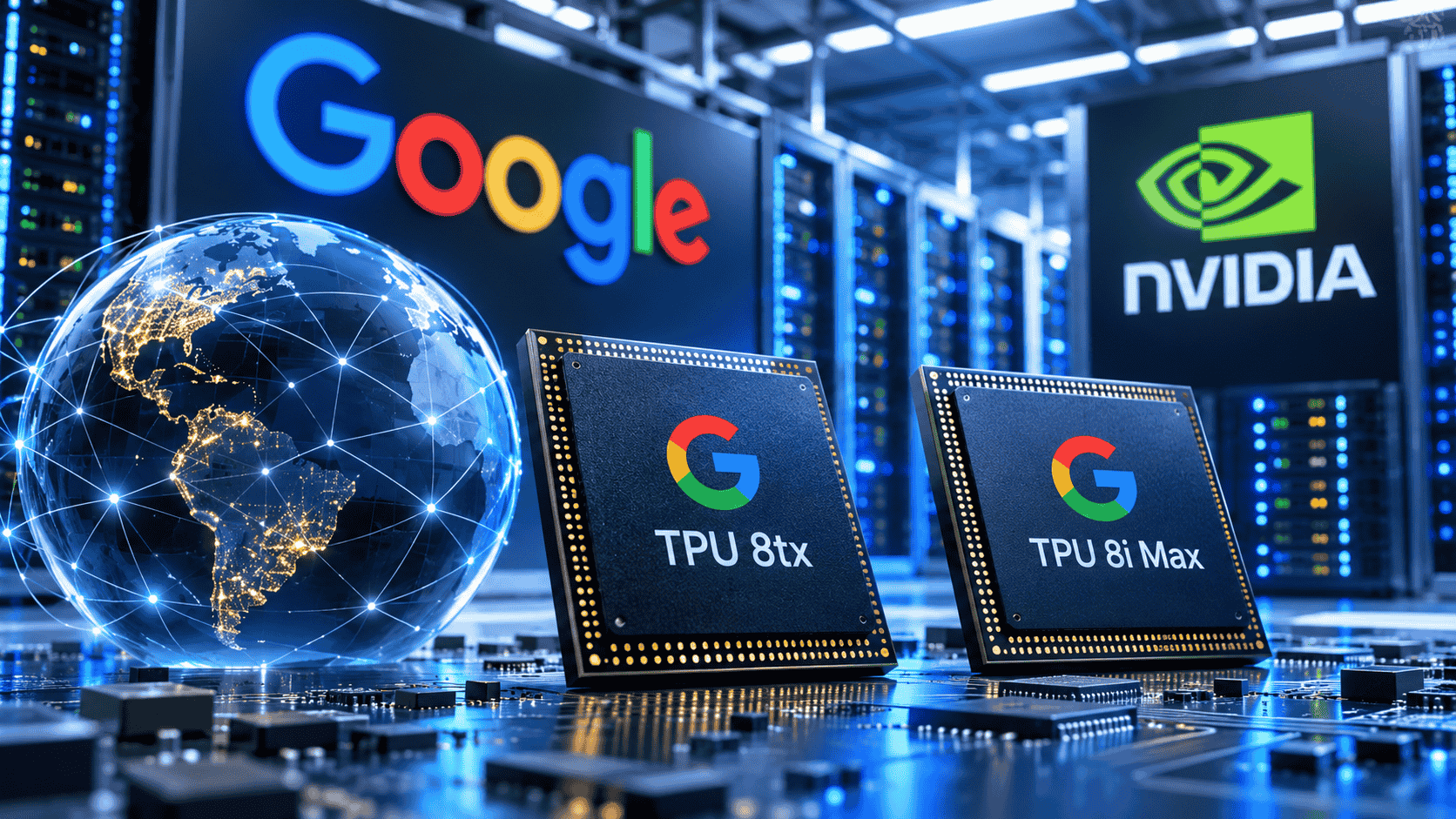
The global artificial intelligence industry is entering a new phase of competition as Google expands its custom semiconductor portfolio with two specialized AI computing systems. Announced on November 9, 2026, the new TPU 8tx and TPU 8i Max systems strengthen Google’s position in the rapidly growing AI infrastructure market and intensify competition with Nvidia.
The announcement highlights an important shift in the technology industry. Competition is no longer limited to developing more powerful AI models. Technology companies are increasingly investing in the processors, memory systems, networking infrastructure and data centers required to operate advanced artificial intelligence applications.
For investors, Google’s latest move raises an important question: could the growing availability of alternative AI processors gradually change the balance of power in the semiconductor industry?
Google Introduces Two New AI Computing Systems
Google’s new systems expand its eighth-generation Tensor Processing Unit (TPU) portfolio. The company introduced TPU 8tx for secure and confidential AI computing and TPU 8i Max for workloads requiring greater memory capacity and processing power.
Unlike a completely new processor architecture, these systems build on Google’s existing TPU technology through specialized configurations, packaging, networking and security features.
The TPU 8tx targets governments, financial institutions and other organizations handling sensitive information. It combines Google’s TPU technology with AMD’s fifth-generation EPYC server processors and hardware-level security capabilities.
The objective is to protect sensitive data and AI models even while they are actively being processed.
The TPU 8i Max addresses a different challenge: memory limitations. It combines two TPU 8i chips into one package, doubling compute capacity, on-chip memory and high-bandwidth memory bandwidth compared with the standard TPU 8i.
This design is particularly relevant to AI applications that process extensive information, including advanced coding assistants, mathematical reasoning systems and AI agents handling complex tasks.
Together, the two systems demonstrate Google’s strategy of developing specialized computing infrastructure for different enterprise AI requirements.
Why Google Is Challenging Nvidia’s Dominance
Nvidia has become one of the most influential companies in the global technology industry because its graphics processing units are widely used to train and operate advanced AI models.
However, the growing cost of AI infrastructure has encouraged major technology companies to develop their own semiconductor solutions.
Google, Amazon and Microsoft are investing in custom silicon to improve computing efficiency, strengthen control over their infrastructure and reduce dependence on external suppliers.
Google’s TPU strategy is particularly important because the company operates both a major cloud computing business and some of the world’s most widely used AI services.
By developing its own processors, Google can integrate hardware, software, cloud services and AI models into a more closely connected ecosystem.
This creates a potential competitive advantage. Instead of depending entirely on commercially available processors, Google can design computing systems around the specific requirements of its AI products and enterprise customers.
However, this does not mean Nvidia is immediately losing its leadership position. Nvidia benefits from a broad hardware ecosystem, established customer relationships, software capabilities and extensive industry adoption.
Google’s expansion represents increasing competition rather than an immediate replacement for Nvidia’s technology.
AI Agents Are Creating a New Demand for Specialized Chips
One of the most important developments behind Google’s announcement is the rapid evolution of AI agents.
Traditional AI applications often respond to individual user instructions. More advanced AI agents can complete multiple tasks, interact with software systems, analyze large amounts of information and perform complex operations with limited human intervention.
These capabilities require substantial computing resources.
For example, an AI coding assistant may need to examine an entire software project, identify problems, understand relationships between different files and generate solutions. Similarly, enterprise AI agents may analyze financial documents, business records and extensive datasets before making recommendations.
Such applications create greater demand for memory capacity, processing speed and efficient communication between computing components.
Google’s TPU 8i Max is designed to address these requirements by increasing memory and processing resources within an existing rack footprint.
The TPU 8tx focuses on another growing requirement: protecting confidential information while AI systems process it.
These developments suggest that future semiconductor competition will depend not only on raw processing performance but also on security, memory efficiency, energy consumption and the ability to support increasingly complex AI workloads.
Google Cloud Could Become a Bigger AI Infrastructure Business
Google’s semiconductor expansion also has significant implications for its cloud computing operations.
Google Cloud reported third-quarter 2026 revenue of approximately $30.71 billion, representing substantial growth compared with the previous year. Reuters reported that sales of Google’s TPU systems made a meaningful contribution to the company’s September-quarter results.
Google is increasingly positioning its custom processors as products that can attract external customers rather than serving only its internal AI operations.
The company has also indicated that nearly 100 customers are using its TPU technology, including businesses, research organizations and other technology companies.
This creates an additional business opportunity.
If more enterprises adopt Google’s processors, the company could generate revenue through cloud infrastructure, specialized computing services and access to its custom semiconductor systems.
For Google, the opportunity extends beyond competing in AI software. It involves building a larger position across the infrastructure supporting the entire artificial intelligence economy.
What Google’s AI Chip Expansion Means for Investors
Google’s latest announcement provides several important investment signals.
1. Semiconductor competition is expanding
Investors have traditionally associated the AI chip market with Nvidia. However, increasing investment in custom processors from major technology companies could gradually diversify the competitive landscape.
Companies involved in semiconductor manufacturing, advanced packaging, memory, networking and chip design may benefit from this broader investment cycle.
2. Cloud computing could become more valuable
The AI infrastructure market is creating new opportunities for cloud providers capable of delivering specialized computing resources.
Google’s strategy demonstrates how custom hardware can strengthen cloud services and potentially improve customer retention.
3. AMD gains another strategic opportunity
Google’s TPU 8tx uses AMD’s fifth-generation EPYC server processors. This highlights the importance of server CPUs alongside specialized AI accelerators.
As AI data centers become more complex, demand may extend across several semiconductor categories rather than concentrating exclusively on graphics processors.
4. Infrastructure costs remain a major risk
Developing custom processors, expanding data centers and securing sufficient electricity require substantial investment.
Technology companies must demonstrate that these investments can generate sustainable revenue and attractive returns. Strong demand alone does not guarantee profitability.
Investors should therefore monitor cloud revenue growth, infrastructure spending, operating margins and customer adoption rather than relying exclusively on product announcements.
Is the Global AI Chip Market Entering a New Competitive Era?
Google’s latest TPU expansion reflects a broader transformation in the semiconductor industry.
The first phase of the AI boom was largely driven by demand for powerful processors capable of training increasingly sophisticated models. The next phase is likely to involve more specialized infrastructure designed for real-time reasoning, autonomous agents, confidential computing and large-scale enterprise applications.
This transition could create opportunities for companies across the semiconductor supply chain.
Nvidia remains a major force, but Google, AMD, Amazon and other technology companies are developing increasingly sophisticated alternatives and complementary technologies.
The market may eventually become more diversified, with different processors serving different AI workloads.
For investors, this means the long-term AI opportunity should not be evaluated through a single company’s market position. The wider ecosystem—including chip designers, cloud providers, memory manufacturers, networking companies and data-center infrastructure suppliers—deserves attention.
Frequently Asked Questions
Is Google competing directly with Nvidia?
Yes. Google is expanding its custom AI processor business, creating alternatives to Nvidia-based infrastructure. However, the two companies have different business models, and Google’s TPUs do not immediately replace Nvidia’s broader hardware and software ecosystem.
What are Google’s TPU 8tx and TPU 8i Max?
TPU 8tx is designed for secure and confidential AI computing, while TPU 8i Max targets demanding AI applications requiring greater memory and processing capacity.
Why are technology companies developing their own AI chips?
Custom processors can help technology companies optimize performance, control infrastructure costs, reduce dependence on external suppliers and develop computing systems specifically for their AI applications.
What does this mean for semiconductor investors?
The expansion of custom AI chips could create opportunities across chip design, memory, advanced packaging, networking and data-center infrastructure. However, investors should evaluate company valuations, capital expenditure and the commercial success of new products.
Final Outlook
Google’s new AI computing systems represent another important development in the global semiconductor race. The company’s strategy reflects a growing belief that the future of artificial intelligence will depend on specialized hardware as much as advanced software.
Nvidia remains a powerful industry leader, but competition is expanding as major technology companies seek greater control over their AI infrastructure.
For investors, the most important opportunity may not be identifying which company wins the entire chip market. It may be understanding which businesses are positioned to benefit as the global AI infrastructure ecosystem becomes larger, more specialized and increasingly competitive.
Author: Anam Younas | Daily Press
Follow Daily Press on X for the latest news and updates: @dailypressit.