Introduction
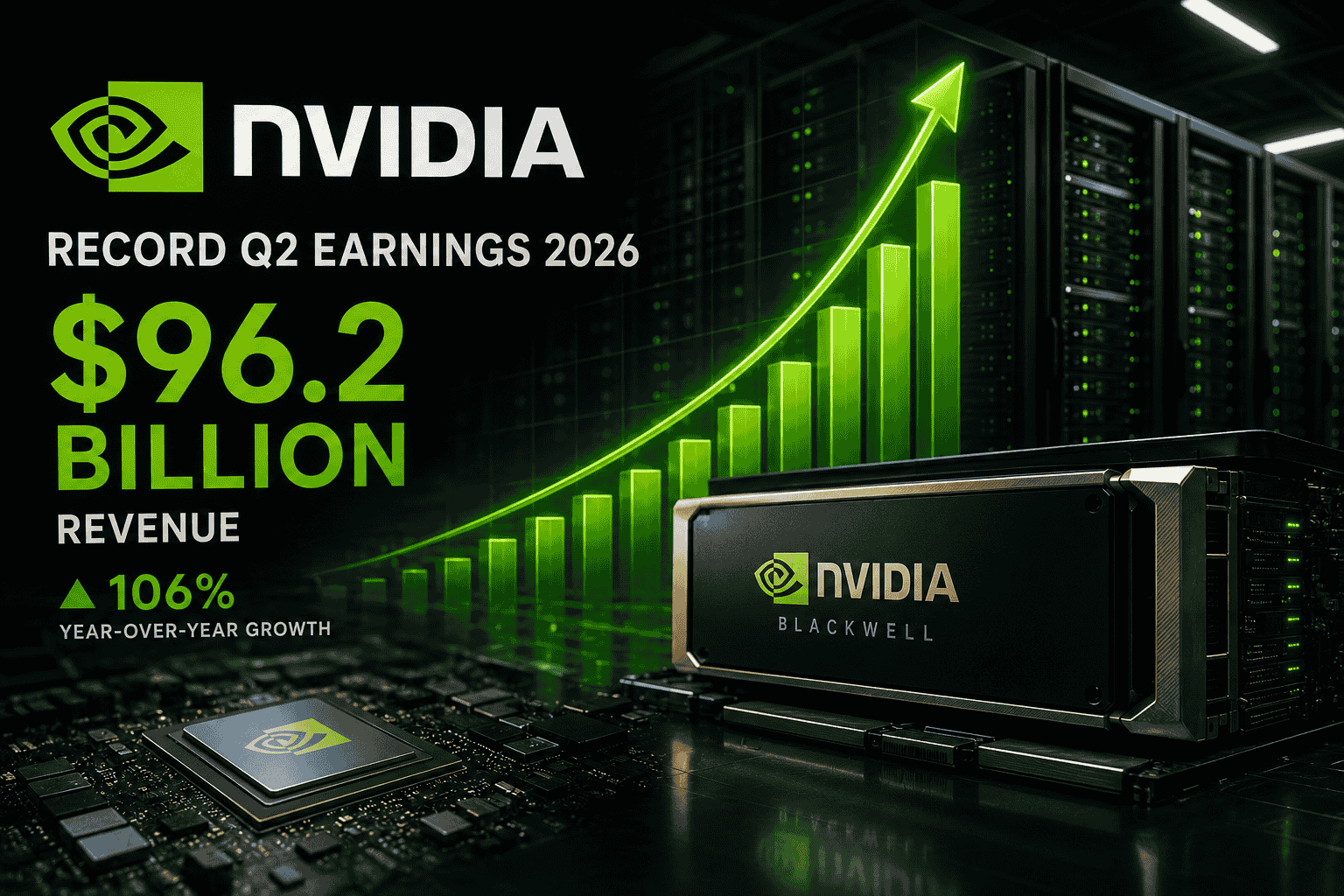
NVIDIA earnings 2026 have delivered another extraordinary result, highlighting how quickly artificial intelligence is transforming the technology and business landscape. The semiconductor giant reported $96.2 billion in revenue for the second quarter of fiscal 2027, an increase of 106% year over year and 18% from the previous quarter.
The results are important far beyond NVIDIA Earnings itself. They provide a snapshot of global demand for AI chips, data centers, cloud computing, generative AI, and increasingly autonomous AI systems.
NVIDIA’s latest numbers suggest that the massive investment cycle surrounding artificial intelligence is not slowing down. Instead, businesses are spending more on computing infrastructure as AI moves from experimental chatbots toward commercial applications, AI agents, robotics, and other forms of physical AI.
NVIDIA Earnings 2026: Key Numbers
NVIDIA Earnings second-quarter results were substantially stronger than those of the same period a year earlier.
The company reported:
- Revenue: $96.2 billion
- Year-over-year revenue growth: 106%
- Quarter-over-quarter revenue growth: 18%
- Data Center revenue: $89.0 billion
- Data Center year-over-year growth: 117%
- GAAP net income: $59.7 billion
- GAAP diluted EPS: $2.46
- Non-GAAP diluted EPS: $2.22
- Gross margin: 75%
NVIDIA $96.2 billion quarterly revenue compares with $46.7 billion during the same quarter a year earlier. Net income also increased dramatically, reaching $59.7 billion compared with $26.4 billion a year earlier.
These figures demonstrate that AI infrastructure spending remains one of the most powerful growth engines in the technology industry.
Data Centers Are Driving the AI Boom
$89 Billion Data Center Business
The most important part of NVIDIA earnings is its Data Center business, which generated $89 billion in quarterly revenue.
That figure represents 117% year-over-year growth and accounts for the overwhelming majority of NVIDIA total revenue.
Why is data-center demand so strong?
Companies developing large AI models need enormous amounts of computing power. Training sophisticated AI systems requires thousands of advanced processors operating together, while deploying those systems for millions of users requires additional computing infrastructure.
Cloud companies, AI laboratories, and large enterprises are therefore investing heavily in NVIDIA earnings accelerated computing platforms.
This has created a powerful cycle: more AI applications create more demand for computing, which creates more demand for NVIDIA’s earnings chips and networking systems.
Blackwell and Vera Rubin Strengthen NVIDIA earnings Position
NVIDIA earnings growth is increasingly connected to complete computing platforms rather than individual graphics processors.
Its Blackwell architecture has become a major part of the company’s AI infrastructure strategy, while its next-generation Vera Rubin platform is now moving into full production.
NVIDIA earnings says Vera Rubin systems are being deployed through major infrastructure partners, including CoreWeave, Google Cloud, Microsoft Azure, Oracle Cloud Infrastructure and Nebius.
The company is also expanding beyond GPUs. Its latest announcements include the NVIDIA Vera CPU, designed for AI-agent workloads, as well as networking, storage and security technologies for large AI factories.
This broader approach is strategically important because future AI systems will need more than powerful GPUs. They will require CPUs, networking, memory, storage, software, and specialized infrastructure working together.
AI Agents Could Become the Next Growth Engine
One of the most important changes happening in artificial intelligence is the move from conversational AI to AI agents.
Traditional chatbots mainly respond to user questions. AI agents are designed to perform multi-step tasks, use tools, interact with software and potentially complete business processes with limited human intervention.
NVIDIA earnings is positioning its hardware and software infrastructure for this transition.
The company has introduced technologies aimed specifically at agentic AI, including its Vera CPU, AI networking systems and software tools designed to support autonomous workloads.
If AI agents become widely adopted by businesses, demand for computing could increase substantially because agents may continuously perform complex reasoning and inference tasks.
That could create another major market opportunity for NVIDIA.
Physical AI and Humanoid Robots
NVIDIA is also betting on physical AI, an area where artificial intelligence interacts with the real world.
Robotics, autonomous vehicles, industrial machines and humanoid robots all require AI models capable of understanding physical environments and making decisions.
NVIDIA has highlighted its robotics strategy, including Isaac GR00T, its humanoid robot reference platform, and technologies designed for physical AI.
This means NVIDIA’s future growth could extend beyond traditional data centers.
If robots become widely used in manufacturing, logistics, healthcare, transportation and other industries, the computing required to operate them could become another important market for the company.
NVIDIA’s Business Model Is Changing
NVIDIA was once primarily known for graphics processors used in gaming and professional computing.
Today, it has evolved into a major full-stack AI infrastructure company.
Its business increasingly includes:
- AI GPUs
- CPUs
- Networking
- Data-center systems
- AI software
- Robotics platforms
- Autonomous vehicle technology
- AI development tools
- Cloud infrastructure partnerships
This transformation has helped NVIDIA capture a significant share of the economic value generated by the AI revolution.
The company is effectively selling the infrastructure required by businesses that want to build and operate artificial intelligence systems.
Financial Strength Remains a Major Advantage
NVIDIA’s latest earnings also demonstrate its financial strength.
The company generated $59.7 billion in quarterly GAAP net income, while its gross margin remained at 75%. During the quarter, NVIDIA also returned approximately $26 billion to shareholders through stock repurchases and dividends.
Strong cash generation gives NVIDIA substantial flexibility to invest in research, infrastructure, acquisitions, strategic partnerships and new technologies.
The company has also been developing financing partnerships designed to help expand AI infrastructure investment.
This illustrates how AI is increasingly becoming not only a technology story but also a major financial and infrastructure story.
NVIDIA’s Next Revenue Target Is $108 Billion
Perhaps the strongest signal from the latest earnings report is NVIDIA’s outlook.
For the third quarter of fiscal 2027, NVIDIA expects approximately $108 billion in revenue, plus or minus 2%. The company also expects a gross margin of around 74%.
A projected quarterly revenue figure above $100 billion would have seemed extraordinary for a semiconductor company only a few years ago.
Today, it is becoming NVIDIA’s expected scale.
Risks Facing NVIDIA and the AI Market
Despite the spectacular results, investors should not assume that NVIDIA’s growth is guaranteed forever.
High AI Infrastructure Spending
Technology companies are committing enormous amounts of money to AI infrastructure. The key question is whether these investments will eventually generate enough revenue and productivity gains to justify their cost.
Competition
Companies such as Google, Amazon and other technology giants are developing their own AI accelerators and chips. Greater competition could eventually put pressure on NVIDIA’s market share and margins.
China Restrictions
Geopolitical restrictions remain another important risk. NVIDIA’s latest revenue outlook excludes Data Center compute revenue from China, demonstrating the potential impact of export restrictions and changing international technology policies.
Energy and Data Center Capacity
AI systems require enormous amounts of electricity. Building new data centers also requires land, cooling systems, power generation and transmission infrastructure.
As AI adoption expands, energy availability could become a major limitation on future growth.
What NVIDIA Earnings Mean for Investors
From a financial perspective, NVIDIA’s results reinforce the argument that AI is not simply a short-term technology trend.
The company is generating extraordinary revenue and profits from real demand for computing infrastructure.
However, NVIDIA’s enormous success also creates extremely high expectations. Investors increasingly expect the company to deliver exceptional growth quarter after quarter.
That means even strong earnings can produce mixed market reactions if investors believe future growth is already reflected in the company’s valuation.
The key financial question is therefore shifting from “Is AI demand real?” to “How long can AI infrastructure spending grow at this extraordinary pace?”
The Future of NVIDIA and Artificial Intelligence
NVIDIA’s latest earnings indicate that the AI revolution is entering a new stage.
The first phase focused heavily on training large language models. The next phase is increasingly about deploying AI at scale.
AI agents, autonomous vehicles, robotics, enterprise AI and physical AI could all require massive amounts of computing power.
NVIDIA is positioning itself across these markets rather than relying on one type of AI workload.
Its strategy is increasingly about building the complete infrastructure behind artificial intelligence.
Conclusion
NVIDIA’s $96.2 billion quarterly revenue is more than another record for a semiconductor company. It is a powerful indicator of the scale of the global AI economy.
With Data Center revenue reaching $89 billion, next-quarter revenue projected at $108 billion and new opportunities emerging in AI agents, robotics and physical AI, NVIDIA remains at the center of the technology industry’s biggest transformation.
For businesses, the NVIDIA earnings report signals that AI infrastructure will remain a major investment priority. For technology companies, it demonstrates the importance of advanced computing. For investors, it offers evidence of extraordinary growth while also highlighting the risks created by enormous expectations.
The biggest question for 2026 and beyond may no longer be whether artificial intelligence will transform the economy.
It is how large the AI economy can ultimately become—and how much of that economic value NVIDIA can continue to capture.