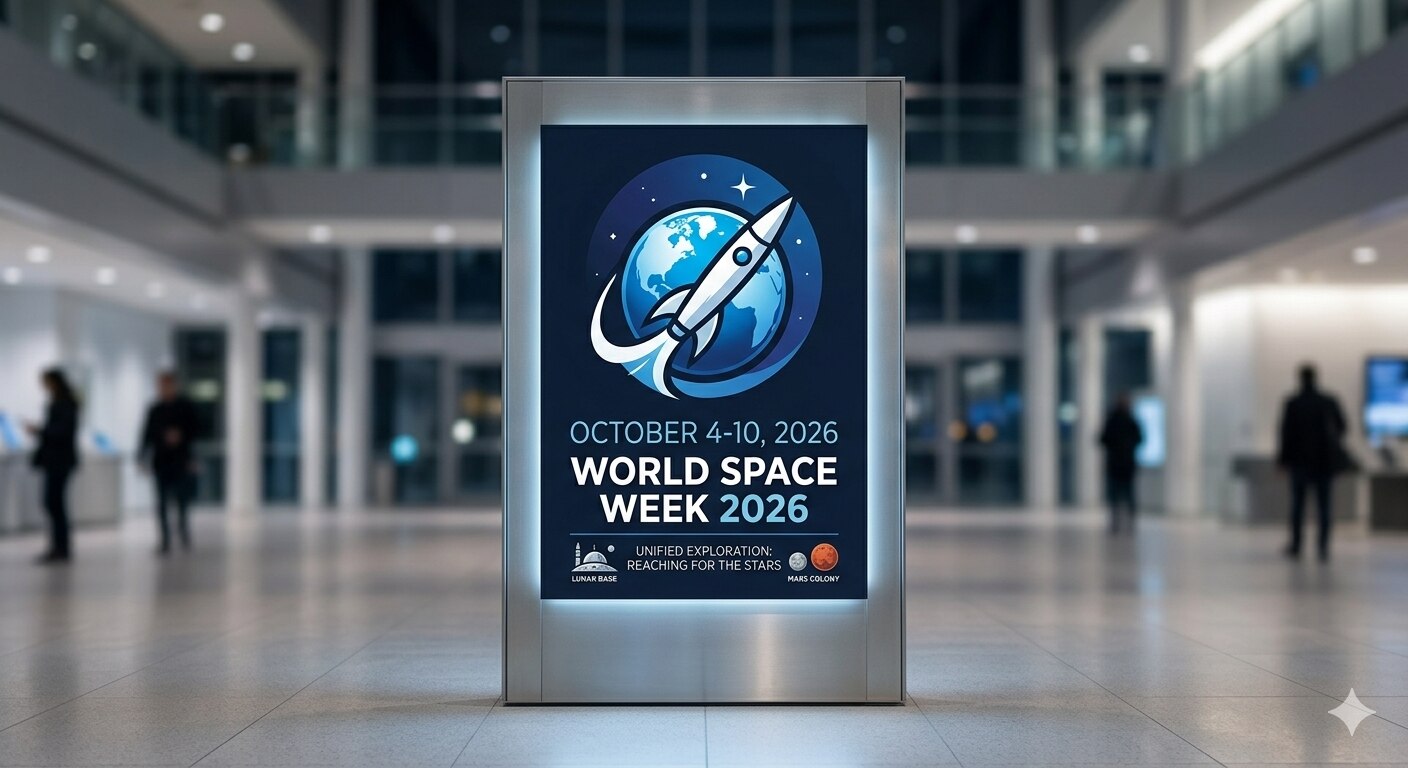
World Space Week 2026 is taking place from October 4 to October 10, bringing renewed attention to one of the fastest-changing areas of the global technology economy: access to space.
This year’s official theme, “Rocket Revolution,” focuses on the transformation of launch technology through reusable rockets, commercial launch providers, startups, universities and new national space programs.
For investors and businesses, however, World Space Week is about more than rockets. It highlights the emergence of a broader commercial space economy involving satellites, communications, Earth observation, artificial intelligence, robotics and space-based services.
Why World Space Week 2026 Matters
World Space Week was proclaimed by the United Nations General Assembly in 1999.
The October 4–10 dates commemorate two major milestones in space history. On October 4, 1957, Sputnik 1 became the first human-made satellite to orbit Earth. On October 10, 1967, the Outer Space Treaty entered into force, establishing fundamental principles governing the peaceful exploration and use of outer space.
More than six decades after Sputnik, the space industry is undergoing another major transformation.
The difference is that today’s revolution is increasingly being driven by commercial investment and technological competition, rather than governments alone.
The Rocket Revolution Is Changing the Economics of Space
Traditional rockets were largely designed for one-time use. That made reaching orbit expensive and limited the number of organizations capable of conducting space missions.
Reusable launch systems are changing that equation.
The ability to recover and reuse major components of launch vehicles can potentially reduce costs, increase launch frequency, and allow companies to operate more like commercial transportation businesses.
That creates a wider market for space services.
More affordable launches can make it easier for companies, universities and governments to deploy satellites and conduct experiments.
The result is a larger ecosystem of businesses operating around space infrastructure.
Satellites Are Becoming a Major Business Platform
The importance of the rocket revolution extends far beyond launch companies.
Satellites already support services used every day, including communications, navigation, weather forecasting and Earth observation. Increasing satellite capacity can also support environmental monitoring, disaster response and connectivity.
This creates opportunities across multiple industries.
Telecommunications companies can use satellites to expand connectivity. Agricultural businesses can use satellite imagery to monitor crops. Financial institutions can use Earth-observation data for risk analysis. Governments can use satellite systems for disaster management and infrastructure planning.
In other words, space is becoming part of the digital economy on Earth.
AI and Robotics Are Joining the Space Economy
The next stage of the space industry will not depend solely on rockets.
Artificial intelligence and robotics are becoming increasingly important to space missions.
AI can help analyze enormous volumes of satellite imagery, identify environmental changes, and assist with navigation. Robotics can support spacecraft operations, planetary exploration and potentially future construction activities beyond Earth.
World Space Week 2026 itself is highlighting this connection.
In Pakistan, World Space Week activities include discussions around AI, robotics and GNSS navigation systems for space missions, demonstrating how space technology is increasingly intersecting with the broader technology industry.
This convergence could create new investment opportunities at the intersection of aerospace, software and AI.
Pakistan’s Growing Role in World Space Week
Pakistan is also using World Space Week 2026 to expand interest in space science and emerging technology.
SUPARCO is coordinating nationwide activities from October 4 to 10, including competitions, educational programs, webinars and technical activities. Programs include rocket-design initiatives, astrophotography, space education and university-level technology challenges.
In Lahore, teacher-training and workshop programs are focusing on designing and 3D-printing rockets. Space technology challenges are also encouraging students and researchers to work on satellite design and development.
These programs demonstrate an important trend: countries do not necessarily need to build enormous space programs overnight to participate in the emerging space economy.
Developing technical talent, satellite capabilities, research institutions and partnerships can provide an entry point.
Pakistan’s Space Ambitions Are Expanding
Pakistan’s space story is also becoming more internationally connected.
The country has developed satellite capabilities and participated in international lunar missions through CubeSat technology.
Pakistan is also pursuing opportunities in human spaceflight through international partnerships and astronaut training programs.
The development illustrates how international partnerships can provide countries without independent crewed spacecraft with opportunities to participate in human spaceflight and space research.
What Investors Should Watch
The commercial space sector presents potentially significant opportunities, but it also carries substantial technological and financial risks.
Investors should look beyond the excitement surrounding rocket launches and examine the underlying business models.
Important areas include:
- Reusable launch technology
- Satellite communications
- Earth-observation services
- Space-based internet
- AI-powered satellite analytics
- Space robotics
- Navigation technologies
- Satellite manufacturing
- Space cybersecurity
- Lunar infrastructure
Companies that can turn space technology into recurring commercial revenue may ultimately have stronger business models than companies dependent entirely on government contracts or occasional launches.
The Space Economy Could Become More Accessible
One of the biggest implications of the rocket revolution is democratization.
As launch systems become more capable and potentially less expensive, more universities, startups and smaller nations may gain access to orbital infrastructure.
That could accelerate innovation.
A university could develop a small satellite. A startup could create an Earth-observation service. An agricultural company could purchase satellite data. A telecommunications provider could use orbital infrastructure to reach remote customers.
The space economy could therefore become less about a handful of aerospace giants and more about a network of companies building services around space infrastructure.
The Next Space Race Is Commercial
The original Space Race was dominated by geopolitical competition.
The emerging space race is increasingly commercial.
Governments remain critical players, but private companies are becoming central to launch services, satellites, communications and exploration.
That transition could create an entirely new generation of businesses.
World Space Week 2026’s “Rocket Revolution” theme captures this transition perfectly. The major story is no longer simply whether humanity can reach space.
The bigger question is how cheaply, how frequently and how commercially we can use it.
For investors, technology companies and governments, that could make the coming decade one of the most important periods in the history of the space economy.
The rocket revolution is not only changing how humanity reaches orbit. It is changing who can participate in the space economy—and potentially how space technology shapes business on Earth.