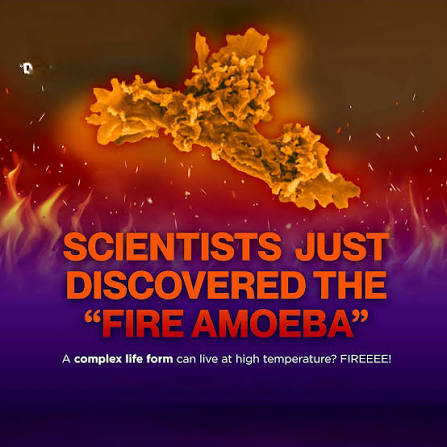
Scientists have discovered a remarkable new species of amoeba capable of surviving and reproducing at temperatures that challenge long-standing assumptions about the limits of complex life.
Informally dubbed the “fire amoeba,” the microscopic organism has demonstrated an extraordinary ability to function in extremely hot geothermal environments. Laboratory observations indicate that it can reproduce at approximately 145°F (63°C) and survive temperatures approaching 147°F (64°C).
The discovery could reshape scientific understanding of how complex organisms adapt to extreme heat and where the boundaries of life may exist.
What Is the Fire Amoeba?
The fire amoeba is a newly identified single-celled organism belonging to the eukaryotic group of life.
Eukaryotes are organisms whose cells contain a nucleus and other specialized structures. Animals, plants, fungi and many microscopic organisms belong to this broad category.
Extreme heat is particularly challenging for eukaryotic cells because high temperatures can damage proteins, DNA and other cellular structures.
The fire amoeba’s ability to continue growing and reproducing under such conditions makes it scientifically unusual.
A Record-Breaking Heat Tolerance
One of the most important aspects of the discovery is the temperature at which the organism can reproduce.
Researchers observed the amoeba undergoing cellular division at approximately 145°F, meaning the organism was not merely surviving the heat. It was actively growing and producing new cells.
The amoeba was also able to remain viable at temperatures around 147°F.
This distinction between survival and reproduction is important. Many organisms can temporarily tolerate environmental conditions that would prevent them from growing. The fire amoeba appears to have evolved biological mechanisms that allow it to remain active at temperatures far beyond those tolerated by most complex life.
Found in a Geothermal Environment
The organism was discovered in extremely hot geothermal waters associated with a volcanic environment in California.
Such environments are natural laboratories for studying extremophiles—organisms that thrive under conditions that would be hostile to most life.
Geothermal streams can contain dramatically different temperatures within relatively short distances. They also support specialized microbial communities adapted to heat, minerals and unusual chemical conditions.
The fire amoeba appears to have developed a niche within this ecosystem where extreme temperatures may actually provide an advantage.
How Does It Survive the Heat?
Scientists are investigating several biological mechanisms that could explain the organism’s remarkable heat resistance.
One possibility involves enhanced systems for repairing DNA damage caused by extreme temperatures.
Another involves specialized proteins capable of maintaining their structure and function under intense thermal stress.
Proteins normally become unstable when exposed to excessive heat. When this happens, essential cellular processes can fail. Organisms living in extreme environments therefore require specialized mechanisms for protecting or repairing damaged proteins.
The fire amoeba appears to possess adaptations that help its cells remain functional under these conditions.
A Protective Response to Extreme Temperatures
The organism also appears capable of changing its physical state when conditions become particularly harsh.
Under extreme heat, the amoeba can develop a more protective outer structure and enter a state that helps it withstand unfavorable conditions.
This adaptation may allow it to survive brief periods of temperatures above its normal growth range.
Researchers have observed that the organism can recover after exposure to temperatures significantly higher than those at which it normally reproduces.
That ability suggests that the amoeba has evolved multiple layers of protection rather than relying on a single heat-resistance mechanism.
The Fire Amoeba Is a Predator
The organism’s environment also helps explain its survival strategy.
The fire amoeba feeds on microorganisms, including heat-adapted bacteria living in the same geothermal environment.
Its exceptional heat tolerance may allow it to occupy an ecological niche that many other predators cannot access.
Extreme temperatures effectively reduce the number of organisms capable of competing for the same food sources.
In evolutionary terms, an environment that appears hostile can therefore become an advantage for an organism specifically adapted to it.
Why Scientists Are Excited About the Discovery
The discovery is significant because it expands the known range of conditions under which eukaryotic life can reproduce.
Scientists have long studied bacteria and archaea that survive at extremely high temperatures. Some microorganisms can grow at temperatures far above those tolerated by most complex organisms.
However, eukaryotic cells are generally considered more vulnerable to extreme heat because of their complex internal structures.
The fire amoeba provides researchers with an opportunity to investigate how a complex cell can overcome these limitations.
Potential Biotechnology Applications
The organism could eventually attract interest from biotechnology researchers.
Heat-resistant proteins and enzymes are already valuable in industrial and scientific applications because they can continue functioning under temperatures that would destroy ordinary biological molecules.
If scientists identify the specific molecular mechanisms responsible for the fire amoeba’s heat tolerance, those mechanisms could potentially inspire new technologies.
Possible areas of interest could include industrial biotechnology, molecular research, enzyme engineering and other processes that require biological materials capable of functioning at elevated temperatures.
However, any practical applications remain a subject for future research.
What It Could Mean for the Search for Life
The discovery could also influence the scientific search for life beyond Earth.
Astrobiologists often consider temperature when determining whether an environment might support life. Discoveries of organisms living under extreme conditions on Earth have repeatedly expanded the range of environments scientists consider potentially habitable.
The fire amoeba does not provide evidence of extraterrestrial life.
Instead, it demonstrates that complex cellular organisms can tolerate environmental conditions that scientists once considered extremely difficult for eukaryotic life.
That could encourage researchers to examine extreme environments more closely when studying the potential habitability of other worlds.
Earth’s Extreme Environments May Hold More Secrets
The discovery highlights how much remains unknown about Earth’s microscopic ecosystems.
Geothermal springs, volcanic regions, deep oceans, underground environments and other extreme habitats contain microorganisms that have evolved under conditions radically different from those experienced by humans.
Many of these environments remain incompletely explored.
The fire amoeba suggests that organisms with unexpected biological capabilities may still be waiting to be identified.
Future research could reveal additional species with even greater tolerance to heat, pressure, acidity or other environmental stresses.
FAQs
What is the fire amoeba?
The fire amoeba is the informal name given to a newly discovered microscopic eukaryotic organism capable of surviving and reproducing at extremely high temperatures.
How hot can the fire amoeba reproduce?
Scientists have observed the organism reproducing at approximately 145°F (63°C).
How hot can it survive?
The organism can survive temperatures around 147°F (64°C) and may tolerate even higher temperatures for limited periods.
Where was the fire amoeba discovered?
It was discovered in a geothermal environment in California associated with volcanic activity.
Why is the discovery important?
The discovery expands scientists’ understanding of the upper temperature limits of complex eukaryotic life and provides an opportunity to study how cells adapt to extreme heat.
Could the fire amoeba be useful for technology?
Potentially. Its heat-resistant proteins and cellular mechanisms could eventually provide insights useful to biotechnology, although significant additional research would be necessary.
A New Perspective on the Limits of Life
The discovery of the fire amoeba demonstrates that the boundaries of life can be more flexible than scientists once believed.
A microscopic organism capable of reproducing at approximately 145°F has evolved to make an environment that would be destructive to most organisms into a place where it can survive, feed and reproduce.
For scientists, the organism represents a valuable natural experiment in evolution, cellular protection, protein stability and extreme-environment biology.
As researchers continue exploring Earth’s hottest and most unusual habitats, the fire amoeba may be only one example of how much remains to be discovered about the remarkable adaptability of life.