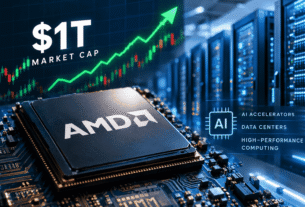
The artificial intelligence investment boom is facing one of its toughest market tests. After months of enthusiasm surrounding AI chips, data centers, cloud computing, and technology infrastructure, investors are beginning to question whether the industry’s enormous spending commitments can deliver profits quickly enough.
The latest sell-off on Wall Street has intensified these concerns. On November 5, 2026, the Nasdaq Composite fell approximately 4.5%, the S&P 500 dropped 3.6%, and the Dow Jones Industrial Average declined 2.9%. Semiconductor companies and AI infrastructure stocks experienced particularly heavy selling.
The correction has raised an important question for global investors: Is this simply a temporary market adjustment, or is the artificial intelligence industry entering a more difficult financial cycle?
My view is that investors should take this correction seriously without abandoning the long-term AI opportunity. The technology may continue transforming the global economy, but that does not mean every company associated with AI represents a good investment at every price.
Why Are AI Stocks Falling So Sharply?
The recent decline is not being driven by one isolated event. Several financial, economic, and political developments are combining to challenge investor confidence.
1. AI Investment Is Becoming Extremely Expensive
Technology companies have committed enormous financial resources to developing AI infrastructure. Building advanced data centers requires specialized processors, networking equipment, electricity systems, cooling technology, and substantial real estate investment.
Companies are competing to secure computing capacity because they believe artificial intelligence will become a major source of future revenue.
However, investors are increasingly questioning the financial return on these commitments.
Building infrastructure is only the first step. Companies must eventually generate enough revenue from AI products and services to justify their spending.
If investment continues increasing faster than revenue, shareholders may begin questioning whether current business strategies are financially sustainable.
2. Investors Are Questioning AI Valuations
AI-related stocks benefited from strong market enthusiasm as investors anticipated rapid growth in artificial intelligence adoption.
However, expectations can sometimes move ahead of actual business performance.
When investors pay exceptionally high valuations based on future growth, even a small disappointment can trigger substantial selling.
This is particularly relevant for semiconductor manufacturers and companies whose business models depend heavily on continued AI infrastructure expansion.
The market is beginning to distinguish between companies that are generating measurable AI-related profits and those whose valuations depend primarily on expectations.
3. Political and Regulatory Uncertainty Is Increasing
The 2026 U.S. midterm election results have introduced another source of uncertainty.
Democratic victories in both chambers of Congress have raised questions about the future regulatory environment for data center construction.
Lawmakers and local communities are increasingly concerned about electricity consumption, water usage, environmental pressure, and the impact of large facilities on local infrastructure.
These concerns could make certain projects more expensive or delay construction approvals.
For investors, the issue is not simply whether data centers will continue expanding. It is whether companies can complete projects on schedule, secure affordable electricity, and generate sufficient returns.
4. Semiconductor Stocks Are Facing Additional Pressure
The semiconductor industry has been one of the biggest beneficiaries of the AI boom. Advanced processors are essential for training and operating increasingly sophisticated AI models.
However, the latest market decline has affected several major chipmakers.
NVIDIA, AMD, and other semiconductor-related companies experienced significant selling pressure as investors reduced exposure to technology stocks.
Weak smartphone-chip sales from Qualcomm also contributed to negative sentiment, demonstrating that the semiconductor industry faces challenges beyond AI demand.
This distinction matters because investors should not treat every semiconductor company as an identical AI investment opportunity.
Is This an AI Bubble or a Necessary Market Correction?
The comparison between the current AI market and previous technology bubbles is becoming increasingly common.
During the dot-com boom, investors placed enormous valuations on internet companies, often without sufficient revenue or sustainable business models. When expectations collapsed, many businesses disappeared.
Today’s AI market has important differences. Several leading technology companies already generate substantial revenue from cloud computing, software, advertising, and digital services. AI is also being integrated into existing products and business operations.
Nevertheless, the presence of genuine technological progress does not automatically justify every stock valuation.
A company can operate an excellent business while its shares remain overpriced.
This is the central lesson investors should remember.
The AI industry may have a promising future, but some companies could still experience years of weak stock performance if their valuations become disconnected from earnings growth.
In my assessment, the current correction should be viewed as a test of financial expectations rather than proof that artificial intelligence has failed.
What Does the AI Sell-Off Mean for Major Technology Companies?
The consequences of this correction will differ across the technology sector.
NVIDIA: Strong AI Position, but High Market Expectations
NVIDIA remains one of the most important companies in the global AI ecosystem. Its advanced processors and computing platforms play a major role in data center development.
However, investors should evaluate the company’s valuation, earnings growth, customer spending, and competitive environment rather than assuming that strong AI demand guarantees continuous share-price appreciation.
The company’s long-term business opportunity and the short-term attractiveness of its stock are two separate questions.
AMD: Competition and Growth Expectations Matter
Advanced Micro Devices is another major participant in the AI semiconductor market.
Its future performance will depend on its ability to compete in advanced computing, gain customers, improve product execution, and convert market opportunities into profitable revenue.
Investors should monitor actual sales growth and margins instead of relying exclusively on expectations about future market share.
Microsoft, Amazon, and Alphabet: The Infrastructure Spending Test
Large cloud providers are investing heavily in AI infrastructure to support enterprise customers and their own services.
Their advantage is that they already operate substantial technology businesses with established customer relationships and multiple revenue streams.
However, infrastructure spending still needs to produce attractive returns.
Investors should examine capital expenditure, free cash flow, cloud revenue growth, and evidence that AI services are contributing meaningfully to profitability.
Smaller AI Infrastructure Companies: Greater Financial Vulnerability
Smaller data center operators and specialized AI cloud providers may face more immediate pressure.
Their businesses often require significant borrowing, construction commitments, and long-term financing arrangements.
If interest rates remain elevated or projects face regulatory delays, these companies could experience financial difficulties even when demand for AI computing remains strong.
For investors, balance-sheet strength is especially important in this segment.
My Investment View: What Should Investors Do During the AI Crash?
In my opinion, the biggest mistake investors could make during this correction is reacting emotionally.
A sharp decline creates fear, but fear alone is not an investment strategy. At the same time, assuming every falling AI stock has become a bargain can be equally dangerous.
Investors should focus on five principles.
1. Separate AI’s Future From Individual Stock Prices
Artificial intelligence has significant potential across healthcare, finance, manufacturing, education, cybersecurity, and enterprise software.
However, not every company participating in the AI industry will become a long-term winner.
Investors should evaluate individual businesses based on revenue, profitability, competitive advantages, debt, and management execution.
My view: Invest in businesses with demonstrable commercial demand rather than buying stocks simply because their companies use the AI label.
2. Pay Attention to Cash Flow and Debt
The AI infrastructure industry requires enormous capital investment.
Companies financing expansion through borrowing may become vulnerable if their projects take longer than expected to generate revenue.
Investors should examine free cash flow, debt maturity schedules, interest expenses, capital expenditure, and customer commitments.
A company with strong technology but a weak financial structure can become a risky investment during a prolonged market correction.
3. Avoid Trying to Predict the Exact Bottom
Markets rarely provide clear signals when a correction has finished.
A stock that falls 15% can decline another 15%. Similarly, a sharp recovery does not necessarily mean the broader market has regained stability.
For long-term investors, gradual investment approaches may reduce the risk of committing all available capital at an unfavorable moment.
However, any investment schedule should reflect personal financial circumstances, risk tolerance, and time horizon.
4. Look Beyond the Most Popular AI Stocks
The AI economy is larger than semiconductor manufacturers and data center operators.
Potential beneficiaries include electricity infrastructure companies, energy storage developers, cybersecurity providers, industrial automation businesses, and software companies that successfully commercialize AI.
Some of these businesses may benefit from AI adoption without carrying the same valuation or infrastructure financing risks as the most heavily traded AI stocks.
Diversification across industries can help reduce dependence on a single investment theme.
5. Keep Cash and Risk Management in the Strategy
During periods of market volatility, liquidity can become valuable.
Investors should avoid excessive borrowing to purchase falling stocks and should not invest money they may need for near-term expenses.
A disciplined portfolio should account for the possibility that market volatility continues for several months.
My key advice is to focus on protecting your investments and maintaining financial stability rather than rushing to purchase stocks simply because their prices have fallen.
Three Scenarios Investors Should Prepare For
The future direction of AI stocks will depend on earnings, financing conditions, technology adoption, and regulatory developments.
| Possible scenario | What it could mean |
|---|---|
| AI spending accelerates | Strong demand could support a market recovery, particularly for companies with competitive products and profitable customers. |
| AI investment slows | Infrastructure companies and highly valued semiconductor stocks could face additional pressure. |
| Market becomes more selective | Companies with stronger cash flows, realistic valuations, and proven AI revenue could outperform weaker competitors. |
The third scenario deserves particular attention. A more selective market does not necessarily mean the end of AI investment. It may instead reward companies that can demonstrate genuine economic value.
The Bigger Picture: AI Is Not Going Away, but Easy Profits May Be
Artificial intelligence is becoming an important part of the global economy. Businesses are exploring ways to reduce operating costs, improve productivity, automate processes, and develop new products using AI systems.
These developments create a meaningful long-term opportunity.
However, financial markets do not reward technological innovation automatically. They reward businesses that turn innovation into sustainable earnings and shareholder value.
The current sell-off is an important reminder that investment enthusiasm can become excessive, particularly when companies commit billions of dollars before the commercial returns are fully established.
For global investors, the next phase of the AI market could be more demanding than the previous one.
Instead of rewarding every company associated with artificial intelligence, the market may increasingly favor businesses with stronger financial foundations, efficient infrastructure, realistic valuations, and clear revenue opportunities.
The real AI investment opportunity may not be in buying every stock that falls during the correction. It may be in identifying the companies that can remain profitable, competitive, and financially stable after the market’s excitement fades.
Frequently Asked Questions (FAQs)
1. Why is the AI stock market crashing in November 2026?
The recent sell-off reflects concerns about expensive AI infrastructure investments, uncertain returns, high borrowing costs, semiconductor weakness, and possible regulatory restrictions on data center expansion in the United States.
2. Is the AI stock market crash the beginning of another dot-com bubble?
Not necessarily. Today’s AI industry includes established companies with significant revenue and existing customers. However, some AI-related stocks may have valuations that exceed what their current earnings can justify.
3. Should investors buy AI stocks during the market correction?
Investors should avoid making decisions based solely on falling prices. They should examine company valuations, cash flow, debt, earnings growth, and long-term competitive advantages before considering an investment.
4. Which companies are most exposed to the AI market sell-off?
Semiconductor manufacturers, AI data center operators, specialized cloud providers, and companies relying heavily on borrowed money for infrastructure expansion may face significant exposure.
5. Will NVIDIA recover after the AI stock market crash?
NVIDIA’s future share performance will depend on AI chip demand, competition, earnings growth, valuation, and broader market conditions. Its importance to AI infrastructure does not guarantee a particular stock-price recovery.
6. What is the biggest lesson for investors from the AI crash?
The biggest lesson is that a promising technology does not automatically make every related stock a good investment. Financial strength, reasonable valuation, sustainable revenue, and disciplined risk management remain essential.
Author: Anam Younas covers business, finance, technology, and global market developments for Daily Press.
Follow Daily Press on X for the latest news and updates: @dailypressit.
Editorial note: This article presents market analysis and general investment considerations, not personalized financial advice.