EU trade mechanism: France and Germany are pushing the European Union toward a tougher and faster trade-defense strategy as concerns grow over China’s industrial strength, trade imbalances, and the increasing use of economic pressure in global politics.
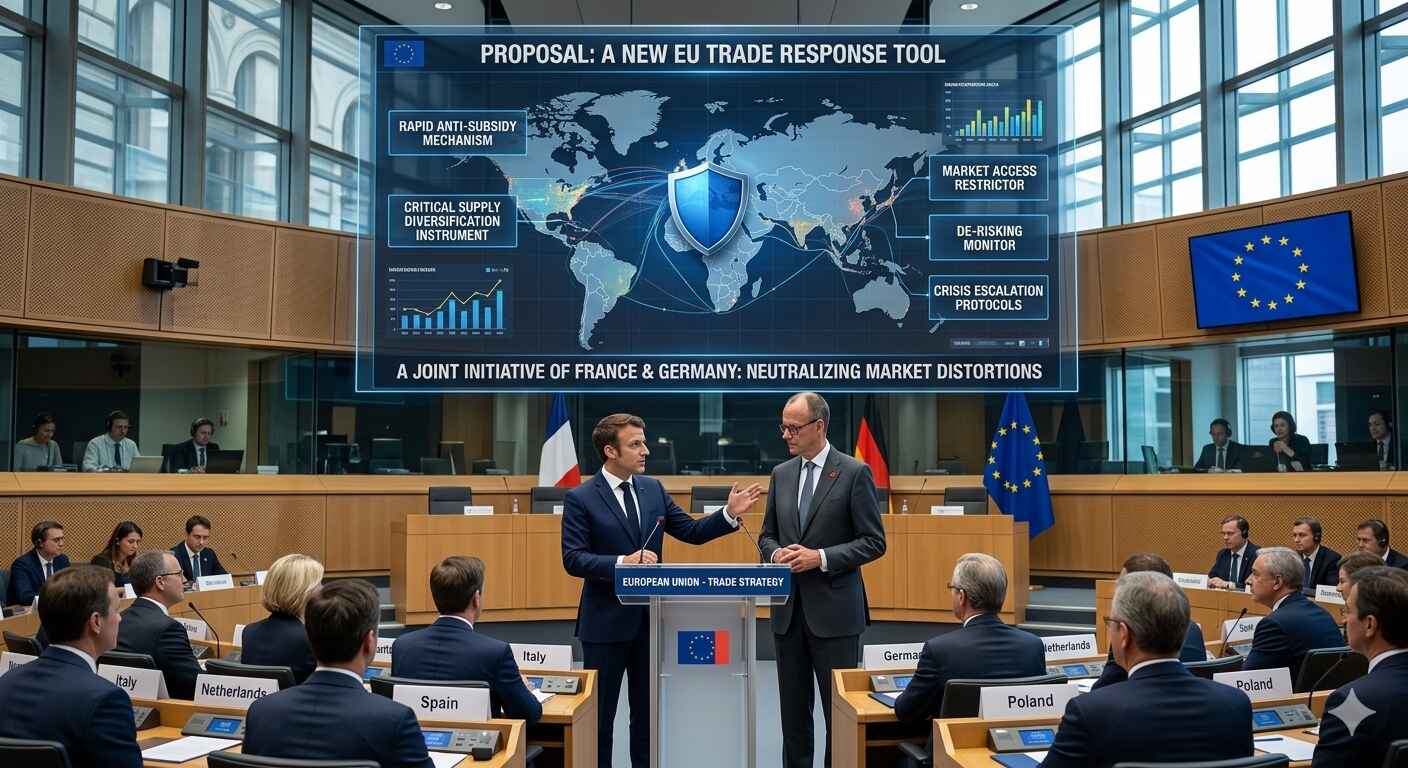
French President Emmanuel Macron and German Chancellor Friedrich Merz have proposed a new rapid-response EU trade mechanism that could give Brussels greater power to respond to countries accused of creating serious and systematic distortions in European markets.
The proposal represents a significant shift in Europe’s approach to international trade. Rather than relying primarily on lengthy investigations and traditional tariffs, Paris and Berlin want the EU to be capable of responding within days when economic security is threatened.
For businesses and investors, the development could reshape the European market and increase the importance of geopolitical risk in investment decisions.
What Is the New EU Trade Tool?
France and Germany want the European Commission to have access to a new instrument capable of restricting access to the EU’s single market when foreign governments or companies undermine fair competition.
The proposed mechanism would be country-agnostic, meaning it would not officially target China or any other individual country.
However, many of the concerns outlined by France and Germany closely resemble complaints the EU has repeatedly raised about China, including industrial subsidies, dumping, excess production capacity and other market-distorting practices.
The two governments want the mechanism to cover situations ranging from individual products to entire economic sectors.
Most importantly, they want decisions to be made much faster than under existing EU procedures.
Why France and Germany Want Faster Action
The global trade environment has changed dramatically.
The United States has increasingly used tariffs and other economic measures as strategic tools, while China has demonstrated its ability to use control over critical exports as leverage.
European policymakers fear that the EU trade could become vulnerable if it cannot respond quickly.
Under current procedures, major EU trade investigations can take months or longer. By the time the EU reaches a decision, European industries may already have suffered significant damage.
The Franco-German proposal therefore seeks to create a system where Brussels can respond rapidly while maintaining EU-level coordination.
Germany has compared the desired capability to the United States’ Section 301 mechanism, which provides Washington with broad authority to respond to unfair foreign EU trade practices.
China Is the Biggest Strategic Concern
Although the proposal does not name a specific country, China is clearly central to the debate.
European officials have become increasingly concerned about China’s industrial capacity in areas such as electric vehicles, batteries, chemicals, machinery and other strategic industries.
European manufacturers face competition from Chinese companies that can benefit from large domestic production networks, lower costs and government support.
France and Germany argue that Europe needs stronger tools to prevent these competitive pressures from undermining its own industrial base.
The issue is particularly sensitive because Europe does not want to completely decouple from China.
Instead, the strategy is increasingly focused on de-risking—reducing dangerous dependencies while maintaining economically valuable EU trade.
Europe Wants More Control Over Its Supply Chains
A second element of the Franco-German proposal focuses on supply-chain diversification.
France and Germany want the EU to reduce excessive dependence on single foreign suppliers for critical products and materials.
This could become increasingly important in industries involving:
- Critical minerals
- Pharmaceuticals
- Chemicals
- Batteries
- Semiconductors
- Energy technology
- Industrial equipment
- Advanced manufacturing
The objective is not necessarily to eliminate imports.
Instead, European policymakers want companies to have alternative suppliers so that a geopolitical dispute does not suddenly disrupt entire industries.
The European Single Market Becomes Leverage
One of the most powerful aspects of the proposed mechanism is the possibility of restricting access to the EU’s enormous single market.
For foreign companies, Europe represents one of the world’s largest consumer and industrial markets.
That gives Brussels significant negotiating power.
The proposed system could therefore allow the EU to respond to unfair practices not only through tariffs but potentially through broader market-access restrictions.
For investors, this creates a new variable when assessing companies with significant exposure to Europe.
Businesses that depend heavily on European sales could face higher regulatory and geopolitical risks if trade disputes escalate.
China Warns Against European Protectionism
Beijing has already criticized the direction of the proposal.
Chinese officials have warned that restrictions targeting Chinese companies or products could trigger a firm response and potentially disrupt China-EU trade and global supply chains.
That creates the possibility of a broader trade confrontation.
Europe is attempting to strengthen its negotiating position without triggering a full-scale trade war with China.
That balancing act will be difficult.
If Brussels moves too aggressively, European companies operating in China could face retaliation.
If Europe moves too cautiously, European industries could continue losing market share in strategic sectors.
The Impact on European Businesses
The new EU trade strategy could produce both winners and losers.
European manufacturers competing directly with heavily subsidized foreign producers could benefit from stronger trade defenses.
Companies producing strategic goods inside Europe could also benefit from greater government support and supply-chain diversification.
However, European businesses that depend heavily on inexpensive imported components could face higher costs.
For example, restrictions on foreign chemicals, machinery, or industrial materials could increase production expenses for European manufacturers.
That means policymakers will need to balance industrial protection with inflation and competitiveness.
What It Means for Investors
Investors should pay close attention to this development because EU trade policy is increasingly becoming an investment factor.
Companies with international supply chains could experience greater volatility if tariffs or market restrictions expand.
At the same time, European investment in domestic production could create opportunities in strategic industries.
Potential beneficiaries could include:
- European semiconductor manufacturing
- Critical-mineral processing
- Battery production
- Industrial automation
- Renewable-energy equipment
- Defense technology
- Pharmaceutical manufacturing
- Strategic logistics
The broader investment theme is European economic resilience.
A New Era of Geoeconomic Competition
The Franco-German proposal reflects a larger transformation in global economics.
EU trade policy is no longer solely about lowering tariffs and increasing international commerce.
It is increasingly connected to national security, technology, industrial capacity and geopolitical influence.
The EU wants to remain open to global trade while ensuring that openness does not create dangerous strategic dependencies.
That could lead to a more interventionist EU trade policy over the coming years.
What Happens Next?
The proposal still needs to move through the EU’s institutional process.
European governments and the European Parliament would need to approve legislation establishing any new trade instrument.
The issue is expected to receive significant attention at the upcoming European discussions on China’s trade relationship and broader EU economic security.
The key question will be whether other EU governments support giving the European Commission greater authority to respond quickly.
If they do, the EU could gain one of its strongest trade-defense mechanisms yet.
The Bigger Picture
France and Germany’s proposal signals that Europe is preparing for a world in which economic power and geopolitical power are increasingly intertwined.
The EU does not want to copy the United States or completely confront China. Instead, it is attempting to develop its own strategic economic toolkit.
For investors, the message is clear: EU trade policy is becoming a much more important component of financial risk assessment.
The next phase of global trade may not be defined simply by free trade versus protectionism.
It may instead be defined by economic security, supply-chain resilience and the ability to respond quickly when commercial competition becomes geopolitical competition.
If France and Germany succeed in building support for the new mechanism, Brussels could have a significantly stronger hand in future EU trade negotiations—and European companies could enter the next decade with greater protection against external economic shocks.