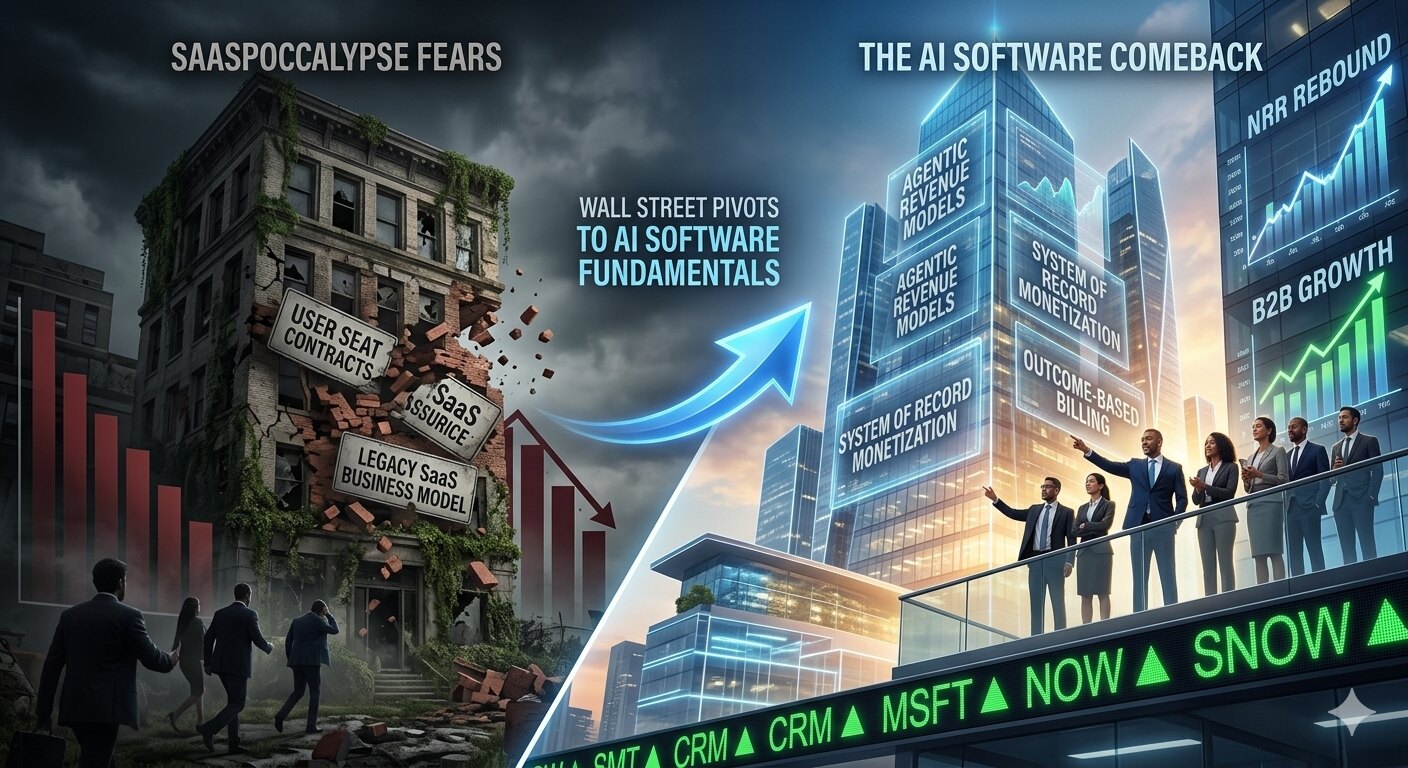
AI Software Comeback: Artificial intelligence has spent much of 2026 being treated as both the biggest opportunity and the biggest threat to the software industry. Earlier this year, investors feared that AI agents could make traditional software obsolete by allowing companies to build their own applications or perform tasks directly through AI.
That fear triggered what became known as the “SaaSpocalypse.” But the latest market action is telling a different story.
U.S. software stocks are recovering strongly as investors increasingly view AI as an enabler of software businesses rather than an existential threat. The shift could mark an important change in the way Wall Street values the next generation of AI companies.
Software Stocks Stage a Major Recovery
Software stocks have rebounded significantly after a difficult period earlier in the year. Investor confidence has improved as companies demonstrate that AI can strengthen existing products instead of simply replacing them.
Expectations for software-company earnings have also improved, reinforcing the argument that the sector could benefit from AI-driven productivity and new revenue opportunities.
Instead of assuming AI will immediately replace software vendors, investors are increasingly betting that established software companies can use AI to increase productivity, introduce new products and strengthen customer relationships.
What Happened to the “SaaSpocalypse”?
The original fear was straightforward.
If AI models became powerful enough to write software, companies might no longer need to purchase expensive software subscriptions. Businesses could theoretically describe what they wanted to an AI system and have customized applications created automatically.
That scenario created enormous uncertainty for traditional SaaS companies.
Software stocks subsequently experienced heavy selling pressure as investors questioned whether subscription-based business models could remain attractive in an AI-driven economy.
But the expected collapse has not happened at the speed investors initially anticipated.
Instead, companies have been integrating AI into their existing products.
This distinction is critical.
AI does not necessarily eliminate the software platform. In many cases, it makes the platform more valuable.
AI Is Becoming a Software Growth Engine
Companies such as Salesforce, ServiceNow, and Accenture demonstrate how established software businesses can adapt to the AI economy.
Rather than competing directly against AI models, these companies are increasingly incorporating AI capabilities into products that customers already use.
That gives established vendors several advantages:
- Large enterprise customer bases
- Proprietary business data
- Established workflows
- Security infrastructure
- Distribution networks
- Long-term customer relationships
An AI model may be powerful, but convincing a large corporation to replace an entire business system is considerably more difficult.
This is why enterprise software could remain relatively resilient even as AI agents become more capable.
Cybersecurity Could Be One of AI’s Biggest Winners
One of the clearest examples of AI creating demand for software rather than destroying it is cybersecurity.
As companies deploy more AI agents, autonomous systems and connected applications, the number of potential security vulnerabilities also increases.
That creates demand for tools capable of monitoring AI systems, detecting unusual behavior and protecting corporate data.
Cybersecurity companies could therefore benefit from the expansion of AI adoption.
The broader lesson for investors is important: every new technology creates new security problems.
AI may automate many business processes, but companies will still need software to control access, protect information, and manage risk.
AI Agents Are Still the Biggest Threat
The software recovery does not mean the danger has disappeared.
AI agents remain one of the biggest structural challenges facing traditional SaaS businesses.
Unlike conventional chatbots, AI agents can potentially perform tasks autonomously. They can search for information, interact with applications, make decisions, and execute workflows.
That could eventually reduce demand for simple software products.
This risk is particularly important for consumer and small-business software.
If an AI agent can manage calendars, bookkeeping, purchasing, customer support or marketing without requiring multiple standalone applications, some software subscriptions could become unnecessary.
For investors, this creates an important dividing line.
The Winners May Own the Workflow
Companies with deeply embedded enterprise systems, proprietary data and complex workflows may be harder to replace.
Companies selling relatively simple tools could face much greater pressure as AI agents become more capable.
Why Wall Street Is Becoming More Selective
The market is therefore not simply returning to the old software trade.
Investors are becoming more selective.
The question is no longer:
“Will AI destroy software?”
The more important question is:
“Which software companies will benefit from AI, and which ones will be bypassed by it?”
That distinction could drive stock performance through the remainder of 2026 and into 2027.
Software businesses capable of monetizing AI features could generate additional revenue while reducing operating costs.
At the same time, companies unable to differentiate their products may face pricing pressure as AI makes competing services cheaper and easier to build.
The 2027 Test Could Be Even Bigger
Despite the current optimism, investors should not assume the AI disruption debate is finished.
One major concern is what happens when significantly more AI computing capacity becomes available.
Greater data-center capacity could make AI-powered coding and software development increasingly efficient. If that happens, the cost of building customized applications could decline substantially.
That could intensify competition with traditional software products.
In other words, 2026 may represent the beginning of the AI-software adjustment rather than the end of it.
The next major test could arrive in 2027 as AI agents become more autonomous and businesses gain greater access to affordable AI infrastructure.
What This Means for Investors
For investors, the current software recovery presents both an opportunity and a warning.
The opportunity is that some software companies may have been oversold because the market initially exaggerated the speed of AI disruption.
The warning is that not every software company deserves the same valuation.
Investors should increasingly examine:
- How deeply AI is integrated into a company’s products
- Whether AI features generate additional revenue
- The strength of proprietary data
- Customer retention rates
- Exposure to enterprise versus smaller customers
- Pricing power
- Cybersecurity capabilities
- Dependence on traditional subscription models
The strongest businesses may ultimately be those that turn AI from a threat into a productivity and revenue engine.
The New AI Investment Battle
The AI investment story is entering a new phase.
Earlier in the boom, investors focused heavily on chips, data centers and computing infrastructure. That created enormous gains for semiconductor companies and infrastructure providers.
Now attention is shifting toward the companies that can monetize AI at the application and enterprise level.
That could give software stocks another opportunity to become leaders of the AI trade.
But the sector will likely remain divided between winners and losers.
The “SaaSpocalypse” may have been premature, but the underlying technological disruption is real.
For Wall Street, the lesson is becoming clearer: AI may not kill software. It may instead determine which software companies survive, grow and dominate the next decade.