Introduction
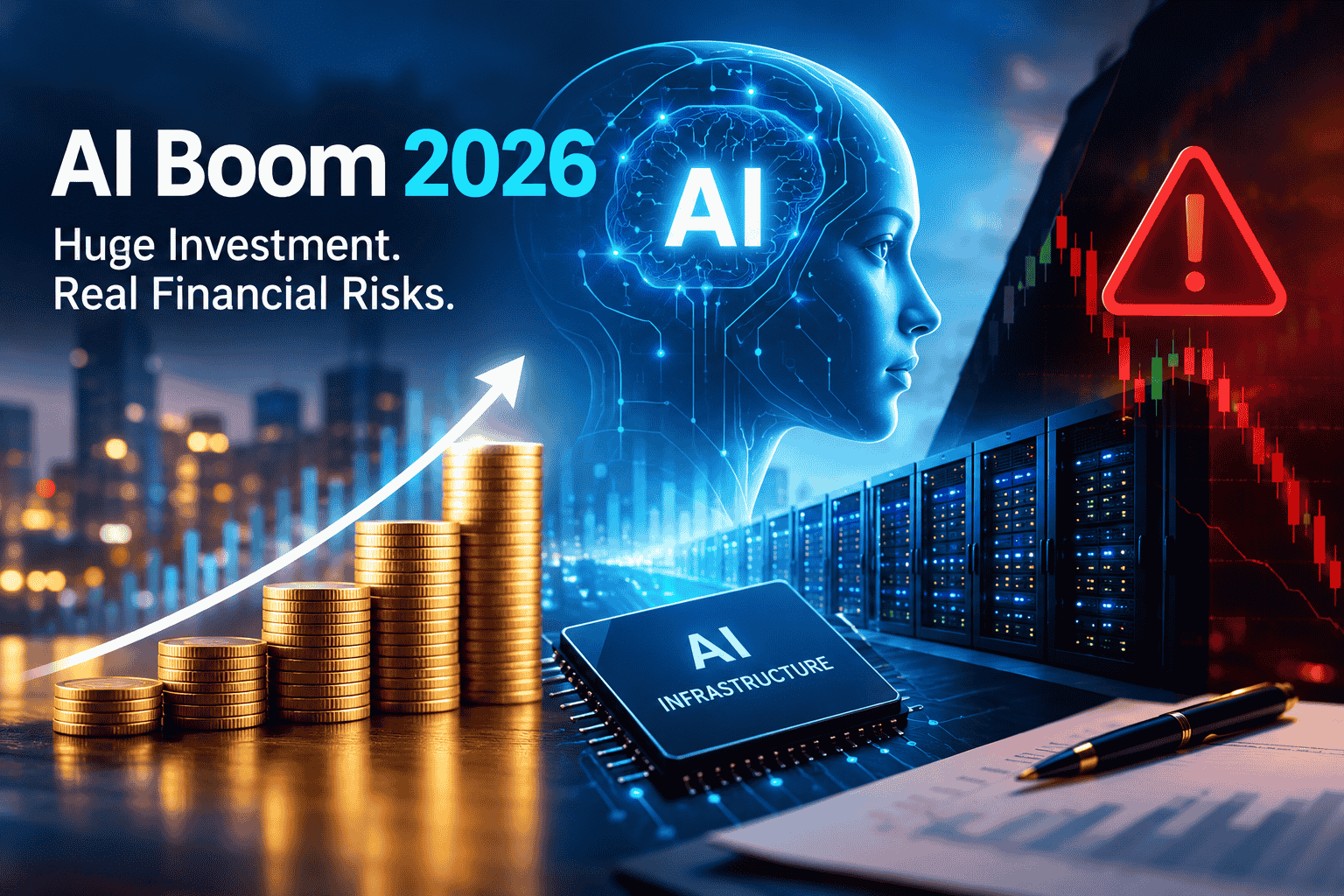
Artificial intelligence has become one of the biggest investment stories of 2026. Technology companies are spending enormous amounts on AI chips, data centers, cloud infrastructure and advanced computing systems as businesses race to capture the next wave of digital growth.
The scale is now attracting attention from financial policymakers. The Bank for International Settlements (BIS) has warned that the rapid AI investment boom could create new financial stability risks if companies fail to generate the profits investors currently expect.
The five largest global technology companies are expected to spend more than $1 trillion on AI-related capital expenditure across 2025 and 2026. At the same time, AI investment is increasingly being supported by debt and private financing.
This raises an important question: Could the AI boom become a financial risk if investment grows faster than actual AI revenues?
Why Companies Are Spending Trillions on AI
The AI race has expanded far beyond software.
Companies are investing heavily in:
- AI data centers
- Advanced AI chips
- Cloud computing
- Networking infrastructure
- Energy and power systems
- AI models and research
- Enterprise AI platforms
- Robotics and automation
The world’s largest technology companies are competing to build enough computing capacity to support increasingly powerful AI models.
For investors, this has created opportunities across the semiconductor, cloud computing, energy and infrastructure industries.
However, the enormous cost of building this infrastructure creates another challenge: companies need AI revenues to eventually justify these investments.
AI Investment Is Increasingly Debt-Financed
One of the biggest concerns surrounding the AI boom is how the expansion is being financed.
Major technology companies have strong cash flows, but AI infrastructure requires enormous amounts of capital. As spending increases, companies and infrastructure developers are increasingly turning toward debt and private credit.
This creates a different risk profile.
If AI demand continues growing rapidly, debt can help companies expand faster. But if AI revenues disappoint, highly leveraged businesses could face pressure from interest payments and declining asset values.
The risk becomes even greater when multiple companies across the AI supply chain depend on one another.
Could AI Become the Next Investment Bubble?
Comparisons between AI and previous technology investment booms are becoming more common.
History shows that major technological breakthroughs can attract enormous amounts of capital. Railways, electricity and the internet all transformed economies, but investment sometimes exceeded the profits that businesses could ultimately generate.
AI could face a similar challenge.
The technology itself may be transformative while individual investments still fail to produce adequate returns.
That distinction is important for investors. A successful technology does not automatically mean every company investing in it will be successful.
The $1 Trillion AI Spending Race
The scale of current AI spending is particularly significant.
The largest technology companies are competing to secure computing capacity before competitors do. This creates an investment race where companies may spend aggressively simply because they fear falling behind.
That can create a cycle:
More AI competition → more infrastructure spending → more financing → higher expectations → greater pressure to deliver returns.
If AI productivity and revenues grow quickly enough, the investment can be justified.
But if adoption slows, companies could find themselves with expensive infrastructure that generates lower-than-expected returns.
AI Data Centers Are Creating New Infrastructure Risks
Data centers are at the center of the AI investment boom.
Advanced AI models require huge amounts of computing power, which means companies need increasingly large data centers and reliable electricity supplies.
This is creating new opportunities for:
- Energy companies
- Semiconductor manufacturers
- Construction firms
- Utility providers
- Cloud companies
- Data-center operators
But it also introduces bottlenecks.
Power availability, grid capacity, construction delays and semiconductor supply can all slow AI expansion.
The result is that AI investment is no longer just a technology issue. It is becoming an infrastructure and economic issue.
What Happens If AI Profits Disappoint?
The biggest financial risk would emerge if AI investment continues rising while expected profits fail to materialize.
A significant slowdown could affect several parts of the market simultaneously.
Technology companies could reduce capital spending. Data-center developers could face lower demand. AI chip orders could weaken. Debt investors could reassess risk. Stock valuations could fall.
Because AI has become closely connected with major technology companies and global financial markets, a large correction could spread beyond the technology sector.
This does not mean an AI crash is inevitable. It means investors need to recognize that exceptionally high expectations create exceptionally high sensitivity to disappointing results.
AI Could Still Transform the Global Economy
Despite the financial risks, the long-term economic potential of AI remains enormous.
AI can improve productivity, automate repetitive tasks, accelerate research and help companies make faster decisions.
Businesses are already using AI for software development, customer service, marketing, financial analysis, logistics and research.
If productivity gains become widespread, AI could generate enough economic growth to justify a significant portion of today’s investment.
The challenge is timing.
Investors are spending money today based partly on expectations about economic benefits that may take years to fully appear.
What It Means for Investors
For investors, the AI boom requires a more selective approach.
Instead of simply investing in companies associated with AI, investors may increasingly focus on fundamentals such as:
- Revenue growth
- Free cash flow
- Debt levels
- AI-related margins
- Infrastructure costs
- Customer adoption
- Return on invested capital
Companies with strong AI products and sustainable cash flows may be better positioned than businesses relying primarily on investor enthusiasm.
The same principle applies to AI infrastructure.
Not every data center, chip company or AI startup will benefit equally from the long-term expansion of artificial intelligence.
AI and the Future of Financial Markets
AI is becoming large enough to influence financial markets and economic policy.
Its impact can be seen in technology valuations, corporate investment, semiconductor demand, energy consumption and global capital flows.
Central banks are also watching AI because it can simultaneously affect productivity, inflation, employment and investment.
That makes the technology different from a traditional business cycle.
If AI boosts productivity, it could increase economic growth. But if companies overinvest and later cut spending sharply, the same boom could contribute to a significant slowdown in investment.
Conclusion
The AI boom of 2026 represents one of the largest technology investment waves in modern history. More than $1 trillion in planned spending by major technology companies highlights the extraordinary confidence surrounding artificial intelligence.
But massive investment also creates financial risks.
The biggest question is no longer whether AI will change the economy. It is whether the economic returns from AI will grow quickly enough to justify the enormous amount of capital being committed today.
For businesses and investors, the next stage of the AI revolution may therefore be less about spending more and more about proving that those investments can generate sustainable returns.
AI could become one of the world’s most important productivity technologies—but the financial market will increasingly demand proof that the AI boom can turn investment into real profits.