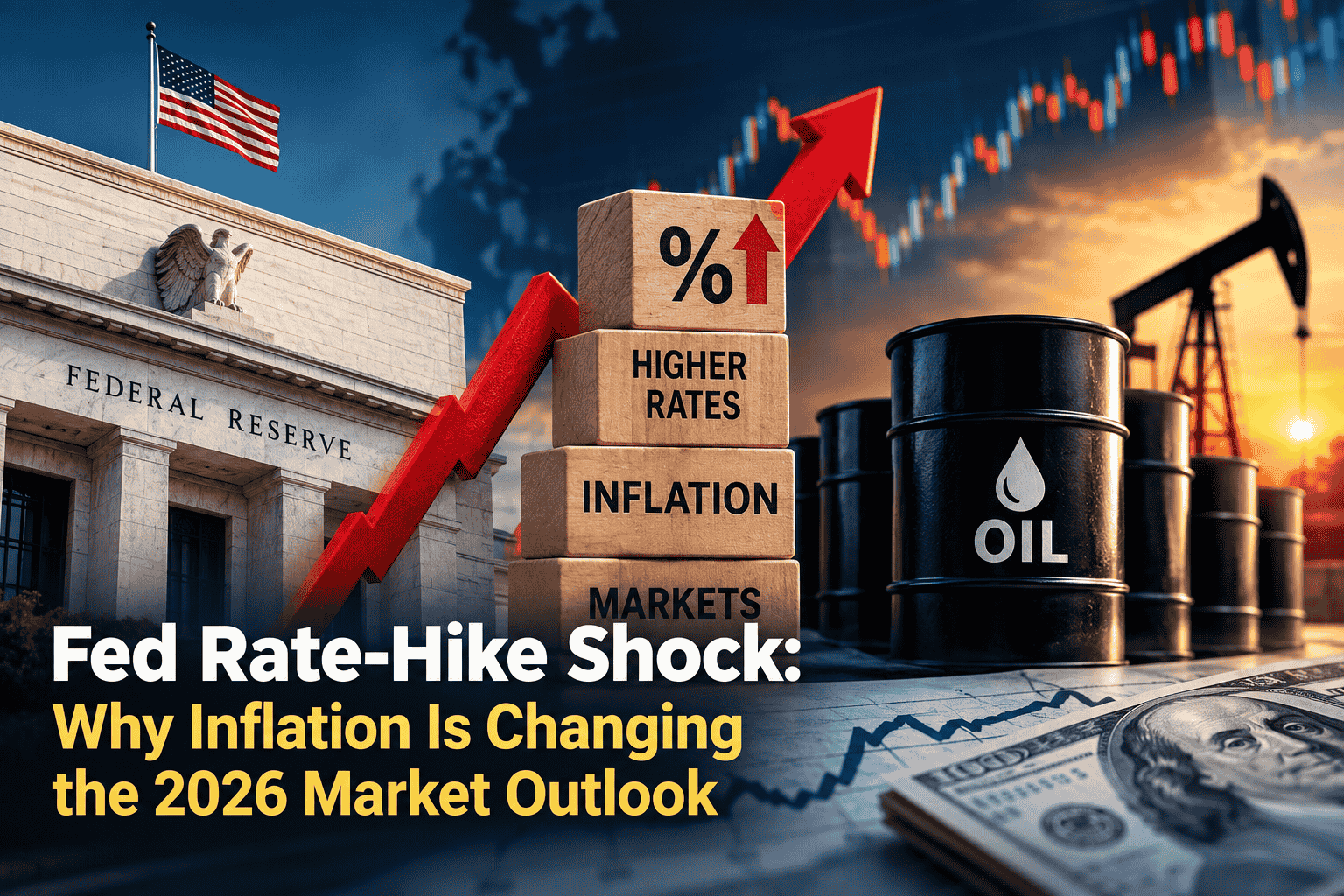
The Fed Faces a Very Different Economic Reality
There was a time earlier this year when financial markets were largely focused on when the Federal Reserve might cut interest rates.
That conversation has changed dramatically.
As the Federal Open Market Committee meets on September 15–16, 2026, investors are instead preparing for the possibility of another rate increase. Markets have been placing roughly a 90% probability on a 25-basis-point increase, according to futures-based measures reported ahead of the meeting.
What changed?
Inflation did not disappear as quickly as expected. Oil prices surged above $100 a barrel amid Middle East tensions. Treasury yields climbed sharply, with the 10-year yield moving around the psychologically important 5% level.
The result is a difficult economic environment in which the Fed must respond to inflationary pressure without unnecessarily damaging economic growth.
Inflation Has Become the Market’s Central Story Again
The latest inflation figures explain why expectations have shifted.
U.S. headline consumer inflation rose 0.4% in August, leaving annual inflation at 3.4%. Core inflation, which excludes food and energy, increased 0.3% during the month and remained above the Federal Reserve’s 2% target.
Those numbers matter because they suggest that the disinflation process has become less straightforward.
The problem becomes even more complicated when energy prices are included.
Oil has climbed sharply as geopolitical tensions threaten energy infrastructure and transportation routes. That creates a direct inflationary impulse that monetary policy cannot solve by itself.
The Fed can influence demand.
It cannot produce more oil.
The Oil Problem Makes This Rate Cycle Different
This is perhaps the most important feature of the current situation.
Higher interest rates can cool consumer spending, housing activity and business investment. But they cannot directly repair damaged energy infrastructure or eliminate geopolitical risk.
That means the Fed is potentially responding to an inflation problem that is partly being created outside the U.S. economy.
The latest oil surge has already pushed Treasury yields higher and strengthened expectations for tighter monetary policy.
If energy prices remain elevated, businesses could face higher transportation and production costs.
Those costs can eventually reach consumers.
That is where a temporary oil shock can become a broader inflation problem.
Why a 25-Basis-Point Move Matters
A quarter-point rate increase may appear small.
For financial markets, however, the significance would extend beyond the actual 0.25 percentage-point move.
It would represent the first increase in the Fed’s benchmark rate in more than three years, according to current reporting.
That would fundamentally change the market narrative.
For much of the recent period, investors have been debating the timing and scale of potential easing.
A renewed tightening cycle raises a different question:
How many additional increases could be necessary if inflation remains above target?
That uncertainty may be more important for markets than the September decision itself.
Treasury Yields Are Sending Their Own Warning
The bond market is already reacting.
The U.S. 10-year Treasury yield has moved above 5%, reaching levels not seen in many years. Rising oil prices and changing expectations for monetary policy have contributed to the increase.
This matters because Treasury yields influence the cost of capital throughout the economy.
When long-term government borrowing costs rise, financing becomes more expensive for companies, households and other borrowers.
Mortgage rates can respond.
Corporate borrowing costs can rise.
Government interest expenses can increase.
And stock-market valuations can face pressure because future earnings are discounted at higher rates.
In other words, the bond market can tighten financial conditions even before the full economic effect of a Fed decision becomes visible.
AI Investment Adds Another Layer
The 2026 economy also has a factor that previous inflation cycles did not have in quite the same form: enormous investment in artificial intelligence infrastructure.
AI companies and technology firms are spending heavily on data centers, semiconductors, electricity and computing capacity.
That spending supports economic activity.
But it can also contribute to demand for capital, construction, energy and technology equipment.
This creates an unusual combination.
The same AI boom that is supporting investment and productivity expectations is also becoming part of the broader discussion about economic demand and inflation.
Markets therefore have to consider two opposing possibilities at once: AI could increase productivity enough to support growth, while the enormous investment required to build AI infrastructure could keep demand elevated.
Wall Street Is Becoming More Sensitive to Rate Expectations
Equity investors have already started adjusting.
On September 15, U.S. stocks closed lower as rising oil prices and Treasury yields increased concerns about inflation and financing costs. Technology and semiconductor shares were among the areas facing pressure.
This does not necessarily mean the end of the broader technology investment cycle.
It does mean investors have to reconsider valuations.
A company expected to generate substantial profits many years from now is more sensitive to changes in interest rates than a company generating significant cash flow today.
That is why higher yields can affect growth stocks even when their underlying businesses remain strong.
The Dollar Could Become Another Market Variable
Higher U.S. interest rates can also affect currency markets.
The dollar strengthened as oil prices pushed yields higher and expectations for tighter Fed policy increased.
A stronger dollar can make imported goods and commodities relatively cheaper for U.S. consumers.
But it can create difficulties elsewhere.
Emerging-market economies with substantial dollar-denominated debt may face greater financial pressure when the U.S. currency strengthens.
Imported energy can also become more expensive in local-currency terms for countries whose currencies weaken against the dollar.
This means the Fed’s decisions can have consequences far beyond the United States.
The Biggest Question Is What Happens After September
The September meeting is only the beginning of the new market debate.
If the Fed raises rates, investors will immediately turn their attention toward future policy.
Will inflation continue falling?
Will oil prices remain above $100?
Will wage pressures accelerate?
Will AI investment continue at its current pace?
Will economic growth weaken?
The answers to those questions will determine whether September represents an isolated policy adjustment or the beginning of a broader tightening phase.
Recent analyst expectations have already become more hawkish. Morgan Stanley, for example, has projected another Fed increase later in 2026 in addition to the September move, although such forecasts remain subject to changing economic data and policy decisions.
What Could Go Right for Markets?
The current environment is not necessarily one-directional.
If Middle East tensions ease and oil prices decline, some inflation pressure could disappear relatively quickly.
If supply-chain conditions improve and core inflation continues moderating, the Fed may have less reason to maintain aggressive tightening.
Meanwhile, continued AI investment could support productivity and corporate earnings.
That combination could eventually give markets a more favorable balance between growth and inflation.
But that outcome depends heavily on developments that are difficult to predict.
What Could Keep Markets Under Pressure?
The opposite scenario would involve sustained energy prices, persistent core inflation and further increases in long-term Treasury yields.
That combination could create pressure across several parts of the economy simultaneously.
Consumers would face higher costs.
Companies would face more expensive financing.
Governments would face larger debt-servicing burdens.
Investors would have to reassess valuations.
And central banks could find themselves maintaining restrictive policies for longer.
That is the scenario financial markets are now trying to price.
The 2026 Market Outlook Is Being Rewritten
The biggest change in the 2026 market outlook is not simply the possibility of a Fed rate hike.
It is the return of inflation uncertainty.
Investors had increasingly expected monetary policy to become less restrictive. Now, rising energy prices and stubborn inflation have forced markets to reconsider that assumption.
The result is a financial environment in which oil, Treasury yields, inflation data and Federal Reserve communication are becoming tightly connected.
One market move can quickly influence the others.
Conclusion: The Fed’s Next Move Is Only Part of the Story
The September 2026 Federal Reserve meeting arrives at a critical point for the U.S. economy.
Inflation remains above the central bank’s 2% objective, oil prices have surged, Treasury yields have climbed and financial markets are reassessing the possibility of additional monetary tightening.
But the most important issue is what happens after the meeting.
A single rate increase will not determine the direction of the economy.
The path of inflation, energy prices, consumer demand, AI investment and long-term bond yields will ultimately shape the market environment.
For investors, 2026 is therefore becoming less about predicting one Fed decision and more about understanding how inflation, energy, interest rates and economic growth interact.
The era of assuming that rates will simply move lower may be giving way to a more complicated market reality—one in which every inflation report and every move in the oil market can change the outlook.
About the Author
Anam Younas
Editor of Daily Press Release
I write about technology, AI, business, finance, and global news, bringing readers clear insights into the latest trends and developments.
For more informative content Follow the Daily Press Release channel on WhatsApp: https://whatsapp.com/channel/0029Vb8gRyoIHphMqA6T2w0U