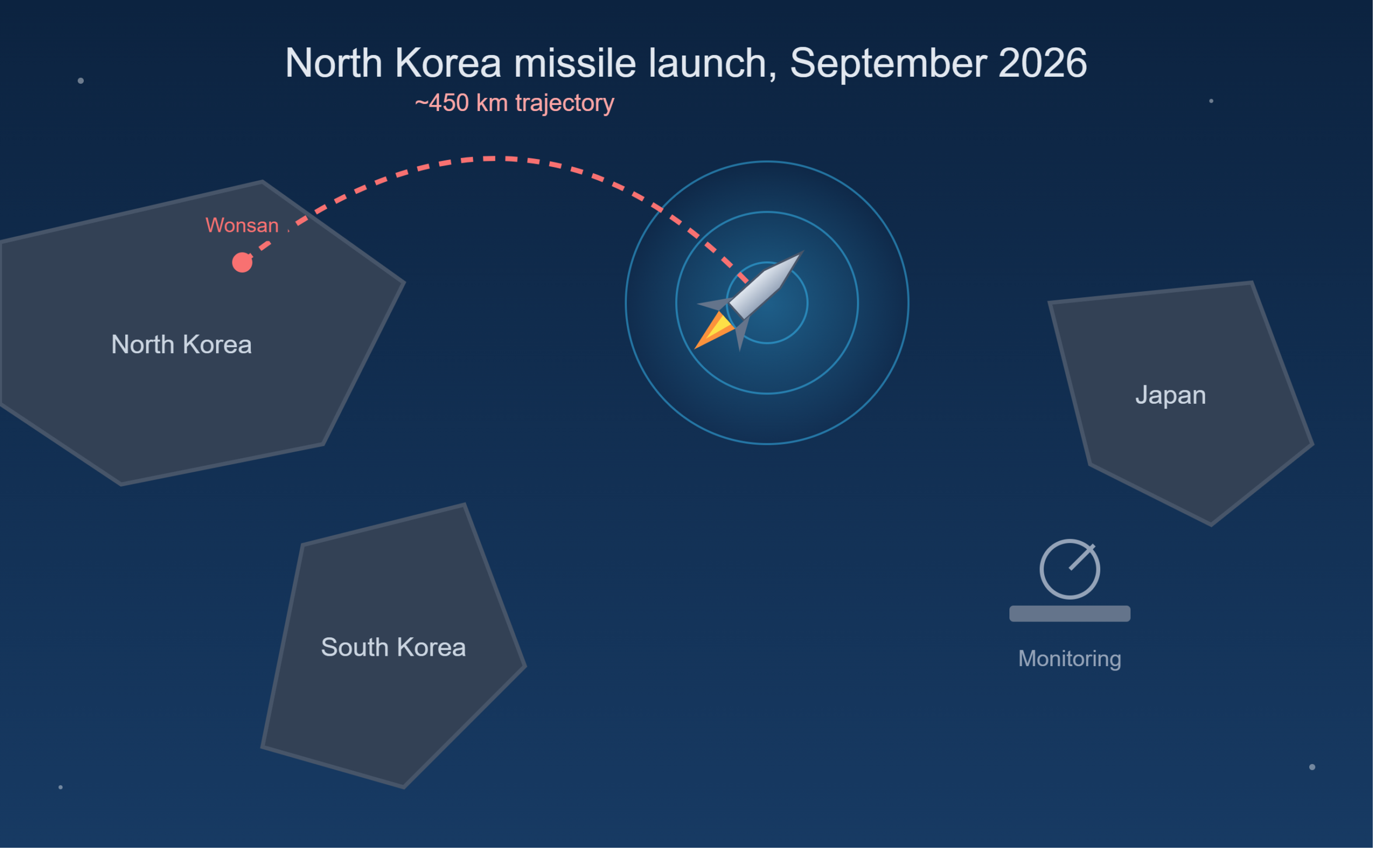
SEOUL — North Korea launched a short-range ballistic missile toward the sea on Sunday, September 20, 2026, prompting South Korea’s presidential office to convene an emergency security meeting and issue a sharp warning that the launch violated United Nations Security Council resolutions.
The launch marks the latest in a growing string of weapons tests by Pyongyang this year, and it lands at a particularly sensitive moment — just days ahead of the U.N. General Assembly and a planned U.S.-China summit, raising fresh questions about North Korea’s timing and intent.
What Happened on Sunday
Missile Detected From the Wonsan Area
According to South Korea’s Joint Chiefs of Staff (JCS), the military detected the ballistic missile launch at approximately 3:00 p.m. local time, originating from the Wonsan area on North Korea’s east coast. The missile flew roughly 450 kilometers (280 miles) before landing in the North’s eastern waters, commonly referred to as the East Sea.
South Korean officials said an additional projectile was also launched off North Korea’s east coast later the same day, though military authorities have not yet released further details about its type, range, or trajectory. Officials noted they were still analyzing the missile’s precise specifications.
Japan Also Detected the Launch
Japan’s Defense Ministry confirmed it had also picked up what appeared to be a North Korean ballistic missile. According to Japanese media, including Kyodo News, the projectile appeared to fall outside Japan’s exclusive economic zone, and no damage or casualties were reported on the Japanese side.
South Korea’s Response: “A Grave Act”
Presidential Office Condemns the Launch
South Korea’s presidential office responded swiftly and firmly, stating that “North Korea’s ballistic missile launch is a grave act that violates U.N. Security Council resolutions,” and urging Pyongyang to “immediately cease such actions.” The statement reflects Seoul’s long-standing position that North Korea’s ballistic missile program — regardless of range or missile type — breaches international law under multiple Security Council resolutions dating back nearly two decades.
Emergency Security Meeting Convened
In the immediate aftermath of the launch, South Korea’s National Security Office held an emergency meeting alongside the Defense Ministry and the Joint Chiefs of Staff. During the meeting, officials reviewed South Korea’s response options, assessed the potential impact on national security, and examined what further measures might be necessary going forward.
Heightened Military Surveillance
South Korea’s military said it has since boosted its surveillance posture and increased readiness in anticipation of possible additional launches. Seoul also confirmed it is closely coordinating and sharing real-time information with both the United States and Japan — a trilateral information-sharing arrangement that has become a standard response protocol following North Korean missile activity in recent years.
Why Now? The Broader Context Behind the Launch
A Pattern of Escalating Weapons Tests
Sunday’s launch did not occur in isolation. It came just eight days after North Korea’s previous ballistic missile test and about a week after the North fired multiple short-range ballistic missiles from the same Wonsan region toward the East Sea. In that earlier launch, the missiles were assessed to be Hwasong-11 series short-range ballistic missiles, fired alongside rounds from 600-millimeter super-large multiple rocket launchers — some of North Korea’s most advanced conventional weapons systems.
Taken together, the pattern suggests Pyongyang is engaged in a deliberate and sustained run of weapons demonstrations, rather than a single isolated test.
A Direct Response to U.S.-South Korea Military Drills
North Korea’s state media and senior officials have framed these launches as retaliation for continued U.S.-led military exercises in the region. Just two days before Sunday’s launch, North Korea threatened to bolster its nuclear deterrent capabilities and respond to what it described as ongoing “U.S. hostilities.”
Notably, this escalation has continued even after U.S. President Donald Trump scaled back a joint military exercise with South Korea last month, in what was widely seen as an attempt to revive diplomatic engagement with North Korean leader Kim Jong Un. That overture, however, appears to have done little to ease tensions.
Kim Yo Jong Dismisses Trump’s Gesture
Kim Jong Un’s sister and senior North Korean official, Kim Yo Jong, publicly rejected the significance of the scaled-back drill. She stated that shortening the exercise “wouldn’t change its provocative, aggressive nature” — a comment that signaled Pyongyang had no intention of easing its own military posture in response. Shortly afterward, North Korea’s military followed through on its earlier threat, launching around 10 short-range ballistic missiles toward the sea in a separate demonstration.
Timing Ahead of Major Diplomatic Events
Analysts have also pointed to the timing of Sunday’s launch, which comes just ahead of the United Nations General Assembly and a planned summit between the United States and China. Some observers suggest North Korea may be using these launches to draw international attention, reinforce its negotiating position, or signal displeasure ahead of high-level diplomatic discussions involving its key allies and rivals.
Understanding the Legal and Security Stakes
Why These Launches Are Considered Illegal Under International Law
North Korea has been barred from testing ballistic missile technology under a series of United Nations Security Council resolutions passed in response to its nuclear weapons program. These resolutions apply broadly to ballistic missile launches regardless of range, meaning even short-range tests — which some analysts consider less strategically significant than intercontinental ballistic missile (ICBM) tests — are still formal violations under international law.
This is why South Korea’s presidential office specifically invoked U.N. Security Council resolutions in its statement, rather than simply criticizing the launch on security grounds alone. It reinforces Seoul’s broader diplomatic argument that North Korea’s actions carry consequences beyond the Korean Peninsula.
What Short-Range Ballistic Missiles Signal Strategically
While short-range ballistic missiles don’t carry the same global alarm as ICBM tests, they remain significant for regional security. These systems are capable of striking targets throughout South Korea and parts of Japan, and repeated testing allows North Korea to refine accuracy, reliability, and launch procedures — capabilities that translate directly into its broader military deterrence strategy.
What Happens Next
South Korean officials have indicated they will continue monitoring for additional launches and remain in close coordination with the United States and Japan. No specific new sanctions or retaliatory measures were announced following Sunday’s emergency security meeting, suggesting Seoul’s immediate response remains centered on diplomatic condemnation, heightened surveillance, and trilateral coordination rather than immediate escalation.
Whether this latest test proves to be part of a short-term pattern or the start of a more prolonged period of North Korean weapons demonstrations will likely depend on how diplomatic efforts — including any renewed engagement between Washington and Pyongyang — unfold in the weeks ahead, particularly around the upcoming U.N. General Assembly session.
Key Facts at a Glance
- Date of launch: Sunday, September 20, 2026
- Location detected: Wonsan area, North Korea’s east coast
- Missile range: Approximately 450 km (280 miles)
- Landing zone: North Korea’s eastern waters (East Sea)
- Additional activity: A second unspecified projectile launched later the same day
- South Korea’s response: Emergency National Security Council meeting; formal condemnation citing U.N. Security Council violations
- International coordination: Real-time information sharing between South Korea, the United States, and Japan
- Broader context: Comes amid a string of North Korean missile tests following scaled-back U.S.-South Korea military drills
About the Author
Anam Younas
Editor of Daily Press Release
I write about technology, AI, business, finance, and global news, bringing readers clear insights into the latest trends and developments.
For more informative content Follow the Daily Press Release channel on WhatsApp: https://whatsapp.com/channel/0029Vb8gRyoIHphMqA6T2w0U