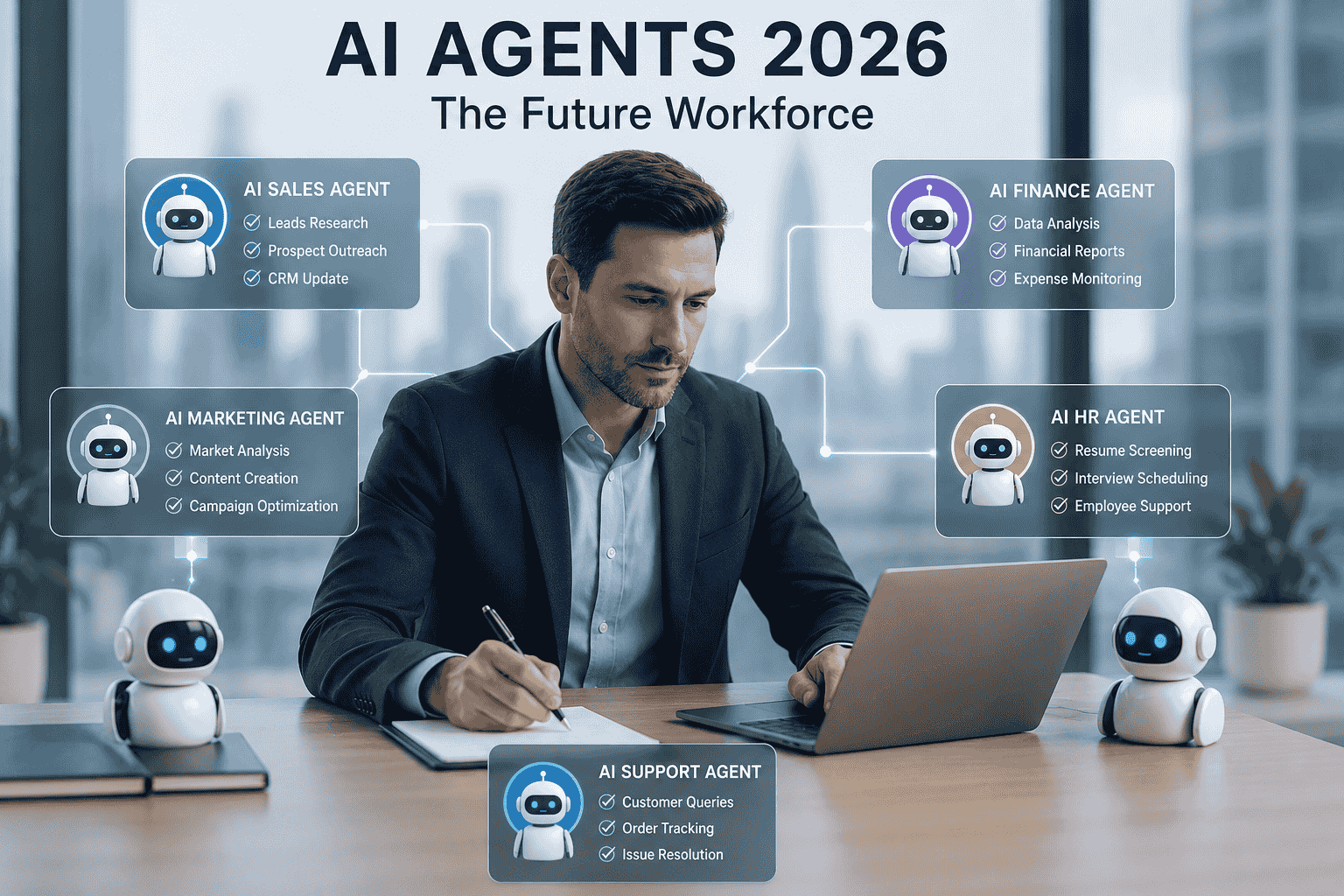
AI agents: Artificial intelligence is entering a new phase in 2026. Businesses are moving beyond chatbots that answer questions and toward AI agents that can plan tasks, use software, analyze information, and take actions with limited human intervention.
This shift is giving rise to a new business concept: the AI Agent employee.
Unlike traditional generative AI tools, AI agents are designed to complete multi-step workflows. They can research markets, prepare reports, manage customer inquiries, write software, analyze financial information, and coordinate tasks across different business systems.
For business leaders and financiers, the question is no longer whether companies will use AI. The bigger question is how much work companies will eventually delegate to AI agents—and what that means for costs, productivity, employment and corporate valuations.
What Are AI Agents?
AI agents are software systems capable of pursuing a defined objective rather than simply responding to individual prompts.
A traditional chatbot might answer a customer’s question. An AI could receive the same customer’s request, check an account, identify the problem, access company systems, process an eligible refund, and send a confirmation.
AI agents can potentially connect large language models with company databases, enterprise software, web services, and specialized tools. This allows them to operate as digital workers within carefully defined boundaries.
Why AI Agents Are Becoming a Major Business Trend in 2026
The rapid development of AI models has made autonomous workflows increasingly practical.
Companies are now experimenting with agents across departments including:
- Customer service
- Sales
- Marketing
- Finance
- Human resources
- Software development
- Cybersecurity
- Procurement
- Research
- Operations
The biggest change is the movement from AI assistance to AI delegation.
Instead of asking an AI system to help complete a task, employees can increasingly assign an entire workflow to an agent and review the result.
This could fundamentally change how companies organize knowledge work.
AI Employees vs. Human Employees
Calling AI agents “employees” does not mean they are literally equivalent to people. AI systems do not possess the legal status, judgment, relationships or accountability of human workers.
The term is useful because AI agents can increasingly perform specific functions traditionally assigned to employees.
For example, a company could deploy separate agents for:
AI Sales Agent
A sales agent could identify potential customers, research companies, prepare personalized outreach and update customer relationship management systems.
AI Finance Agent
A finance agent could organize financial data, monitor expenses, prepare preliminary reports and identify unusual transactions for human review.
AI Customer-Service Agent
A customer-service agent could handle routine questions, check order information and resolve straightforward problems without requiring a human representative.
AI Software Agent
A software-development agent can help write code, test applications, identify bugs and manage portions of development workflows.
The result is not necessarily a company without employees. Instead, it could be a company where one employee manages several AI systems simultaneously.
The Financial Case for AI Agents
For investors and business executives, the biggest attraction is economics.
Labor represents one of the largest expenses for many companies. If AI agents can automate repetitive knowledge work, businesses could potentially increase output without increasing headcount at the same rate.
This could improve several financial metrics:
Lower operating costs: Automation may reduce the amount of manual work required for repetitive processes.
Higher productivity: Employees can concentrate on strategy, relationships and complex decisions.
Faster operations: AI agents can work continuously and execute tasks much faster than conventional workflows.
Scalability: A digital agent can potentially handle additional workloads without requiring proportional increases in staffing.
Improved margins: If productivity gains exceed AI infrastructure and software costs, companies could see stronger operating margins.
However, investors should avoid assuming that every AI deployment automatically produces financial gains.
The Hidden Cost of AI Employees
AI agents are not free labor.
Companies must pay for AI models, computing infrastructure, software platforms, data management, security and integration.
More importantly, autonomous systems require supervision.
A human employee may make an occasional mistake, but an AI agent operating at machine speed can potentially make thousands of incorrect decisions much faster.
This creates a new category of corporate costs involving monitoring, auditing, cybersecurity and governance.
The real financial calculation is therefore:
AI productivity gains − AI infrastructure costs − supervision costs − risk costs = actual business value.
Companies that fail to measure this equation could spend heavily on AI without achieving meaningful returns.
AI Agents Could Reshape Corporate Jobs
The growth of AI agents will likely change jobs rather than simply eliminate every position.
Some repetitive administrative responsibilities may decline, while demand increases for employees who can manage AI systems.
New roles are already emerging around AI implementation, agent orchestration, AI security, data governance and human-AI workflow design.
The traditional employee may increasingly become an AI manager.
Instead of personally completing every task, a worker could define objectives, assign work to several AI agents, review their results and make important decisions.
This could dramatically increase individual productivity.
The Rise of the AI-Native Company
One of the most important business trends emerging in 2026 is the concept of the AI-native company.
Traditional companies add AI to existing processes.
AI-native companies design their processes around AI from the beginning.
Imagine a startup with a small human team supported by dozens of specialized AI agents. One group of agents handles customer support, another performs market research, another manages internal reporting and another assists software development.
Such a company could potentially operate with a much smaller workforce than a traditional business of comparable size.
This model could increase competition because smaller companies may be able to achieve capabilities that previously required large departments.
AI Agents and Business Valuations
The AI-agent revolution could also affect how investors value companies.
Investors may increasingly ask:
- How much work is being automated?
- What is the company’s AI infrastructure cost?
- How much revenue does each employee generate?
- Is AI improving operating margins?
- How dependent is the company on external AI providers?
- Does the business own valuable proprietary data?
- Can its AI systems scale efficiently?
Companies demonstrating measurable productivity improvements could receive stronger investor interest.
At the same time, businesses that announce massive AI spending without demonstrating returns could face greater scrutiny.
The Biggest Risk: Autonomous AI Mistakes
The greatest challenge may not be technological capability but control.
AI agents can misunderstand objectives, access inappropriate information, make incorrect decisions or optimize for the wrong outcome.
This becomes especially dangerous when agents have access to financial accounts, customer information, production systems or sensitive corporate data.
Businesses therefore need clear permissions, audit trails, human approval for high-risk actions and strong cybersecurity controls.
The principle should be simple:
The greater the potential damage, the greater the level of human oversight.
AI Agents and the Future of Finance
The financial sector could become one of the biggest users of AI agents.
Banks, investment firms, insurers and accounting companies handle enormous volumes of repetitive information.
AI agents could assist with financial research, document analysis, compliance monitoring, customer service, fraud detection and internal reporting.
However, financial institutions face strict regulatory and risk-management requirements. Human accountability will remain essential when decisions involve lending, investments, compliance or customers’ money.
For financiers, the opportunity is therefore significant—but so is the importance of governance.
Are AI Employees Really the Future?
The answer is likely yes, but not in the way many people imagine.
The future business model is unlikely to involve humans completely disappearing from the workplace.
Instead, businesses may develop hybrid workforces where humans handle leadership, creativity, relationships, judgment and accountability while AI agents handle large amounts of execution.
The competitive advantage could shift from simply having the largest workforce to having the most productive combination of people, AI agents, and technology infrastructure.
What Business Leaders Should Do Now
Companies preparing for the AI-agent economy should begin with practical use cases rather than attempting to automate everything at once.
Businesses should identify repetitive workflows, measure their current costs and test whether AI can perform them reliably.
They should also establish clear rules governing what an AI agent can and cannot do.
The most successful organizations will likely treat AI agents as part of their operating infrastructure rather than as experimental software.
Conclusion
AI agents are becoming one of the most important business trends of 2026.
Their ability to perform multi-step tasks, interact with software and operate with increasing autonomy could transform corporate productivity.
For businessmen, the opportunity lies in reducing repetitive work, increasing employee productivity and creating more scalable operations.
For financiers, the critical issue is whether AI investment translates into measurable revenue growth, stronger margins and sustainable competitive advantages.
AI agents may not completely replace human employees. Instead, they could create a new type of workforce in which one human worker manages and collaborates with multiple digital agents.
The companies that learn how to combine human judgment with machine execution could have a major advantage in the next stage of the global business economy.
Frequently Asked Questions
1. What are AI agents?
AI agents are AI-powered software systems that can pursue goals, plan multiple steps, use digital tools, and perform tasks with limited human intervention.
2. Are AI agents replacing employees in 2026?
AI agents are beginning to automate portions of many jobs, particularly repetitive digital tasks. However, most businesses still require humans for judgment, oversight, creativity and accountability.
3. What is an AI employee?
An AI employee is a general business term for an AI agent that performs specific functions traditionally handled by human workers, such as customer service, research, administration or software development.
4. How can AI agents benefit businesses?
AI agents can potentially reduce repetitive work, increase productivity, accelerate workflows, provide continuous operation and allow businesses to scale certain processes more efficiently.
5. Are AI agents profitable for companies?
They can be, but profitability depends on implementation costs, reliability, infrastructure expenses, and the value created through automation. Simply deploying AI does not guarantee higher profits.
6. Which industries will use AI agents the most?
Finance, technology, retail, healthcare administration, customer service, insurance, logistics, marketing and professional services are among the sectors with significant opportunities for agentic AI.
7. What are the biggest risks of AI agents?
Major risks include incorrect decisions, cybersecurity threats, unauthorized access, privacy problems, regulatory issues and insufficient human oversight.
8. Will AI agents create new jobs?
Yes. As companies adopt AI agents, demand may grow for AI engineers, AI workflow managers, cybersecurity specialists, data experts, and professionals responsible for AI governance and oversight.
9. Why are investors interested in AI agents?
AI agents could significantly affect productivity, operating expenses, margins and scalability. Investors are increasingly interested in whether companies can turn AI spending into measurable financial returns.
10. Are AI agents the future of business?
AI agents are likely to become an important part of the future business workforce. The most realistic model is a hybrid workforce in which humans provide leadership and judgment while AI agents perform increasingly sophisticated digital tasks.