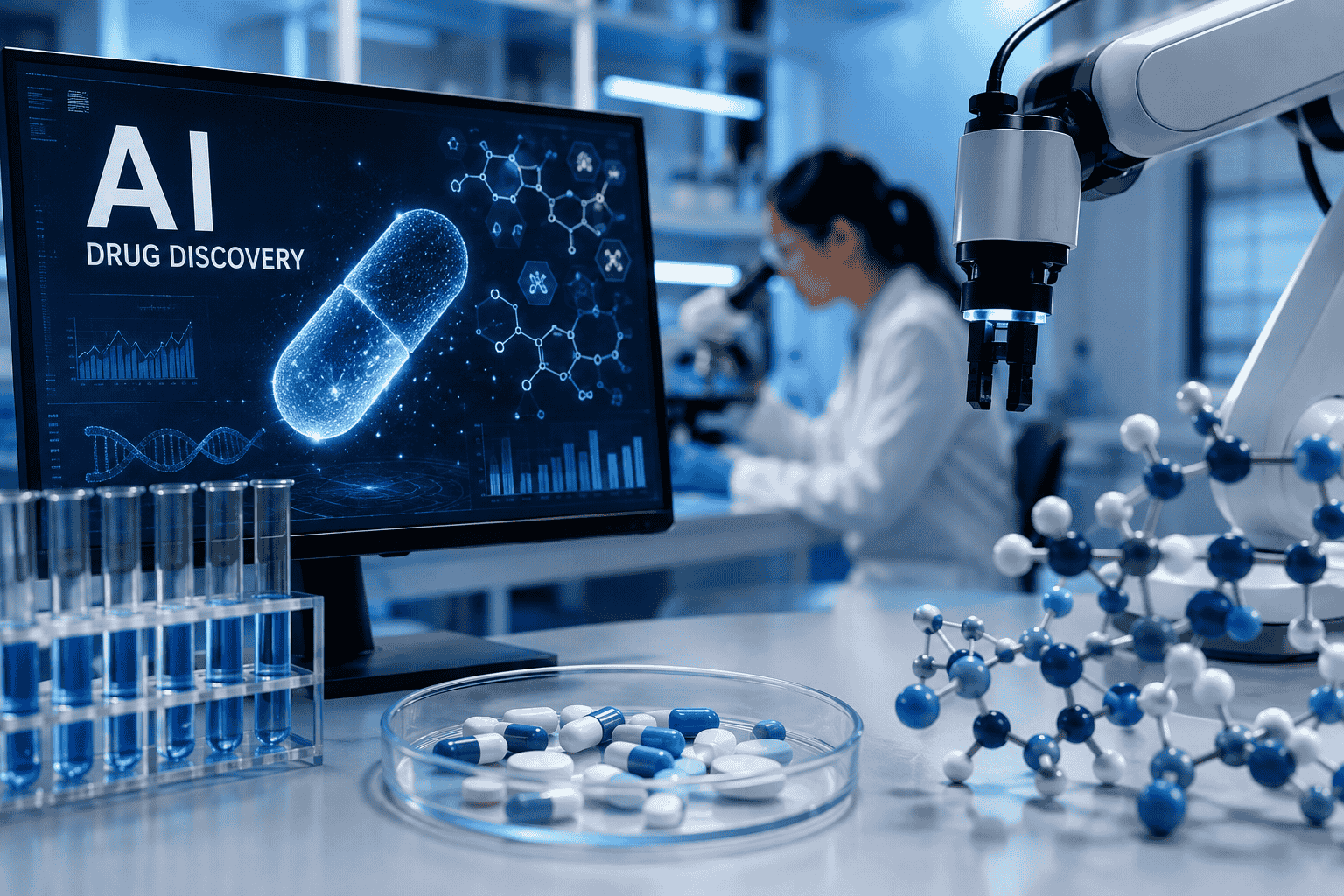
The pharmaceutical industry is entering a new era as artificial intelligence (AI) transforms drug discovery and development. For decades, creating a new medicine has required years of laboratory research, extensive testing and billions of dollars in investment. AI is now helping researchers analyze enormous amounts of biological and chemical data, identify promising drug candidates and make research decisions faster.
In 2026, AI drug discovery is no longer just a futuristic concept. Pharmaceutical companies, biotechnology firms, and technology companies are increasingly combining artificial intelligence with advanced laboratories, biological databases, and automation to improve the way new medicines are developed.
What Is AI Drug Discovery?
AI drug discovery refers to the use of artificial intelligence, machine learning, deep learning and generative AI to identify and develop potential medicines.
Traditional drug discovery often involves researchers testing thousands or even millions of chemical compounds to determine which ones might work against a particular disease. AI can analyze huge datasets and identify patterns that may be difficult for humans to detect.
AI systems can help researchers answer questions such as:
- Which biological target should a drug focus on?
- Which molecules could interact with that target?
- How effective might a potential drug be?
- Could a molecule cause toxic effects?
- Which patients may respond best to a treatment?
- How can clinical trials be designed more efficiently?
Instead of replacing scientists, AI is increasingly becoming a powerful research assistant.
How Artificial Intelligence Is Speeding Up Drug Discovery
One of the biggest advantages of AI is its ability to process massive quantities of information.
Drug researchers work with data from molecular structures, proteins, genetics, medical records, scientific publications and laboratory experiments. AI models can combine these different types of information to identify relationships and generate new hypotheses.
1. Finding New Drug Targets
Before developing a medicine, scientists need to identify a biological target associated with a disease.
AI can analyze genomic, protein and clinical information to discover potential targets that may contribute to diseases such as cancer, neurological disorders and autoimmune conditions.
This can help researchers move beyond familiar biological pathways and explore previously overlooked opportunities.
2. Designing New Molecules
Generative AI is becoming particularly important in pharmaceutical research.
Instead of simply searching through existing compounds, generative models can propose entirely new molecular structures based on specific requirements.
Researchers can instruct an AI system to search for molecules with desirable characteristics, such as strong target activity, appropriate stability and potentially lower toxicity.
The result is a much broader exploration of chemical possibilities than traditional trial-and-error approaches can provide.
3. Predicting Drug Safety
A promising molecule can still fail if it produces harmful side effects.
AI can analyze chemical and biological data to predict characteristics such as toxicity, metabolism and potential interactions with other substances.
Identifying possible safety problems earlier could prevent researchers from spending years and millions of dollars developing a compound that ultimately fails.
However, AI predictions still need to be confirmed through laboratory studies and clinical testing.
AI Is Changing Clinical Trials
The impact of AI extends beyond the laboratory.
Clinical trials are among the most expensive and complicated stages of pharmaceutical development. Finding suitable participants, designing trial protocols and analyzing results can take considerable time.
AI can help researchers identify potential participants based on medical and biological characteristics. It can also analyze historical clinical data to help researchers design more efficient trials.
Another important development is the use of AI to identify biomarkers. These biological indicators can help researchers determine which patients are more likely to respond to a particular treatment.
This supports the growth of precision medicine, where treatments are increasingly designed around the characteristics of individual patients.
Big Pharma Is Increasing Its AI Investment
Major pharmaceutical companies are rapidly expanding their use of artificial intelligence.
Companies are forming partnerships with AI startups, cloud computing providers and specialized biotechnology companies. These collaborations combine pharmaceutical expertise and clinical data with advanced computing and machine-learning technology.
In 2026, AI will be applied across areas including oncology, immunology, rare diseases, neurological disorders and metabolic diseases.
The growing number of partnerships demonstrates that pharmaceutical companies increasingly view AI as a strategic technology rather than simply an experimental research tool.
AI and Automated Laboratories
One of the most exciting developments is the combination of AI with laboratory automation.
An AI system can propose an experiment, while robotic laboratory equipment performs the experiment and generates new data. That information can then be fed back into the AI system for the next round of analysis.
This creates a potentially powerful design-build-test-learn cycle.
Instead of researchers manually performing every step, automated laboratories can conduct repetitive experiments at much greater speed. AI can then help determine which experiments should be performed next.
This combination of AI and robotics could significantly change pharmaceutical research over the next decade.
The Role of AI in Personalized Medicine
Healthcare is increasingly moving toward treatments tailored to individual patients.
AI can analyze information from genetics, medical histories, imaging and other biological sources to identify patterns associated with treatment response.
For example, two patients with the same disease may respond differently to the same medicine. AI could help researchers understand the biological differences behind those outcomes.
This could eventually lead to more personalized treatment strategies and reduce the use of ineffective medicines.
Challenges Facing AI Drug Discovery
Despite its enormous potential, AI is not a magic solution for pharmaceutical research.
One of the biggest challenges is data quality. AI models require large quantities of reliable information. Poor-quality, incomplete or biased data can produce unreliable predictions.
Another challenge is biological complexity. Human biology is extremely complicated, and a successful prediction in a computer model does not guarantee success in a human patient.
Regulation is another major issue. Pharmaceutical companies must demonstrate that AI-assisted discoveries meet strict standards for safety, effectiveness and quality.
There is also a growing need for scientists who understand both biology and artificial intelligence. The pharmaceutical industry will require teams capable of interpreting AI results and determining whether those predictions make scientific and medical sense.
Can AI Reduce the Cost of Developing Medicines?
The pharmaceutical industry spends enormous amounts of money developing new medicines, partly because many potential drugs fail during research and clinical development.
AI could reduce some of these costs by helping companies identify weak candidates earlier and prioritize the most promising ones.
However, it is important not to assume that AI will automatically make every new medicine cheaper. Clinical trials, manufacturing, regulatory approval and large-scale testing remain expensive.
The more realistic opportunity is that AI can improve decision-making and reduce wasted effort throughout the development process.
The Future of AI Drug Discovery
The next phase of AI drug discovery could involve increasingly autonomous research systems.
Future platforms may combine generative AI, advanced protein modeling, robotics, high-performance computing and real-world clinical data into a connected discovery pipeline.
Scientists could use these systems to investigate diseases, design molecules, simulate their properties, conduct automated experiments and refine candidates much faster than traditional workflows allow.
At the same time, human expertise will remain essential. AI can identify patterns and generate possibilities, but scientists must determine whether those discoveries are biologically meaningful and medically useful.
Conclusion
AI drug discovery is changing the pharmaceutical industry by bringing artificial intelligence into some of the most important stages of medicine development. From discovering biological targets and designing molecules to predicting safety and improving clinical trials, AI is helping researchers work with information at a scale that was previously difficult to manage.
The technology will not eliminate the complexity or uncertainty of drug development. But as AI becomes more powerful and increasingly connected with automated laboratories and advanced biological data, it could make pharmaceutical research faster, smarter and more precise.
The biggest opportunity may not be AI replacing scientists. Instead, the future of medicine could depend on scientists and intelligent machines working together to discover treatments that were previously too difficult, expensive or time-consuming to find.
For more information, read our latest analysis on the COVID-19 U.S. Wave 2026 and what the renewed summer surge could mean for Americans.