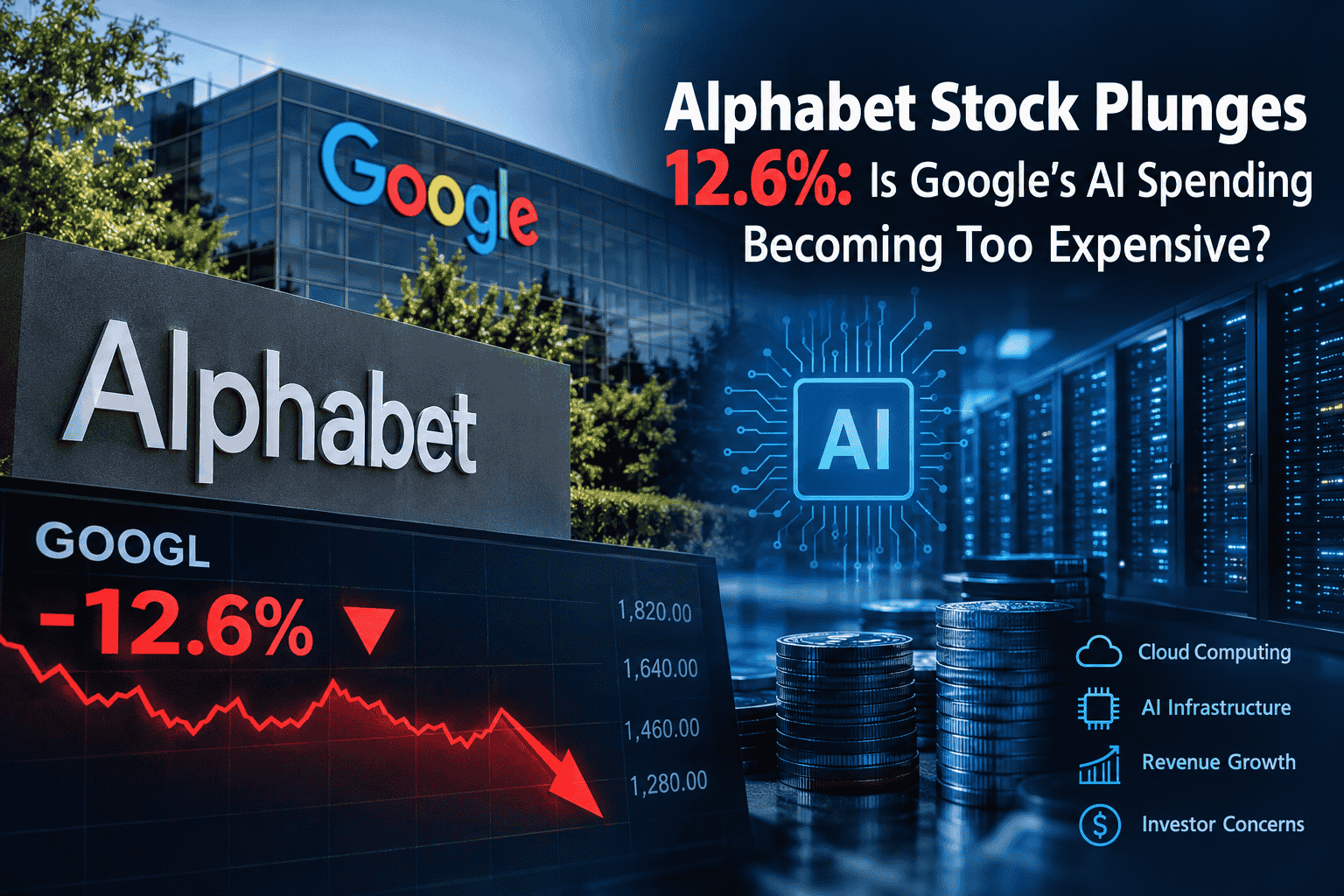
Alphabet, the parent company of Google, has suffered a sharp stock market decline after its latest quarterly results raised fresh concerns about the financial cost of artificial intelligence. On October 29, 2026, Alphabet shares fell 12.6%, marking their steepest one-day decline in more than two decades as investors reassessed the company’s expanding AI investments and the returns they could generate.
The sell-off reflects a growing challenge for major technology companies: artificial intelligence offers enormous commercial opportunities, but building the infrastructure required to support it demands unprecedented levels of capital. Investors are increasingly questioning whether revenue growth from AI services, cloud computing, and advanced chips can justify the cost of data centers, computing equipment, and other infrastructure.
For Google, the immediate question is whether its long-term AI strategy can deliver sustainable profits without putting excessive pressure on cash flow. For the wider technology industry, the decline sends a warning that investors may no longer reward AI spending without clear evidence of financial returns.
Why Did Alphabet Stock Fall 12.6%?
Alphabet’s October 29 stock decline followed its third-quarter earnings report, which highlighted several concerns about the company’s financial performance and spending priorities.
The company reported approximately $127.6 billion in quarterly revenue, representing strong year-over-year growth but falling slightly short of market expectations. Its search advertising business also showed signs of slower growth, raising questions about the future performance of one of Google’s most important revenue sources.
At the same time, Alphabet continued to spend heavily on AI infrastructure. Capital expenditure reached approximately $51.4 billion during the quarter, more than double the level reported a year earlier.
The combination of disappointing revenue expectations, weaker-than-expected profit, and rapidly increasing investment unsettled investors.
Markets had previously rewarded technology companies for committing billions of dollars to AI development. However, investors are increasingly demanding proof that these investments can translate into stronger earnings, higher cash generation, and sustainable business growth.
Alphabet’s decline therefore represents more than a reaction to one earnings report. It reflects a broader reassessment of the financial risks associated with the global AI investment boom.
Google’s AI Spending Is Reaching Historic Levels
Google is investing heavily in data centers, AI processors, networking equipment, cloud infrastructure, and advanced computing systems to support its expanding AI operations.
These investments are intended to strengthen Google’s position in several competitive markets, including generative AI, enterprise cloud services, AI-powered search, and autonomous AI applications.
The company has indicated that its capital expenditure could reach approximately $195 billion to $205 billion in 2026, with spending expected to increase further in 2027.
Such investment levels demonstrate the scale of Google’s ambitions. They also create a significant financial challenge because infrastructure spending often occurs before companies can fully monetize the services it supports.
Building a data center requires substantial upfront expenditure on land, construction, electricity infrastructure, cooling systems, and specialized processors. Once operational, the facility must generate sufficient revenue over time to justify its initial cost.
If AI adoption grows faster than expected, these investments could strengthen Google’s competitive position and produce attractive long-term returns. If demand or pricing falls short of expectations, however, the company could face lower returns on its infrastructure spending.
Is Google’s AI Business Generating Enough Revenue?
Google’s financial results reveal a more complicated picture than a simple story of excessive spending.
Its cloud business has emerged as a major growth engine, benefiting from rising demand for AI computing capacity, enterprise software, and cloud-based services.
During the third quarter, Google Cloud revenue increased approximately 103% year over year to $30.7 billion. The division’s operating income also rose substantially, suggesting that demand for Google’s cloud services is creating meaningful commercial opportunities.
The company is also expanding its AI chip business through its Tensor Processing Units, commonly known as TPUs. These processors are designed to accelerate AI workloads and provide an alternative to specialized chips supplied by competitors.
However, rapid growth does not automatically guarantee strong cash flow.
Google must invest in processors, data centers, and related equipment before some of the resulting revenue arrives. Selling AI chip systems to external customers can also require significant spending on inventory and infrastructure.
Meanwhile, the company’s traditional search advertising business faces questions about how AI-generated answers could change the way users interact with search results and how advertisers reach potential customers.
The central challenge is balancing investment in new revenue opportunities with the need to protect Google’s established profit engines.
The AI Investment Boom Faces a New Financial Reality
Alphabet’s stock decline reflects a wider change in investor expectations across the technology sector.
Over the past several years, major technology companies have increased AI spending to compete in generative AI, advanced computing, and enterprise automation. These investments have supported demand for semiconductor manufacturers, cloud providers, data center developers, and electricity infrastructure.
However, the economics of AI infrastructure are becoming more important as spending increases.
Investors increasingly want to understand how quickly AI services can generate revenue, whether computing costs will decline, and how much profit companies can retain after paying for infrastructure and operating expenses.
Three financial pressures deserve particular attention.
1. Rising Capital Expenditure
Data centers and AI processors require substantial upfront investment. Companies must spend billions of dollars before knowing exactly how much demand they will attract or how quickly customers will adopt new services.
If infrastructure capacity grows faster than customer demand, expensive equipment could remain underutilized and reduce investment returns.
2. Pressure on Free Cash Flow
Free cash flow measures the cash a business generates after accounting for capital expenditure. It helps investors assess how much money remains available for debt repayment, acquisitions, dividends, share repurchases, and other corporate priorities.
When capital expenditure rises faster than operating cash generation, free cash flow can deteriorate even when reported revenue continues to grow.
For companies pursuing aggressive AI strategies, maintaining healthy cash flow will be a major test of financial discipline.
3. Uncertain Returns on AI Products
AI products may attract users without immediately producing sufficient revenue to cover their development and operating costs.
Companies must find sustainable ways to monetize AI through subscriptions, enterprise contracts, advertising, cloud computing, and specialized services.
Investors will increasingly distinguish between companies demonstrating measurable AI profitability and those relying primarily on expectations of future growth.
What Google’s Stock Decline Means for Nvidia and the Technology Sector
Alphabet’s performance has implications beyond Google itself because the company is an important participant in the AI infrastructure ecosystem.
Nvidia supplies specialized processors used to train and operate AI models, while cloud providers, semiconductor manufacturers, networking companies, and data center operators depend on continued investment by large technology customers.
If major AI developers become more cautious about spending, some infrastructure suppliers could face slower order growth or greater pricing pressure.
However, the impact will not necessarily be uniform.
Google’s investment in its own TPU processors illustrates how large technology companies are attempting to diversify their computing infrastructure. Alternative AI chips could reduce dependence on a single supplier while creating new competition in the semiconductor market.
At the same time, strong demand for cloud computing and AI services could continue supporting infrastructure spending even if investors become more selective about individual projects.
The key question for the technology sector is whether AI-related revenue will grow quickly enough to support the enormous investments being made across the industry.
Should Investors Be Worried About Google’s AI Strategy?
Alphabet’s stock decline does not automatically mean that its AI strategy is failing. It does, however, demonstrate that strong technological capabilities and ambitious investment plans are not enough to guarantee investor confidence.
Google retains major advantages, including its search business, cloud infrastructure, AI research capabilities, advertising ecosystem, and global customer base. These assets could help the company turn AI adoption into long-term revenue growth.
The company’s growing cloud business also suggests that AI infrastructure can create substantial commercial opportunities.
Nevertheless, investors should monitor several indicators over the coming quarters:
- Revenue growth: Whether AI products, cloud services, and advertising generate sustained increases in sales.
- Capital expenditure: Whether infrastructure spending continues rising faster than expected.
- Free cash flow: Whether the company can fund its investments while maintaining financial flexibility.
- AI monetization: Whether AI-powered products produce measurable revenue and sustainable margins.
- Competitive pressure: Whether rival AI developers and semiconductor providers affect Google’s market position.
These indicators can help investors evaluate whether the company is converting its AI investments into lasting economic value.
A sharp stock decline may attract investors looking for opportunities, but short-term price movements alone cannot establish whether a company is undervalued. Investment decisions should consider valuation, financial performance, competitive risks, and individual risk tolerance.
What Comes Next for Alphabet?
Google is unlikely to abandon its AI ambitions simply because investors have become more cautious. Artificial intelligence remains strategically important to its search products, cloud operations, advertising technology, and long-term competitive position.
The company will instead face growing pressure to demonstrate that its infrastructure investments can deliver durable financial returns.
That could mean prioritizing the most commercially promising AI applications, improving computing efficiency, expanding enterprise contracts, and finding new ways to monetize AI-powered services.
The next several quarters will be important in determining whether Google’s expanding AI ecosystem can generate enough revenue and cash flow to justify its substantial investment requirements.
For the wider technology industry, the message is equally clear: AI remains a major growth opportunity, but investors are beginning to place greater emphasis on profitability, financial discipline, and measurable results.
Conclusion: Google’s AI Ambitions Face a Critical Test
Alphabet’s 12.6% stock decline on October 29 highlights the financial uncertainty surrounding the global AI investment boom. Although Google continues to expand its AI capabilities and cloud business, the scale of its infrastructure spending has raised questions about cash flow, investment returns, and the long-term economics of artificial intelligence.
The company’s future performance will depend on its ability to turn AI demand into sustainable revenue while managing the costs of developing and operating increasingly powerful computing systems.
For investors, the lesson is not that AI has lost its potential. It is that technological progress and financial success are not the same thing.
As the AI industry matures, companies that combine innovation with strong execution, disciplined spending, and profitable business models may be better positioned to deliver lasting value.
Frequently Asked Questions (FAQs)
Why did Alphabet stock fall 12.6% in October 2026?
Alphabet shares fell 12.6% on October 29 after its quarterly results raised concerns about revenue expectations, profitability, and rapidly increasing AI infrastructure spending.
How much is Google spending on AI infrastructure?
Alphabet indicated that its 2026 capital expenditure could reach approximately $195 billion to $205 billion. This spending supports data centers, AI chips, and other infrastructure, although not all capital expenditure is exclusively related to AI.
Is Google’s AI business profitable?
Google’s cloud division has reported strong revenue and operating income growth. However, the profitability of individual AI products and the overall return on AI infrastructure investment remain important questions for investors.
How does Google’s AI spending affect Nvidia?
Google’s demand for AI processors supports the broader semiconductor industry, but its development and sale of proprietary TPU chips could also increase competition for Nvidia and other chip suppliers.
Could Google’s stock recover after the decline?
A recovery is possible, but it depends on factors such as earnings growth, AI monetization, cash flow, market valuation, and investor confidence. A single-day decline does not determine the stock’s future direction.
Does Google’s stock decline mean the AI bubble is collapsing?
Not necessarily. The decline indicates that investors are becoming more selective about AI spending and financial returns. Whether the broader AI market is overvalued depends on future earnings, valuations, adoption, and investment performance across the industry.