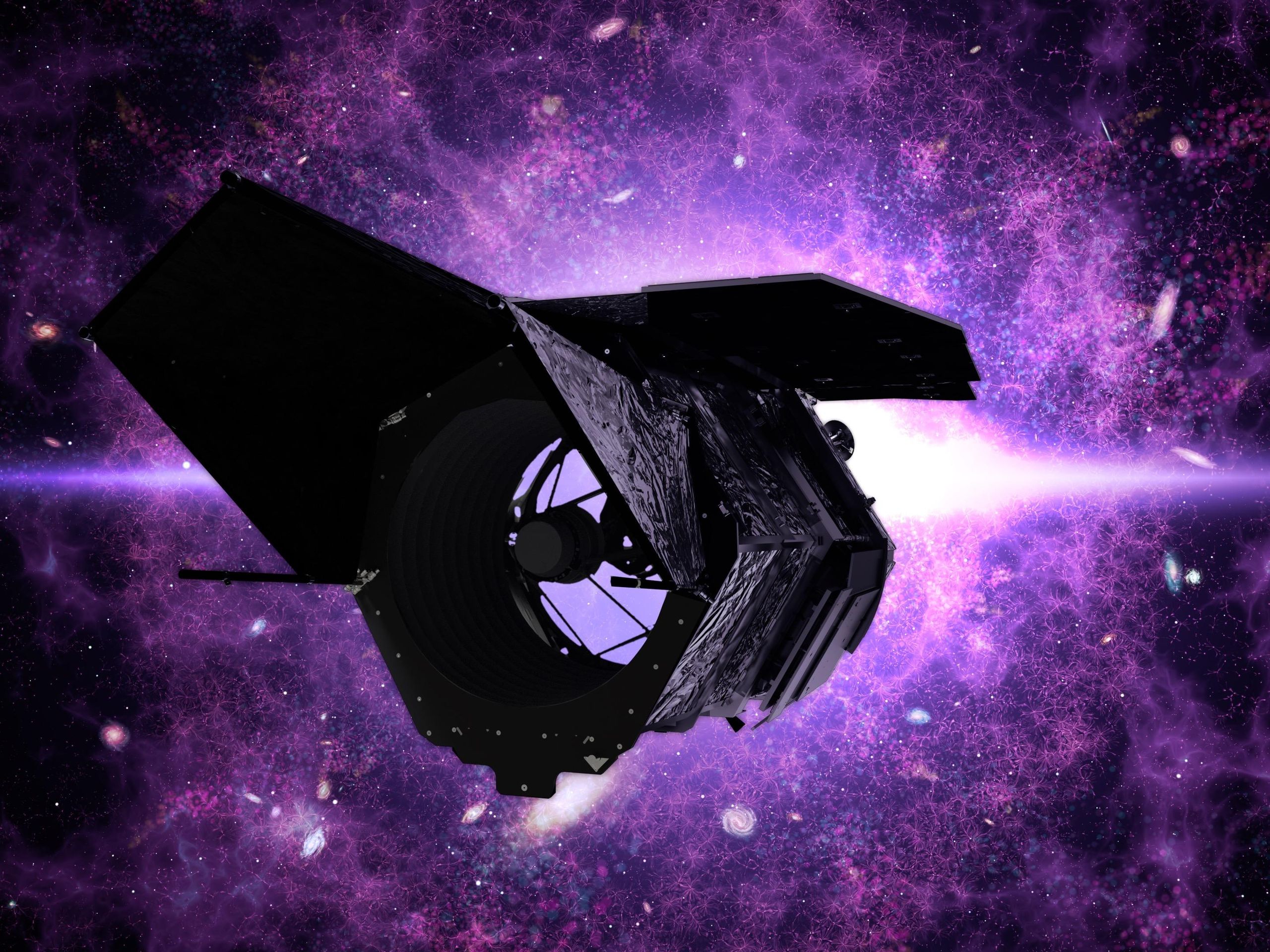
NASA’s Nancy Grace Roman Space Telescope has reached a major milestone after successfully activating its powerful 300-megapixel Wide Field Instrument (WFI) in space. The infrared camera is now operational as the observatory continues its journey toward its final destination, roughly one million miles from Earth.
The activation marks an important step in preparing Roman for its future scientific mission. Once fully commissioned, the telescope is expected to survey enormous areas of the universe while maintaining image sharpness comparable to the Hubble Space Telescope.
NASA Activates Roman’s Main Science Instrument
The Wide Field Instrument is the primary scientific camera aboard the Roman Space Telescope. NASA confirmed its successful activation in September 2026 as mission teams began a months-long process of calibrating and testing the observatory.
The WFI combines a huge field of view with infrared imaging capabilities. Its detector system contains 18 Teledyne H4RG-10 sensor chip assemblies, allowing Roman to capture enormous amounts of astronomical information in individual observations.
NASA says a single Roman image will cover an area of the sky larger than the apparent size of the full Moon while delivering detail comparable to Hubble.
That combination is one of the telescope’s most important advantages: Roman is designed to look at extremely large sections of the sky without giving up the ability to study individual astronomical objects in detail.
Roman Telescope’s First Starlight
Following activation, the Wide Field Instrument captured its first photons of starlight.
The initial image was not intended to represent Roman’s final image quality. The detector array was still in its launch configuration and the telescope had not yet been fully focused. NASA described the resulting stars as appearing spread across many pixels, something expected during this early testing stage.
The image nevertheless represents an important technical milestone because it confirms that the telescope’s primary science instrument is operating in space.
Further calibration and focusing will be required before Roman begins producing its intended scientific observations.
What Will NASA’s Roman Telescope Study?
Roman has been designed to investigate some of the biggest questions in modern astrophysics.
One of its major objectives is understanding dark energy, the mysterious component associated with the accelerating expansion of the universe. The telescope will also investigate dark matter and help scientists understand how matter is distributed across cosmic history.
Another major research area will be exoplanets. Roman is expected to conduct large-scale surveys that can reveal populations of planets outside our solar system.
Its wide-field observations will also help astronomers study galaxies, stars and the large-scale structure of the universe.
By surveying huge areas rather than focusing only on individual objects, Roman will provide a different perspective from telescopes such as Hubble and the James Webb Space Telescope.
Roman and Hubble Have Different Strengths
Roman is not designed simply to replace Hubble.
Instead, the two observatories can complement each other.
NASA says Roman will have angular resolution comparable to Hubble while providing a field of view at least 100 times larger. This means Roman can rapidly identify interesting objects across huge portions of the sky, after which other telescopes can conduct more detailed observations.
The James Webb Space Telescope can also complement Roman by providing highly detailed observations of selected targets.
This combination could create a powerful research pipeline: Roman surveys enormous regions, identifies potentially important objects or events, and other observatories investigate them in greater depth.
Roman Also Carries a Planet-Hunting Coronagraph
The Wide Field Instrument is not Roman’s only major scientific technology.
The telescope also carries the Coronagraph Instrument, which is designed to demonstrate advanced technology for directly imaging planets around other stars.
A coronagraph works by suppressing the overwhelming glare of a star, potentially allowing scientists to detect much fainter light reflected from planets orbiting it.
NASA says Roman’s coronagraph is designed to see planets that can be almost a billion times fainter than their host stars, although the instrument’s initial role is also to demonstrate the technology required for future missions.
Mission teams have already begun early tests of the coronagraph’s electronic, digital and mechanical systems.
A Telescope Built for Huge Cosmic Surveys
The scale of Roman’s imaging capability is one of its defining features.
Its 300-megapixel camera will allow scientists to collect wide-field infrared observations at a scale that would be difficult for conventional narrow-field space telescopes.
The goal is not simply to create spectacular space photographs. Roman’s enormous data sets will be used for scientific surveys that can measure how galaxies and matter have changed over billions of years.
Those observations could help scientists better understand the expansion of the universe, the distribution of dark matter and the formation of planetary systems.
Roman Is Heading Toward L2
Roman launched aboard a SpaceX Falcon Heavy on August 30, 2026, beginning its journey toward the second Sun-Earth Lagrange point, known as L2. NASA places the telescope roughly 930,000 miles, or about 1.5 million kilometers, from Earth at its operating location.
The telescope is expected to reach its final orbit after roughly three months.
During this period, engineers will deploy, calibrate and test the observatory’s systems before science operations begin.
NASA currently expects Roman’s first science images to be released in early 2027.
NASA’s Roman Mission Could Last Much Longer Than Expected
Another recent development has made the mission even more significant.
NASA says Roman may now have enough fuel for at least 22 years of potential science operations, more than twice its original 10-year fuel-based design expectation.
The improvement comes from several factors, including an extremely accurate first trajectory correction, additional fuel loaded before launch and expected savings during subsequent maneuvers.
The telescope’s primary mission is still designed around five years of science operations, with the potential for another five-year extended mission. The additional fuel provides an opportunity for a much longer operational lifetime if the spacecraft and instruments remain healthy.
What Comes Next for Roman?
The activation of the 300-megapixel camera is only the beginning.
NASA teams must now complete extensive calibration and testing. Engineers will focus the telescope, verify instrument performance and prepare the observatory for its scientific surveys.
The Coronagraph Instrument will also continue its technology demonstrations.
If the commissioning process proceeds as planned, Roman will begin opening a new era of wide-field astronomy in 2027.
The Bigger Picture
NASA’s Roman Space Telescope represents a major shift toward large-scale astronomical surveys. Instead of examining relatively small regions of the sky at a time, Roman will be capable of scanning enormous areas with high sensitivity and sharp infrared vision.
Its 300-megapixel camera is therefore more than a record-setting piece of technology. It is the central tool behind a mission designed to investigate dark energy, dark matter, exoplanets and the evolution of the universe on an unprecedented scale.
With its primary instrument now activated and its journey to L2 underway, Roman has moved another step closer to beginning what could become one of the most important astronomical surveys of the coming decade.
About the Author
Anam Younas
Editor of Daily Press Release
I write about technology, AI, business, finance, and global news, bringing readers clear insights into the latest trends and developments.
For more informative content Follow the Daily Press Release channel on WhatsApp: https://whatsapp.com/channel/0029Vb8gRyoIHphMqA6T2w0U