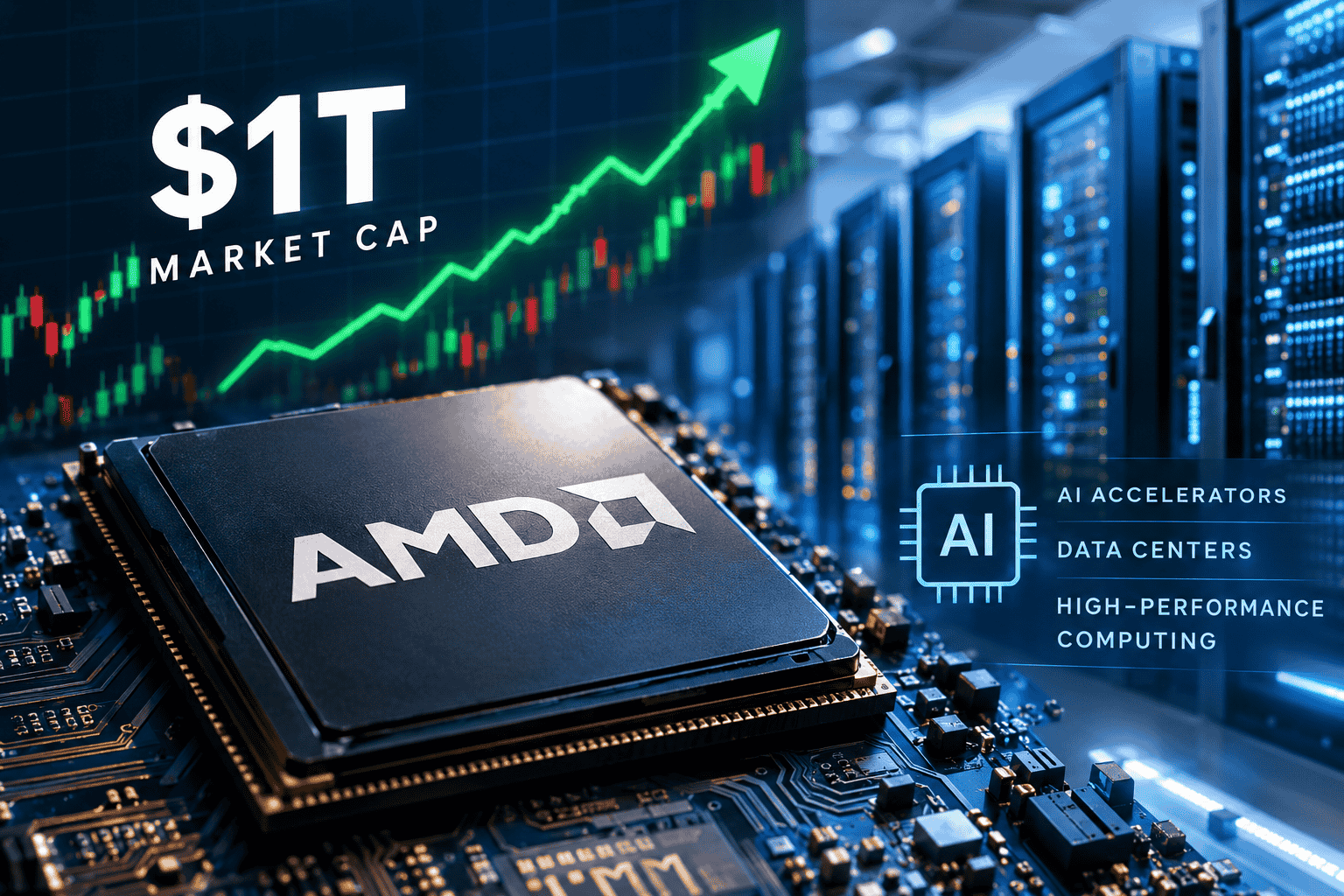
Advanced Micro Devices (AMD) has reached a major milestone as its market capitalization surpassed $1 trillion, highlighting the extraordinary financial impact of the artificial intelligence boom on the global semiconductor industry.
AMD’s rapid rise in 2026 reflects growing investor interest in AI infrastructure, data centers, processors and advanced graphics technology. As businesses continue investing billions of dollars in artificial intelligence, chip manufacturers have become some of the most important companies in the global technology economy.
The AMD milestone is therefore about more than one company’s valuation. It demonstrates how AI is changing investment patterns, technology competition and the future direction of the semiconductor industry.
AMD’s $1 Trillion Market Milestone
AMD’s market value surged as investors responded to strong demand for its data-center processors and AI accelerators.
The company has increasingly transformed itself from a traditional PC and gaming chip manufacturer into a major competitor in the high-performance computing and AI markets.
Its business now spans several important areas, including:
- Data-center processors
- AI accelerators
- Graphics processors
- Gaming chips
- Enterprise computing
- Networking technology
- High-performance computing systems
The company’s growing exposure to artificial intelligence has become one of the most important factors behind its valuation growth in 2026.
AI Is Driving AMD’s Growth
The global AI boom requires enormous amounts of computing power.
Training advanced AI models requires powerful processors and accelerators, while operating AI applications at scale requires large data centers filled with high-performance computing equipment.
This has created a huge market for semiconductor manufacturers.
AMD’s Data Center business has become a major growth engine as companies expand their AI infrastructure. Demand for its EPYC server processors and Instinct AI accelerators has increased as cloud providers, enterprises and AI developers expand their computing capacity.
The company’s growing presence in this market is changing how investors view AMD.
Instead of being valued primarily as a PC and gaming company, AMD is increasingly being viewed as an important player in the global AI infrastructure market.
AMD and Nvidia Competition Intensifies
AMD’s rise also highlights the growing competition in the AI semiconductor industry.
Nvidia remains one of the most powerful companies in the AI chip market, but AMD is aggressively expanding its presence with its Instinct family of AI accelerators.
For major technology companies, having multiple chip suppliers can provide greater flexibility and reduce dependence on a single hardware provider.
This creates an opportunity for AMD.
The company does not necessarily need to dominate the entire AI accelerator market. Capturing a significant share of a rapidly expanding market could generate substantial long-term revenue.
Why Data Centers Matter
The AI revolution is creating an enormous demand for data-center infrastructure.
AI companies require specialized facilities capable of supporting thousands of advanced processors simultaneously. These facilities also require networking equipment, cooling systems, electricity and storage infrastructure.
As AI models become more sophisticated, the computing requirements are increasing.
This creates opportunities for semiconductor companies across multiple categories.
AMD is positioning itself to benefit from this trend through CPUs, GPUs and broader computing platforms designed for large-scale AI workloads.
AI Is Changing Global Investment
AMD’s trillion-dollar valuation is part of a much larger investment trend.
Investors are increasingly directing capital toward companies connected to AI infrastructure.
The beneficiaries include:
- Semiconductor manufacturers
- Cloud computing companies
- Data-center operators
- Networking companies
- Memory manufacturers
- Energy providers
- Cooling technology companies
- Advanced manufacturing businesses
This means the economic impact of AI extends far beyond software companies.
The technology is creating demand for physical infrastructure on a global scale.
AMD’s Strong Financial Momentum
AMD’s financial performance has also strengthened investor confidence.
The company’s revenue has been growing rapidly, particularly in its Data Center segment.
The increasing contribution from data centers is important because enterprise and cloud computing typically provide larger and more durable revenue opportunities than traditional consumer electronics markets.
AMD’s expanding AI business could therefore become one of the company’s most important sources of long-term growth.
What AMD’s $1 Trillion Valuation Means for Investors
AMD’s milestone demonstrates how investors are thinking about the future of artificial intelligence.
AI Infrastructure Is Becoming a Major Market
The AI economy requires massive investments in computing infrastructure. Semiconductor companies are positioned at the foundation of that ecosystem.
Semiconductor Competition Is Increasing
The AI chip market is becoming increasingly competitive, with companies developing GPUs, CPUs, custom AI accelerators and networking solutions.
Data Centers Are Becoming Strategic Assets
Data centers are no longer simply facilities for storing information. They are becoming critical infrastructure for AI, cloud computing and digital services.
Valuations Depend on Continued Growth
AMD’s trillion-dollar valuation also creates higher expectations for future revenue, profits and AI market share.
If AI demand continues growing rapidly, semiconductor companies could benefit. However, any significant slowdown in AI investment could affect the industry’s growth expectations.
Risks Facing the AI Chip Industry
The AI semiconductor boom also comes with significant risks.
Competition is becoming increasingly intense. Companies must continuously develop more powerful and efficient chips while investing heavily in research and development.
Geopolitical tensions and semiconductor trade restrictions can also affect international sales and supply chains.
Another important risk is AI spending itself.
Technology companies are investing enormous amounts of money in AI infrastructure. Investors will increasingly want to see whether those investments produce sufficient revenue and productivity gains.
If AI companies reduce capital spending, semiconductor demand could eventually be affected.
AMD’s Role in the Future of AI
AMD’s $1 trillion milestone places the company among the world’s most valuable technology businesses and gives it a much larger role in the AI economy.
The company’s future growth will depend heavily on its ability to expand its AI accelerator business, strengthen its data-center portfolio and compete effectively against other semiconductor manufacturers.
The broader market will also be watching whether global AI spending continues at its current pace.
If businesses continue building AI infrastructure, AMD could remain an important beneficiary of the semiconductor investment cycle.
The Bigger Picture
AMD’s rise to a trillion-dollar valuation illustrates a fundamental change in the technology industry.
Artificial intelligence is no longer only about chatbots, software applications and digital services.
It is becoming an infrastructure business.
AI requires processors, data centers, electricity, networking systems, advanced manufacturing and enormous amounts of capital.
That transformation is creating new opportunities across the global economy while increasing the strategic importance of semiconductor companies.
Conclusion
AMD’s $1 trillion market valuation represents a major milestone for the semiconductor industry and another indication of the enormous financial influence of artificial intelligence.
The company’s growing Data Center business, AI accelerators and high-performance computing technologies have positioned it to participate in one of the largest technology investment cycles in history.
For global investors and businesses, the AMD story demonstrates an important reality: the AI revolution is increasingly becoming a hardware and infrastructure revolution.
As companies continue investing in AI, the demand for advanced chips and computing infrastructure could remain one of the defining forces shaping global markets throughout 2026 and beyond.
About the Author
Anam Younas
Editor of Daily Press Release
I write about technology, AI, business, finance, and global news, bringing readers clear insights into the latest trends and developments.
For more informative content Follow the Daily Press Release channel on WhatsApp: https://whatsapp.com/channel/0029Vb8gRyoIHphMqA6T2w0U