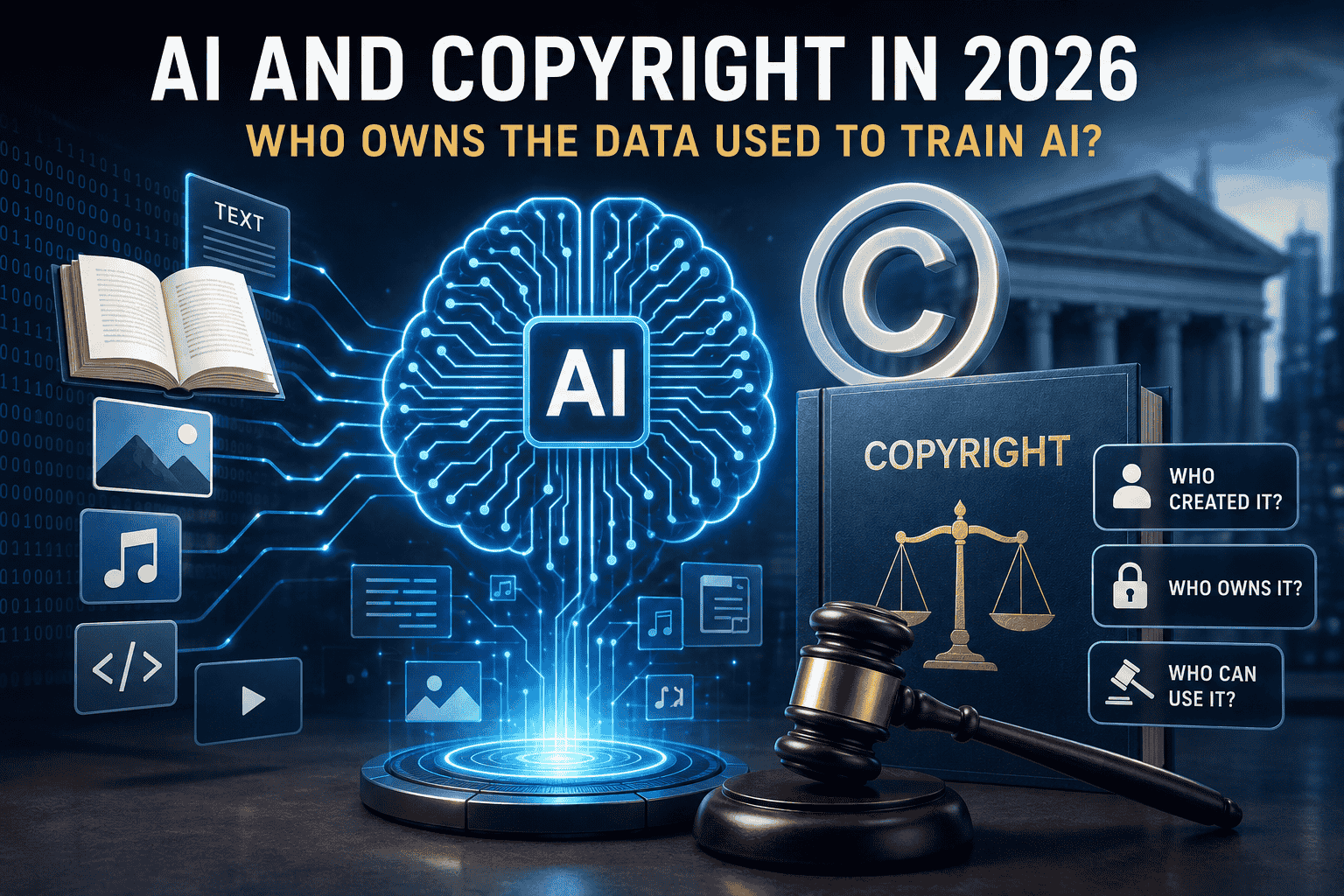
AI and Copyright has become one of the most powerful technologies in the world, but its rapid growth has created a major question for the digital economy: who owns the content used to train AI?
Modern AI models learn from enormous collections of text, books, photographs, music, software, websites and other digital material. Some of that information is publicly available, while other material is protected by copyright. In 2026, the debate over whether AI companies can legally use copyrighted works for training has become one of the technology industry’s biggest legal and business battles.
Authors, journalists, musicians, photographers, publishers and software developers are increasingly asking whether their work should be used to build commercial AI systems without permission or payment.
What Is AI Copyright?
AI copyright refers to the growing legal debate surrounding the use of copyrighted material to develop artificial intelligence systems and the ownership of content created with AI and Copyright.
AI companies require enormous datasets to train large language models, image generators, music systems and other AI technologies. Those datasets can contain material created by millions of people.
The central question is whether AI companies need permission to use this material or whether certain forms of AI training are protected by existing copyright exceptions.
Why AI Training Data Has Become a Copyright Issue
AI Models Need Massive Amounts of Data
Generative AI and Copyright systems learn patterns from huge quantities of information.
Large language models can process books, articles, websites and other text. Image-generation systems can learn from enormous collections of photographs, artwork and illustrations.
The controversy begins when those datasets contain copyrighted material.
AI companies argue that training is different from simply republishing copyrighted content. They say AI systems analyze information to learn patterns rather than provide users with traditional copies of the original works.
Copyright owners have raised a different concern: companies may be building highly profitable commercial products using creative work without licensing or compensating the creators.
AI Copyright Beyond Content: The Rise of AI Drug Discovery
The copyright debate is expanding beyond books, journalism, music and visual content. Artificial intelligence is also becoming increasingly important in scientific research, including pharmaceutical development.
AI drug discovery uses machine learning, generative AI and large biological datasets to help researchers identify potential drug targets, design molecules, predict safety risks and improve clinical research. These systems depend on large volumes of scientific, chemical and biological information, making data ownership and responsible data use increasingly important.
As AI becomes more deeply integrated into pharmaceutical research, questions about data licensing, intellectual property and ownership could become just as important in healthcare as they are in media and entertainment. Businesses developing AI-powered medical technologies will need to understand not only how their models work, but also where their training data comes from.
For a deeper look at how artificial intelligence is transforming pharmaceutical research, read our related analysis, AI Drug Discovery: How Artificial Intelligence Is Changing the Pharmaceutical Industry.
Is AI Training Fair Use?
The U.S. AI and Copyright Debate
One of the biggest legal questions in the United States is whether AI training can qualify as fair use.
Fair use can allow copyrighted material to be used without permission in certain circumstances. Courts typically consider factors including the purpose of the use, the nature of the copyrighted work, the amount used and the impact on the original market.
AI has made these questions significantly more complicated.
An AI company might argue that training is transformative because the system learns general patterns from copyrighted material. Copyright holders may argue that commercial AI companies are exploiting their work and potentially creating products that compete with the original content.
There is currently no single rule that automatically determines whether every use of copyrighted material for AI training is legal.
Major AI Copyright Lawsuits
OpenAI and The New York Times
One of the most closely watched AI and Copyright disputes involves The New York Times and OpenAI.
The case concerns allegations surrounding the use of Times content in the development of AI systems. The dispute has become an important test of how copyright law should apply to generative AI.
In 2026, the U.S. government also became involved in the broader legal debate, adding further attention to the question of whether AI training can qualify as fair use.
The eventual outcome could influence how AI companies work with journalism, publishing and other copyrighted material.
Anthropic and the $1.5 Billion Settlement
Another major development involved Anthropic and copyright claims brought by authors.
Anthropic agreed to a $1.5 billion settlement connected to claims involving copyrighted books and AI development.
The dispute highlighted an important issue: the way copyrighted material is obtained can be just as important as how it is subsequently used.
The case has encouraged AI companies to pay closer attention to the sources and legality of their training datasets.
Copyright and AI-Generated Music
Music Companies Enter the AI Debate
The copyright battle has expanded beyond books and journalism.
Music publishers and record companies are increasingly concerned about AI systems that learn from copyrighted songs, lyrics and recordings.
In 2026, lawsuits involving major music publishers and AI companies demonstrated that the music industry is becoming more aggressive about protecting copyrighted material.
The central concern is whether AI developers should be able to use protected musical works without licensing agreements.
The results of these disputes could have a major impact on the future economics of AI-generated music.
How Europe Is Regulating AI Copyright
The EU AI Act
The European Union has taken a more structured approach to AI regulation.
Under the EU AI Act, providers of general-purpose AI models face obligations connected to copyright compliance and transparency regarding training content.
This means AI companies operating in Europe increasingly need systems for managing and documenting the information used to train their models.
The European approach places significant emphasis on transparency, accountability and compliance.
What Is the UK Doing About AI Copyright?
No Broad New Training Exception
The United Kingdom has also been considering how copyright law should respond to artificial intelligence.
Rather than creating a broad new exception that would automatically allow AI companies to train models on copyrighted material, policymakers have continued examining how existing copyright protections can work alongside AI development.
The debate demonstrates the difficulty governments face when attempting to encourage AI innovation while protecting creative industries.
Who Owns AI Training Data?
Copyright Usually Belongs to the Rights Holder
The answer is not as simple as saying that an AI company owns the information inside its model.
Copyright generally belongs to the creator or another legitimate rights holder unless the rights have been transferred or licensed.
An AI company does not automatically become the owner of every copyrighted work contained within a training dataset.
The more important question is whether the company has the legal right to use that material for training.
Owning an AI Model Is Different
A company can own or control its AI model while still facing legal disputes about the material used to develop that model.
This distinction could become increasingly important as courts establish clearer rules around AI training.
Who Owns AI-Generated Content?
Human Creativity Remains Important
Copyright questions also apply to content produced by AI.
In the United States, human authorship remains an important requirement for copyright protection. Simply entering a prompt into an AI system does not necessarily mean that the resulting image, article, music or other work automatically receives copyright protection for the user.
However, significant human creative contributions may receive protection depending on how the final work was created.
This creates a new legal question: how much human involvement is required for AI-assisted content to receive copyright protection?
The Rise of AI Licensing Deals
Licensing Could Become a Major Business Model
One possible solution to the copyright conflict is the development of a large-scale licensing market for AI training data.
Instead of collecting copyrighted content without permission, AI companies could negotiate agreements with publishers, artists, photographers, musicians and other rights holders.
Licensing agreements could provide creators with new revenue while giving AI developers access to high-quality and legally controlled datasets.
The challenge is determining how much creators should be paid.
An AI model can require billions of individual pieces of information, making traditional licensing systems difficult to scale.
Why Data Provenance Matters
Businesses Need to Know Where AI Data Comes From
The concept of data provenance is becoming increasingly important.
Businesses developing AI systems need to understand where their training data originated, whether they have permission to use it and what legal risks could arise later.
Companies using third-party AI platforms also need to understand how their AI provider handles copyrighted material and what rights apply to AI-generated output.
In the future, demonstrating that training data was legally obtained could become an important competitive advantage.
How AI Copyright Could Affect Businesses
The copyright debate is becoming a major business issue rather than simply a legal dispute.
AI Companies
AI developers may need to invest more heavily in licensed datasets, compliance systems and content-management technologies.
Publishers and Creators
Writers, photographers, musicians and publishers could potentially gain new revenue opportunities through licensing agreements.
Technology Users
Businesses using AI-generated content may need to understand whether the material they produce can legally be used for advertising, publishing, software development or commercial purposes.
Can AI and Copyright Coexist?
The future will likely involve a combination of approaches rather than a single solution.
Possible models include:
- Copyright licensing agreements
- Compensation systems for creators
- Greater transparency about training datasets
- Opt-out mechanisms
- Legally sourced datasets
- New copyright legislation
- Court decisions establishing clearer standards
The goal will be to balance AI innovation with the economic rights of creators.
The Future of AI and Copyright in 2026 and Beyond
The AI copyright debate is unlikely to disappear soon.
Courts will continue considering major lawsuits, governments will introduce new regulations, and creative industries will demand greater control over how their work is used.
At the same time, AI companies need access to enormous quantities of high-quality data to improve their systems.
The technology industry may therefore move toward a model where licensed data, transparent training practices and creator compensation become increasingly common.
Conclusion
AI and copyright in 2026 has become one of the defining legal and economic debates surrounding artificial intelligence.
The question is no longer simply whether AI and Copyright can create content. It is whether companies should be able to use millions of copyrighted works to develop powerful commercial AI systems without permission or compensation.
Major disputes involving technology companies, publishers, authors and music businesses could eventually reshape the rules governing AI development.
The outcome could determine who controls digital knowledge, who gets paid for creative work and how the next generation of artificial intelligence is built.