Introduction
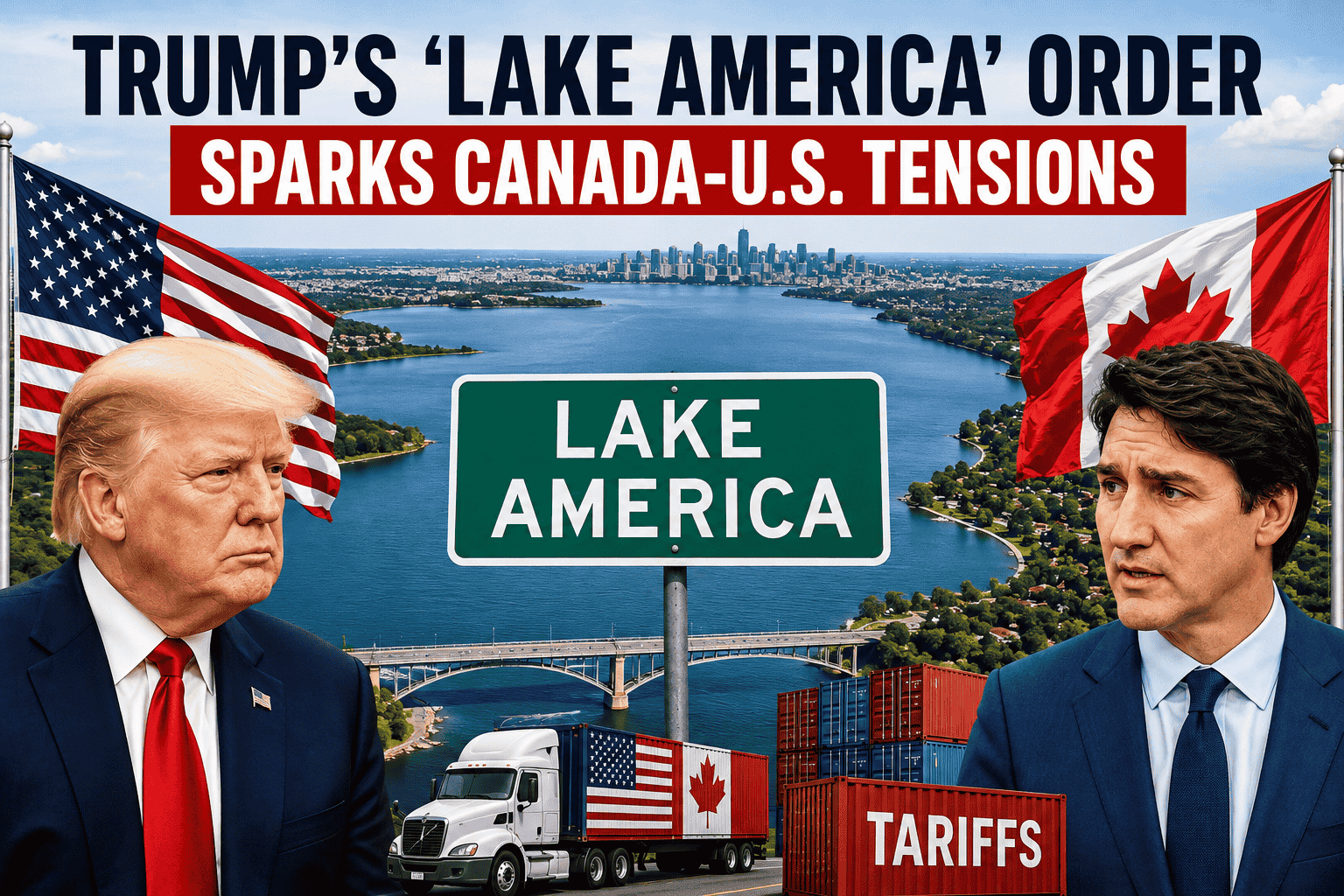
Relations between the United States and Canada have entered another tense phase after President Donald Trump signed an executive order directing the U.S. government to rename Lake Ontario as “Lake America.” The move is highly symbolic because Lake Ontario sits along the border between New York and the Canadian province of Ontario.
The announcement comes at a sensitive moment. Washington and Ottawa are already locked in a major trade dispute over tariffs, retaliatory measures, and disagreements about the future of North American economic relations. The lake-name decision has therefore become more than a geographical issue—it has become another symbol of the increasingly complicated relationship between the two countries.
What Is the “Lake America” Order?
On August 27, 2026, Trump signed an executive order instructing the U.S. government to take steps to officially use “Lake America” for the body of water historically known as Lake Ontario in U.S. federal records.
The order directs federal agencies to update maps, documents and geographic databases. The administration says the decision recognizes the lake’s importance to American history, commerce, transportation, defense and regional economic activity.
However, the change applies to U.S. government naming. Because the lake is shared by the United States and Canada, the American decision does not automatically mean Canadian authorities will adopt the new name.
Why Is Lake Ontario Important?
Lake Ontario is one of North America’s five Great Lakes and plays an important role in transportation, industry, agriculture, energy and tourism.
The lake borders New York in the United States and Ontario in Canada, making it an important part of the Great Lakes region. The wider Great Lakes–St. Lawrence Seaway system supports the movement of commodities and connects inland North American markets with international trade routes.
The lake is also important for communities on both sides of the border. Millions of people depend on the Great Lakes for drinking water, transportation, recreation, tourism and economic activity.
For Canada, Lake Ontario is an established geographical name deeply connected with the country’s history and the province that shares its northern and western shoreline.
Canada Rejects the New Name
The announcement has generated criticism in Canada, where officials and political figures have indicated that Canadians will continue referring to the body of water as Lake Ontario.
Canadian Prime Minister Mark Carney has rejected the idea of adopting Trump’s preferred terminology, reinforcing the view that Canadian institutions will continue using the traditional name.
This disagreement illustrates a broader problem: geographical naming can become politically sensitive when a landmark is shared between two sovereign countries.
The controversy is therefore unlikely to be resolved simply through a U.S. executive order.
The Decision Comes During a Trade War
The timing of the Lake America announcement is particularly significant.
The United States and Canada are already facing escalating trade tensions. The Trump administration has imposed tariffs on certain Canadian goods, while Canada has responded with retaliatory measures affecting American products.
The measures have created uncertainty for businesses on both sides of the border.
The dispute is particularly important because the U.S. and Canada have highly integrated economies. Automotive manufacturing, agriculture, energy, manufacturing and logistics all depend heavily on cross-border trade and it leads to a US Canada trade war.
As tariffs increase costs and create uncertainty, companies may reconsider suppliers, production locations and investment decisions.
Impact on Businesses and the Economy
The biggest potential consequence of the broader Canada-U.S. dispute is economic rather than geographical.
Companies operating across the border may face higher costs if tariffs remain in place. Manufacturers could experience increased prices for imported components, while retailers may have to adjust prices or search for alternative suppliers.
As trade tensions continue, entrepreneurs and investors are also paying closer attention to businesses for sale in Ontario, particularly opportunities in industries that serve local consumers and cross-border markets.
The automotive industry is especially exposed because vehicles and components frequently cross the U.S.-Canada border during the manufacturing process.
A prolonged trade conflict could affect:
- Manufacturing costs
- Consumer prices
- Agricultural exports
- Automotive supply chains
- Tourism
- Cross-border investment
- Energy markets
- Small businesses
- Regional employment
Although the Lake America order itself is unlikely to have a major direct economic impact, its political symbolism matters because it arrives during an already difficult period for bilateral relations.
Could Tourism Be Affected?
Tourism has also become part of the broader Canada-U.S. dispute.
Some Canadian political leaders have encouraged Canadians to choose domestic travel and Canadian-made products rather than spending money in the United States.
If political tensions remain high, tourism businesses in border states could feel the effects.
Hotels, restaurants, retailers and attractions that traditionally depend on Canadian visitors could face weaker demand if Canadians increasingly avoid U.S. travel.
A Symbol of Changing Canada-U.S. Relations
For decades, Canada and the United States have maintained one of the world’s most important economic and political relationships. The two countries share a long border, extensive trade connections, security cooperation and cultural ties.
The Lake America controversy highlights how quickly those relationships can become politically charged.
The issue is not really about a name alone. Instead, it reflects disagreements over trade, national sovereignty, economic independence and political identity.
Canada has increasingly emphasized the need to diversify its international trade relationships rather than relying so heavily on the U.S. market. At the same time, Washington has continued pushing policies designed to strengthen American domestic production and bargaining power.
What Happens Next?
The future of the dispute will depend primarily on whether Washington and Ottawa can return to meaningful trade negotiations.
The lake-name controversy may remain largely symbolic, but tariffs could have much more serious consequences if they remain in place for an extended period.
Businesses will be watching closely for changes in tariff policies, automotive trade rules, agricultural restrictions and negotiations surrounding North American trade.
A prolonged dispute could encourage companies in both countries to diversify supply chains and seek alternative international markets.
Conclusion
Trump’s “Lake America” order has added another layer to already strained Canada-U.S. relations. While changing the name used by U.S. federal agencies is primarily symbolic, the decision has attracted significant attention because it comes alongside an escalating trade dispute.
The larger story is the changing economic relationship between the United States and Canada. Tariffs, supply-chain uncertainty, political disagreements and calls for greater economic independence could have consequences far beyond the name of one Great Lake.
For businesses and investors, the key issue is not whether the lake is called Lake Ontario or Lake America. The more important question is whether Washington and Ottawa can reduce trade tensions before they begin causing more serious damage to one of the world’s most integrated cross-border economies.