Introduction
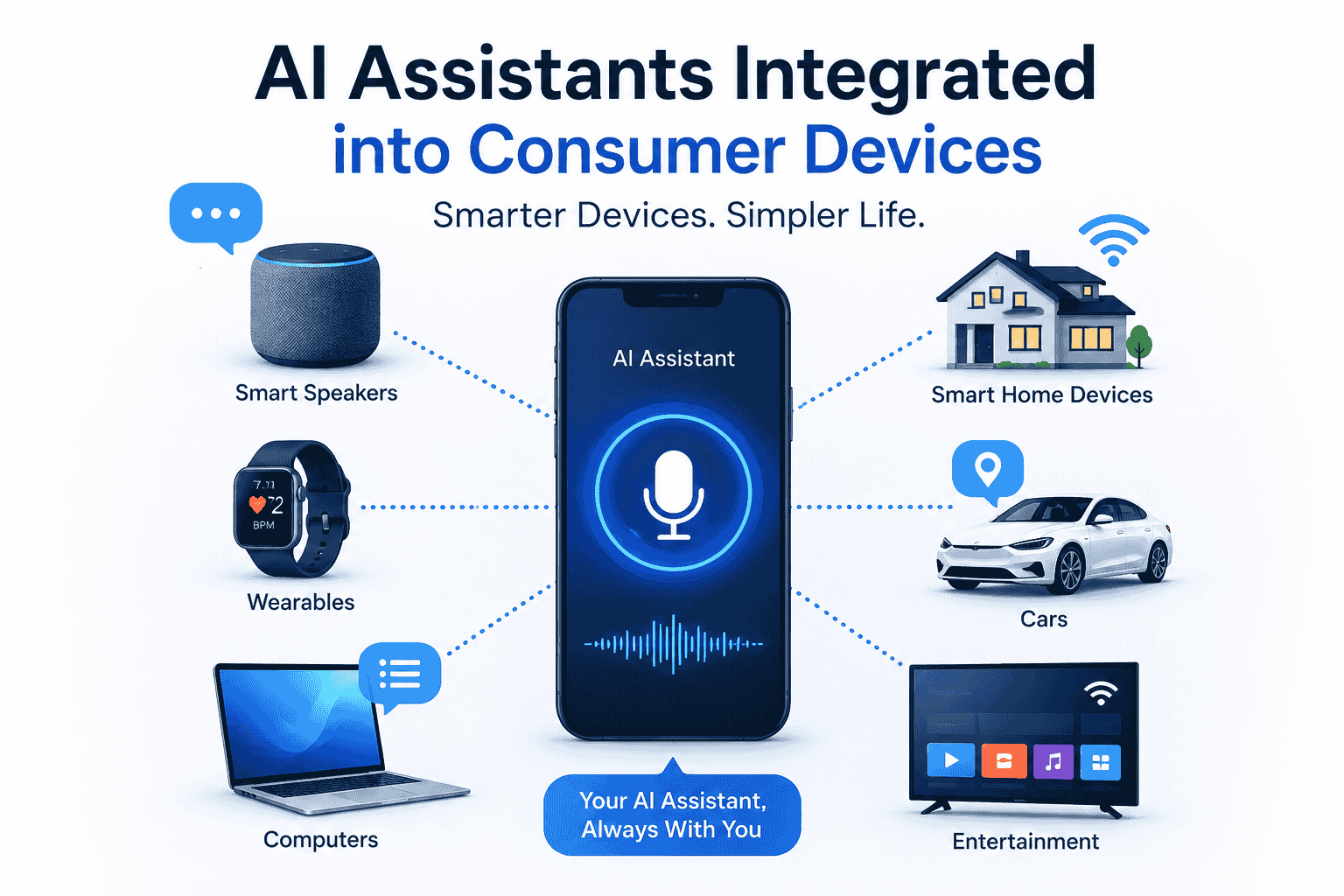
AI assistants: Artificial intelligence is no longer limited to research laboratories or specialized business applications. Today, AI assistants are becoming a fundamental part of everyday consumer technology. Smartphones, smart speakers, televisions, wearable devices, automobiles, and home appliances are increasingly equipped with intelligent assistants designed to simplify daily activities and create more personalized experiences.
The evolution of AI assistants represents one of the most significant technological transformations of the modern era. Traditional digital assistants could perform only simple tasks, such as setting alarms, playing music, or answering basic questions. Modern AI assistants have evolved into sophisticated systems capable of understanding context, learning user preferences, automating workflows, and performing complex actions with minimal human intervention.
As technology companies continue to integrate artificial intelligence into consumer devices, the relationship between humans and technology is undergoing a major transformation. Instead of simply operating devices, users are now interacting with intelligent systems that can anticipate needs, provide recommendations, and perform tasks automatically.
This article explores how AI assistants integrated into consumer devices are reshaping industries, improving user experiences, and influencing the future of technology.
What Are AI Assistants?
An AI assistant is a software system that uses artificial intelligence technologies such as machine learning, natural language processing, speech recognition, and computer vision to understand user requests and perform specific tasks.
Unlike traditional software, AI assistants are designed to communicate naturally with users. Instead of navigating through multiple menus or applications, users can simply speak or type a request.
AI assistants can perform a wide range of activities, including:
- Managing schedules
- Sending messages
- Providing navigation assistance
- Controlling smart home devices
- Answering questions
- Recommending products
- Translating languages
- Automating repetitive tasks
The latest generation of AI assistants can also analyze images, understand context, and remember previous interactions to provide more personalized responses.
The Evolution of AI Assistants in Consumer Technology
The first generation of digital assistants focused primarily on voice commands. These systems followed predetermined instructions and could only recognize specific phrases.
Over time, advances in machine learning enabled assistants to become more conversational and intelligent.
The evolution of AI assistants can be divided into four major phases:
Rule-Based Assistants
Early assistants relied on predefined commands and limited databases. They could execute only simple instructions and often struggled to understand natural language.
Voice Recognition Systems
Improvements in speech recognition allowed users to communicate more naturally with their devices. Voice assistants became capable of performing searches, making phone calls, and controlling media.
Context-Aware AI
Modern assistants can analyze contextual information, including location, user behavior, calendar events, and previous interactions. This allows them to provide more relevant recommendations.
Autonomous AI Agents
The newest generation of AI assistants can complete multi-step tasks independently. Instead of simply responding to commands, they can organize information, automate workflows, and proactively offer solutions.
This transition from reactive software to proactive intelligence represents a significant technological breakthrough.
AI Assistants in Smartphones
Smartphones have become the primary platform for AI integration.
Modern mobile devices contain powerful processors, high-quality cameras, microphones, location services, and advanced sensors. These features provide AI assistants with valuable information that improves decision-making and personalization.
AI assistants integrated into smartphones can now:
- Summarize articles and emails
- Organize notifications
- Translate conversations in real time
- Improve photography
- Generate content
- Predict user behavior
- Provide intelligent search capabilities
One of the most important developments is on-device AI processing. Instead of sending information to cloud servers, many smartphones can process AI tasks locally.
This approach provides several advantages:
Better Privacy
User data remains on the device, reducing the risk of unauthorized access.
Faster Performance
On-device processing eliminates delays caused by internet communication.
Offline Functionality
Many AI features continue to operate without an internet connection.
As smartphone manufacturers continue to develop specialized AI processors, mobile devices will become even more intelligent and efficient.
AI-Powered Smart Homes
The concept of the smart home has evolved significantly because of AI assistants.
Traditional home automation required users to manually configure individual devices. Modern AI assistants simplify this process by connecting multiple devices through a unified ecosystem.
Today’s AI-powered smart homes can manage:
- Lighting systems
- Security cameras
- Thermostats
- Entertainment systems
- Kitchen appliances
- Energy consumption
Instead of manually adjusting every setting, homeowners can communicate with a single AI assistant that coordinates all connected devices.
For example, an AI assistant might automatically lower the thermostat, lock doors, turn off lights, and activate security systems when it detects that everyone has left the house.
Future smart homes may become entirely predictive, adapting automatically to changing circumstances without requiring direct user input.
Wearable Devices and Personal AI Companions
Wearable technology is rapidly becoming one of the most important areas for AI integration.
Smartwatches, smart glasses, wireless earbuds, and health-monitoring devices are increasingly incorporating AI assistants that operate continuously throughout the day.
Wearable AI assistants can:
- Monitor physical activity
- Track heart rates
- Analyze sleep patterns
- Provide health recommendations
- Deliver real-time notifications
- Offer navigation assistance
Unlike smartphones, wearable devices remain physically connected to users, allowing AI systems to collect more contextual information.
This development has led to the emergence of personal AI companions that continuously learn from user behavior.
In the future, wearable assistants may function as digital companions capable of managing schedules, organizing communications, monitoring health conditions, and providing proactive guidance.
AI in Automobiles
The automotive industry is experiencing a significant transformation through AI integration.
Modern vehicles are becoming intelligent environments capable of understanding driver preferences and responding to natural language commands.
AI assistants in automobiles can currently:
- Provide navigation
- Control entertainment systems
- Answer questions
- Make phone calls
- Adjust vehicle settings
- Monitor driving behavior
Advanced systems can also analyze traffic conditions, recommend efficient routes, and improve fuel efficiency.
The integration of AI into connected vehicles represents an important step toward autonomous transportation.
Future vehicles may rely heavily on AI assistants to coordinate navigation, maintenance, safety, and communication.
The Benefits of AI Assistants in Consumer Devices
Increased Productivity
AI assistants reduce the time required to complete routine tasks.
Instead of manually searching for information, users can obtain immediate answers through conversational interactions.
Enhanced Personalization
Artificial intelligence continuously learns from user behavior.
This allows assistants to provide recommendations that align with individual preferences.
Improved Accessibility
AI assistants make technology more accessible for individuals with disabilities.
Voice commands, speech recognition, and automated assistance create more inclusive digital experiences.
Better User Experiences
Traditional software often requires users to adapt to specific interfaces.
AI assistants reverse this relationship by adapting technology to human communication patterns.
This creates more intuitive and efficient interactions.
Challenges and Privacy Concerns
Despite their advantages, AI assistants present several challenges.
Data Privacy
Many AI systems require access to personal information, including messages, locations, calendars, and browsing activity.
Consumers remain concerned about how this information is collected, stored, and used.
Security Risks
Connected devices can become potential targets for cyberattacks.
Manufacturers must continuously improve security protocols to protect user information.
Overdependence on Technology
As AI assistants become more capable, users may become increasingly dependent on automated systems.
Finding the right balance between automation and human control will remain an important challenge.
Ethical Considerations
Questions regarding transparency, accountability, and decision-making continue to influence discussions surrounding artificial intelligence.
Developers must ensure that AI systems operate fairly and responsibly.
The Future of AI Assistants
The next generation of AI assistants will move beyond individual devices.
Instead of interacting with separate assistants on smartphones, televisions, and automobiles, users will experience a unified AI ecosystem that operates seamlessly across multiple devices.
Future AI assistants may become:
- More conversational
- More proactive
- More personalized
- More autonomous
- More privacy-focused
Artificial intelligence will eventually shift from an application that users actively open to an invisible technology that continuously supports everyday activities.
This transformation will redefine how humans interact with technology.
Conclusion
AI assistants integrated into consumer devices are revolutionizing the way people communicate with technology. From smartphones and wearable devices to smart homes and automobiles, artificial intelligence is becoming an essential component of modern life.
These intelligent systems are improving productivity, enhancing personalization, and creating more natural digital experiences. At the same time, concerns related to privacy, security, and ethics continue to shape the development of AI technologies.
As innovation accelerates, AI assistants will become increasingly sophisticated, eventually evolving into intelligent companions capable of understanding human behavior and anticipating individual needs.
The future of consumer technology will not be defined by hardware alone. Instead, it will be shaped by intelligent systems that seamlessly connect devices, services, and people into a single, integrated digital experience.