Introduction
Humanoid robots are moving from science fiction into the real world. In 2026, advances in artificial intelligence, computer vision, sensors, batteries, and robotics are making it possible for machines with human-like bodies to perform increasingly complex physical tasks.
This new generation of machines is often described as Physical AI or embodied AI. Unlike traditional AI systems that operate mainly through screens, text, or voice, Physical AI allows intelligent systems to understand and interact with the physical world.
Humanoid robots can see objects, understand their surroundings, plan actions, move through environments, pick up items, and learn from repeated tasks. Companies are developing these robots for factories, warehouses, logistics, healthcare, retail, and eventually homes.
Popular machines such as Tesla Optimus, Figure 02 and Figure 03, Boston Dynamics Atlas, Agility Robotics Digit, Apptronik Apollo, Unitree G1, and 1X NEO are helping demonstrate what the future of intelligent machines could look like.
The rise of humanoid robots could transform industries, change the future of work, and create an entirely new robotics economy.
What Is Physical AI?
Physical AI refers to artificial intelligence systems that can understand and interact with the physical environment.
Traditional AI can generate text, recognize images, analyze information, or answer questions. Physical AI adds another important capability: action.
A Physical AI system can receive information from cameras and sensors, understand the environment, make a decision, and then physically perform an action.
For example, a humanoid robot working in a warehouse could:
- Identify a package using cameras.
- Determine where the package needs to go.
- Walk toward the package.
- Pick it up using robotic hands.
- Navigate around people and equipment.
- Place the package in the correct location.
This combination of perception, reasoning, movement, and learning is what makes Physical AI particularly important.
Why Humanoid Robots Are Becoming More Advanced
Several technologies are contributing to the rapid development of humanoid robots.
Artificial Intelligence
Modern AI models allow robots to understand instructions, recognize objects, interpret environments, and make decisions.
Instead of programming every movement manually, developers can increasingly train robots to perform tasks using demonstrations, simulations, and large amounts of real-world data.
Computer Vision
Cameras allow humanoid robots to understand their surroundings.
Advanced vision systems can identify objects, people, obstacles, surfaces, and changes in the environment.
This is essential because real-world environments are rarely perfectly predictable.
Advanced Sensors
Humanoid robots use cameras, force sensors, microphones, motion sensors, and other technologies to understand what is happening around them.
Sensors can help robots determine how strongly they should grip an object or how to maintain balance while walking.
Better Batteries and Motors
Humanoid robots require significant amounts of energy to walk, lift objects, and perform repetitive work.
Improvements in batteries, motors, actuators, and lightweight materials are making robots more practical for real-world applications.
Popular Humanoid AI Robots in 2026
Several humanoid robots have attracted significant attention because they demonstrate increasingly practical capabilities.
Tesla Optimus
Tesla Optimus is one of the most recognizable humanoid robots in the world.
Tesla’s long-term goal is to develop a general-purpose robot capable of performing repetitive and physically demanding tasks.
Optimus is designed with human-like arms, legs, hands, and a sophisticated vision and AI system.
The potential applications include factory work, material handling, repetitive manufacturing tasks, and eventually household assistance.
Figure 02 and Figure 03
Figure AI’s Figure robots are another major development in Physical AI.
Figure’s humanoids are designed primarily for industrial applications.
The robots have demonstrated capabilities involving object handling, manufacturing tasks, and increasingly sophisticated manipulation.
Figure 03 represents the company’s continuing effort to make humanoid robots more capable and commercially useful.
Boston Dynamics Atlas
Boston Dynamics Atlas is famous for demonstrating advanced movement and balance.
The company has developed Atlas for industrial environments, with a particular focus on mobility, manipulation, and physically demanding tasks.
Atlas demonstrates why humanoid robots could be useful in environments designed for humans.
Agility Robotics Digit
Agility Robotics Digit is designed primarily for logistics and industrial work.
Digit has become one of the most recognizable examples of a humanoid robot being developed for practical warehouse and manufacturing applications.
Its design focuses on moving items and performing repetitive material-handling tasks.
Apptronik Apollo
Apptronik Apollo is another important humanoid robot designed for industrial environments.
Apollo is being developed to work alongside people in manufacturing and logistics.
Its human-like design allows it to potentially perform tasks in existing workplaces without requiring companies to completely redesign their facilities.
Unitree G1
Unitree G1 has attracted attention because it combines humanoid movement with a relatively compact design.
It is used for robotics development, research, demonstrations, and experimentation.
1X NEO
1X NEO represents another interesting direction: humanoid robots designed for the home.
A household robot could eventually help with tasks such as organizing objects, carrying items, cleaning, and assisting people with everyday activities.
Real Examples and Incidents of Humanoid Robots
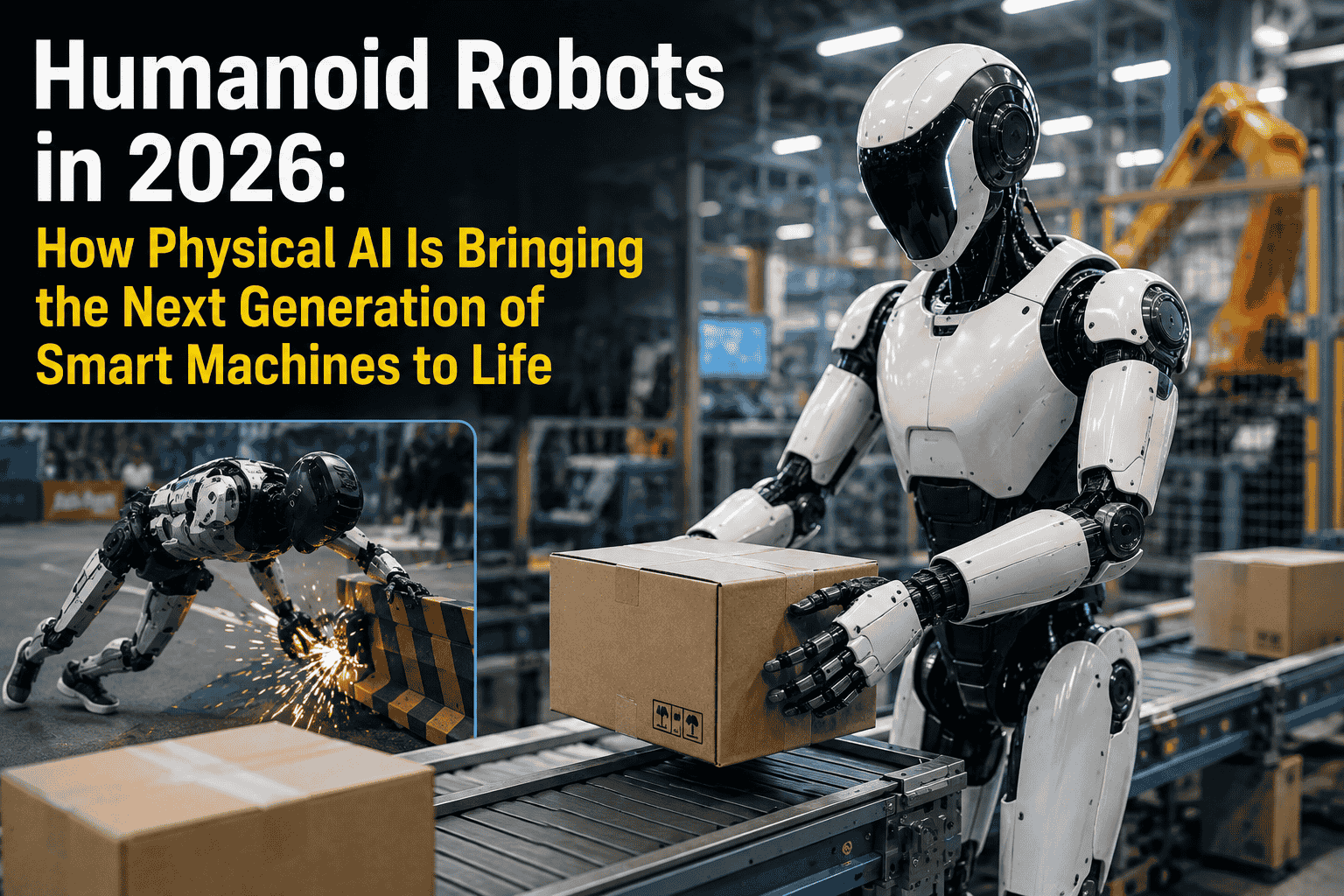
Humanoid robots are already being tested in real workplaces. Figure 02 worked at BMW’s Spartanburg plant, performing repetitive tasks involving automotive components. The deployment showed how Physical AI can support workers in manufacturing.
- Digit, developed by Agility Robotics, has also been deployed in real warehouse operations with GXO Logistics, demonstrating how humanoid robots can move and handle materials in commercial environments.
- In 2026, Figure 03 continued testing at BMW facilities, focusing on more advanced industrial and logistics tasks.
- Real incidents also show that the technology still faces challenges. During a humanoid robot running test in Beijing in 2026, a robot reportedly lost control and crashed into a safety barrier, highlighting ongoing issues with balance, movement, and physical reliability.
- Meanwhile, projects such as Tesla Optimus, Boston Dynamics Atlas, Apptronik Apollo, Unitree G1, and 1X NEO continue to demonstrate the rapid growth of humanoid robotics.
These examples show that humanoid robots are moving into the real world, but they still need improvements in safety, reliability, battery life, and cost before becoming widely used.
How Humanoid Robots Are Being Used
The first major applications of humanoid robots are likely to involve controlled environments.
Manufacturing
Factories contain repetitive tasks that can be automated.
Humanoid robots could potentially:
- Move components
- Carry materials
- Sort parts
- Load equipment
- Perform repetitive assembly tasks
Warehousing
Warehouses are another natural environment for humanoid robots.
Machines can potentially move boxes, transport items, organize inventory, and perform repetitive material-handling activities.
Logistics
Humanoid robots could eventually assist with loading, unloading, sorting, and transportation operations.
Healthcare
Healthcare could become an important long-term application.
Humanoid robots may eventually assist with delivering supplies, transporting equipment, supporting elderly people, or performing routine non-medical tasks.
Retail
Retail businesses could use humanoid robots for inventory management, product movement, customer assistance, and repetitive back-room tasks.
Why Humanoid Design Matters
A major advantage of humanoid robots is that humans have already designed much of the world around the human body.
Doors have handles.
Stairs are built for two-legged movement.
Shelves are positioned at human heights.
Tools are designed for human hands.
A humanoid robot can potentially use existing infrastructure without requiring every environment to be rebuilt.
This is one of the strongest arguments for developing humanoid machines instead of creating completely different robotic designs.
How AI Is Changing Robotics
The biggest transformation is not the robot’s physical appearance.
It is the intelligence inside the machine.
Older robots were generally programmed to perform specific movements repeatedly.
Modern Physical AI aims to make robots more adaptable.
Instead of simply following a fixed sequence, a robot could receive an instruction such as:
“Pick up the package and place it on the nearby shelf.”
The robot would then need to identify the package, locate the shelf, plan a path, manipulate the object, and respond to unexpected obstacles.
This represents a major shift from traditional automation toward more flexible machine intelligence.
Challenges Facing Humanoid Robots
Despite impressive progress, humanoid robots still face major challenges.
Cost
Advanced humanoid robots require expensive hardware, sensors, computing systems, and maintenance.
Reducing costs will be essential for widespread adoption.
Battery Life
Walking and physically manipulating objects require substantial energy.
Longer operating times and faster charging will be important.
Safety
Robots’ AI must safely operate around humans.
A machine capable of lifting heavy objects must be carefully controlled to prevent accidents.
Reliability
Businesses cannot depend on robots that frequently stop working or require constant human intervention.
Industrial customers will expect consistent performance.
Real-World Learning
Training robots in laboratories is not enough.
Machines need experience with unpredictable environments, different objects, changing lighting conditions, and unexpected human behavior.
Will Humanoid Robots Replace Human Workers?
The impact on employment is one of the biggest questions surrounding Physical AI.
Humanoid robots could reduce the need for humans to perform certain repetitive, dangerous, or physically demanding tasks.
However, they could also create new jobs.
Companies will need people to:
- Build robots
- Program AI systems
- Maintain machines
- Analyze performance
- Train robotic systems
- Manage human-robot teams
The likely outcome is not simply humans versus robots.
Instead, many workplaces may develop human-robot collaboration, where robots handle repetitive physical work while humans focus on decision-making, creativity, communication, and specialized skills.
The Future of Humanoid Robots
The next stage of robotics will likely focus on making humanoids more autonomous, affordable, reliable, and intelligent.
Future robots could become capable of learning new tasks from demonstrations, understanding natural language instructions, remembering previous experiences, and adapting to unfamiliar environments.
The biggest breakthrough may occur when robots become flexible enough to perform many different jobs instead of being limited to one specific task.
That could transform humanoid robots from specialized machines into general-purpose workers.
Conclusion
Humanoid robots in 2026 represent a major step toward the combination of artificial intelligence and the physical world.
Machines such as Tesla Optimus, Figure 02 and Figure 03, Boston Dynamics Atlas, Agility Robotics Digit, Apptronik Apollo, Unitree G1, and 1X NEO demonstrate the growing diversity of the humanoid robotics industry.
Physical AI is giving robots the ability to see, understand, learn, plan, and act in real environments. Manufacturing and logistics are likely to remain major early markets, while healthcare, retail, and household applications could become increasingly important.
Humanoid robots still face challenges involving cost, battery life, safety, reliability, and real-world intelligence. However, technological progress is moving the industry closer to a future where intelligent machines can work alongside people.
The most important development is not simply that robots are learning to walk like humans. They are learning to understand and interact with the world around them. That shift could make Physical AI one of the most transformative technology trends of the coming decade.