Introduction
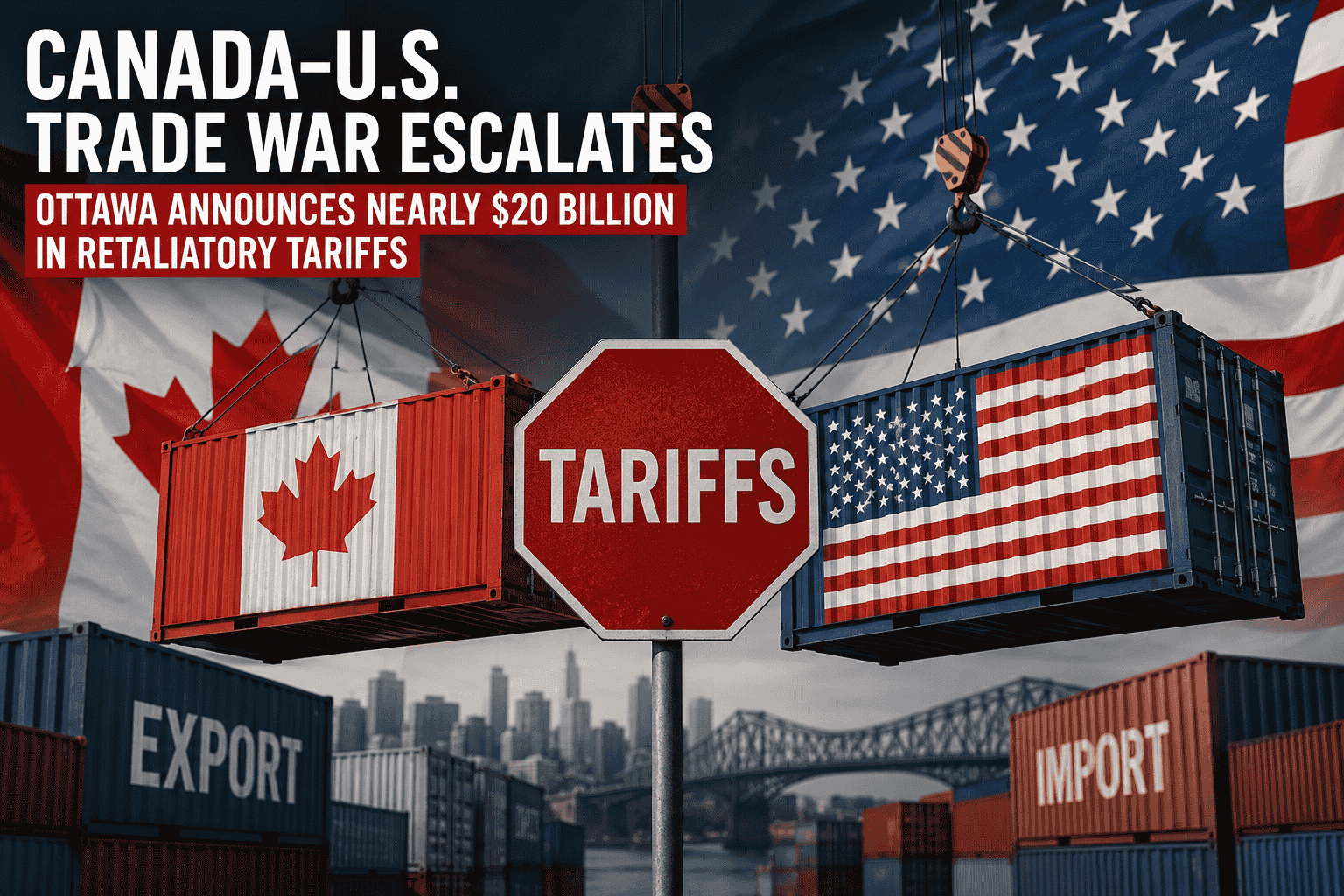
The Canada–U.S. trade war has entered a more serious phase in August 2026, with Ottawa announcing a new round of retaliatory tariffs against American products following the collapse of recent trade negotiations.
Canada’s latest measures target roughly $20 billion worth of annual Canada–U.S. imports and are scheduled to take effect on September 8, 2026. The new tariffs cover around 700 products, with rates of 15%, 25%, and 50%, depending on the product category.
The escalation represents another major challenge for two economies whose supply chains have been deeply connected for decades. From manufacturing and agriculture to retail, energy, and technology, businesses on both sides of the border could face higher costs and greater uncertainty.
Why Has the Canada–U.S. Trade War Escalated?
The latest escalation follows the breakdown of trade negotiations between Ottawa and Washington.
The United States recently imposed a 50% tariff on approximately $20 billion of Canadian imports under its latest trade measures. Canada responded by preparing a dollar-for-dollar retaliation.
The dispute has developed after months of disagreements involving tariffs, trade balances, manufacturing, agriculture and broader economic policy.
For Canada, the latest response is intended to protect domestic businesses and workers while putting pressure on the United States to reconsider its tariff strategy.
For American policymakers, tariffs are being used as a tool to encourage changes in Canada’s trade policies and strengthen Canada–U.S. economic interests.
The result is a rapidly changing North American trade environment.
When Will Canada’s New Tariffs Take Effect?
Canada’s new retaliatory tariffs are scheduled to begin at 12:01 a.m. on September 8, 2026.
The measures will apply to hundreds of American products entering Canada.
The tariffs are designed to match the latest Canada–U.S. measures as closely as possible, although the exact rate depends on the product.
This gives businesses several weeks to prepare for potentially higher import costs.
Companies that depend heavily on American suppliers will need to review contracts, inventories, pricing strategies and alternative sources before the new measures take effect.
Which American Products Will Face New Tariffs?
The new Canadian tariffs cover a wide variety of products.
Steel and Aluminum
Steel and aluminum are among the most important targets.
Some existing Canadian tariffs on American metals will increase from 25% to 50%, matching the latest Canada–U.S. rate.
This could affect manufacturers that rely on American metal products for construction, machinery and industrial production.
Consumer Goods
A wide range of consumer products will also be affected.
The targeted categories include:
- Furniture
- Clothing
- Appliances
- Electronics
- Prepared foods
- Personal-care products
- Carpets
- Paper products
- Plastics
- Sporting and recreational products
Higher import costs could eventually influence retail prices if businesses pass additional expenses to consumers.
Agricultural and Food Products
Agricultural goods are another important part of the retaliation.
Certain dairy products, seafood and other food categories will face tariffs of up to 25%.
This could create new opportunities for Canadian producers, but it could also make some American food products more expensive for Canadian consumers.
How Will Canadian Businesses Be Affected?
The impact will vary considerably between industries.
Businesses that compete directly with American companies could potentially benefit if imported U.S. products become more expensive.
For example, Canadian manufacturers may gain market share if customers switch from American products to locally produced alternatives.
However, companies that depend on American machinery, components, raw materials or equipment could face higher operating costs.
Small businesses may be particularly vulnerable because they often have less negotiating power and fewer alternative suppliers.
For these companies, even a moderate increase in input costs can significantly affect profit margins.
Canada Announces a C$7.5 Billion Support Package
Ottawa is also taking steps to reduce the economic impact of the trade dispute.
The Canadian government has announced a C$7.5 billion support package for businesses and workers affected by the tariffs.
Part of the program will provide financial support for companies experiencing cash-flow problems.
The Business Development Bank of Canada is expected to provide interest-free loans ranging from C$2.5 million to C$5 million to eligible businesses.
Companies receiving support will also have a significant period before repayments begin.
The objective is to give businesses time to adjust their supply chains, protect jobs and adapt to the new trading environment.
What Does the Trade War Mean for American Businesses?
The consequences will not be limited to Canada.
American exporters selling products to Canadian customers could face reduced demand if their goods become significantly more expensive.
Canada is one of America’s most important trading partners, meaning even relatively targeted tariffs can affect manufacturers, farmers and retailers.
Companies may respond by lowering prices to absorb part of the tariff, searching for Canadian customers through different distribution strategies or shifting production.
Some businesses may also reconsider their dependence on the Canadian market.
The Automotive Industry Faces Particular Pressure
The North American automotive industry is one of the sectors most exposed to the trade conflict.
Vehicles and components frequently cross the Canada–U.S. border multiple times during production.
A component manufactured in one country may be shipped to another for assembly before the finished vehicle is moved back across the border.
Tariffs can therefore accumulate costs throughout the production process.
The situation is even more significant because the United States has also threatened additional 50% tariffs on Canadian automobiles, auto parts and steel beginning January 1, 2027.
If those measures take effect, manufacturers could face major decisions about where to produce vehicles and components.
Consumers Could Feel the Impact
Tariffs are paid by importers, but their economic effects can eventually reach consumers.
When imported products become more expensive, businesses have several choices.
They can absorb the additional cost, reduce their profit margins, negotiate with suppliers or increase prices.
Some companies may choose to raise prices.
Canadian consumers could therefore see higher costs for certain American products, including appliances, electronics, clothing, furniture and food.
However, the impact will not necessarily be immediate or identical across all products.
Companies with large inventories may initially continue selling products purchased before the new tariffs took effect.
Could the Trade War Increase Inflation?
Inflation is another concern.
If tariffs remain in place for an extended period, higher import costs could contribute to increased prices in certain sectors.
The effect would depend on how businesses and consumers respond.
If Canadian consumers switch to domestic or alternative international products, some price increases could be limited.
But if alternative suppliers are more expensive or difficult to find, businesses could have little choice but to pass higher costs through the supply chain.
This makes the trade dispute an important issue for Canadian monetary and economic policy.
Canada May Look for New Trading Partners
One of the longer-term consequences could be a shift in Canada’s international trade strategy.
Canadian companies may increasingly look toward Europe, Asia and other international markets to reduce dependence on the United States.
The same could happen in the opposite direction, with American businesses searching for alternative suppliers and customers.
Trade diversification can reduce long-term vulnerability, but it is not easy.
The Canada–U.S. have spent decades building highly integrated supply chains, transportation networks and business relationships.
Replacing those connections could take years.
Could the Trade War Hurt Both Economies?
Despite the political objectives behind tariffs, trade conflicts often create costs on both sides.
Canada could experience weaker exports, reduced investment and pressure on industries dependent on the American market.
The United States could face higher prices for Canadian inputs, weaker demand for American exports and disruptions to manufacturing supply chains.
The longer the tariffs remain in place, the greater the possibility that businesses will permanently change their sourcing and investment decisions.
That could make it harder to quickly restore the previous trading relationship even if governments eventually reach a new agreement.
What Happens Next?
The next few months will be critical.
Canada’s retaliatory tariffs are scheduled to begin on September 8, while the United States is considering additional measures for Canadian automobiles, parts and steel.
Businesses will be watching negotiations closely.
The biggest question is whether both governments eventually return to the negotiating table with enough flexibility to reach an agreement.
A compromise could reduce tariffs and restore confidence.
A further escalation, however, could create deeper disruption across North American supply chains.
Conclusion
The Canada–U.S. trade war in 2026 has entered a new and more uncertain stage.
Canada’s decision to impose nearly $20 billion in retaliatory tariffs on American imports demonstrates that Ottawa is prepared to respond aggressively to Washington’s trade measures.
With tariffs of up to 50%, approximately 700 American products are affected, while a C$7.5 billion support package is being introduced to help Canadian businesses and workers manage the economic pressure.
The consequences could extend far beyond government policy.
Manufacturers, farmers, retailers, consumers and transportation companies on both sides of the border may face higher costs and changing market conditions.
The automotive industry is particularly vulnerable because of its highly integrated North American supply chain.
Ultimately, the biggest issue is not simply the value of the tariffs. It is whether the trade conflict becomes a temporary negotiating tactic or develops into a long-term restructuring of the world’s most integrated bilateral trading relationship.
For Canada and the United States, the coming months could determine whether decades of economic integration survive the latest tariff battle—or whether North American trade enters a completely new era.