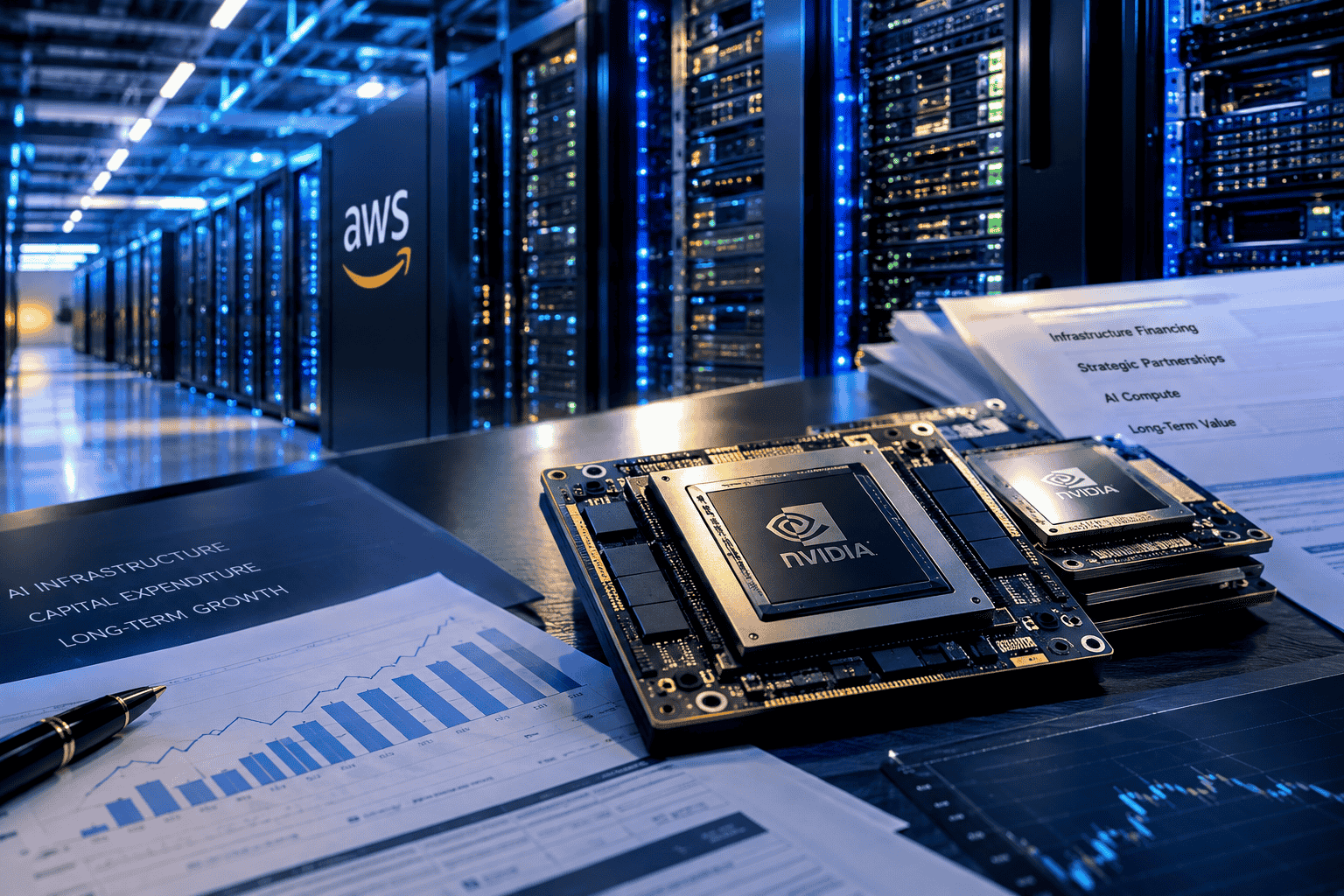
Amazon is exploring a new way to finance its rapidly expanding artificial intelligence infrastructure: moving approximately $8 billion worth of Nvidia AI chips into an investor-backed financial vehicle and leasing the hardware back.
The proposed transaction highlights a major shift taking place across the AI industry. As companies spend hundreds of billions of dollars on data centers, processors and networking equipment, technology companies are increasingly looking beyond traditional corporate borrowing and cash-funded capital expenditure.
For investors and financiers, Amazon’s reported plan offers another example of how AI chips are beginning to be treated as financeable infrastructure assets.
The discussions are preliminary, meaning the structure could change or may not ultimately be completed. However, the concept is significant because it could help Amazon finance AI expansion while limiting the amount of hardware directly held on its balance sheet.
How Amazon’s $8 Billion Nvidia Chip Deal Could Work
According to reports, Amazon has been speaking with investors about placing thousands of Nvidia Grace Blackwell chips into a special-purpose vehicle, or SPV.
Under the proposed structure, outside investors would provide financing to the vehicle. The SPV would own the chips, while Amazon would lease the hardware back and continue using it in its data centers.
The chips are reportedly installed across more than a dozen Amazon data centers in five U.S. states, including Nevada and Virginia.
Amazon could also offer investors an equity stake of up to 10% in the vehicle, according to reports, while Amazon itself would not retain an ownership interest in the SPV.
The structure resembles a traditional sale-and-leaseback transaction, but with high-performance AI processors rather than conventional industrial equipment.
That distinction matters because it suggests financial markets are beginning to explore whether AI computing hardware can support specialized investment products.
Why Amazon Is Exploring the Financing Structure
Amazon is facing an enormous AI infrastructure spending cycle.
The company has raised its 2026 capital expenditure target to approximately $220 billion, with a substantial portion directed toward AWS infrastructure, AI chips and data-center expansion.
That level of spending creates a balance-sheet challenge even for a company of Amazon’s scale.
Buying AI chips outright requires significant upfront capital. At the same time, the hardware begins depreciating as newer generations of processors become available.
A sale-and-leaseback arrangement could allow Amazon to continue using the processors without owning all of the underlying assets.
In financial terms, Amazon would be moving toward a more asset-light infrastructure model.
Nvidia Chips Are Becoming Financial Assets
The proposed Amazon transaction is part of a much larger development in AI finance.
For years, investors primarily viewed semiconductors as technology products. Now, the enormous cost of AI computing is encouraging financial institutions to examine whether processors can be financed similarly to other productive assets.
The idea is gaining attention because AI companies require enormous quantities of GPUs and accelerators, while the hardware itself represents a significant portion of data-center investment.
Nvidia has also been involved in efforts to develop financing structures around AI infrastructure. Reuters recently reported that Nvidia’s broader $500 billion financing initiative has encountered caution from Wall Street because lenders remain uncertain about the long-term residual value of GPUs.
Banks generally prefer assets with established resale markets and predictable depreciation schedules.
AI chips present a more complicated proposition.
A processor that is extremely valuable for today’s AI workloads could become less competitive after several generations of new chips arrive.
The Biggest Question: How Long Will AI Chips Retain Their Value?
For financiers, depreciation may be one of the most important issues surrounding AI chip financing.
An aircraft, for example, has a well-established secondary market and a long history of operating values.
AI accelerators are different.
Their value depends heavily on:
- Computing performance
- Energy efficiency
- AI model requirements
- Software compatibility
- Data-center infrastructure
- Availability of newer generations
- Demand for cloud computing
That creates uncertainty for investors purchasing the hardware through financing vehicles.
Reuters reported that financial institutions involved in Nvidia-related financing have been cautious about accepting long useful lives for GPUs and have sought additional protections, including customer commitments and guarantees.
Amazon’s proposed transaction could therefore become an important test of whether institutional investors are willing to treat advanced AI chips as long-term infrastructure assets.
Why the Model Matters for Amazon
The potential benefit for Amazon is not simply raising cash.
The transaction could provide several financial advantages.
Lower Upfront Capital Requirements
Amazon would not need to keep the entire value of the chips tied up in owned equipment.
Greater Balance-Sheet Flexibility
Moving assets into a separate financing structure could help Amazon manage the enormous investment requirements associated with AI and AWS.
Continued Access to Computing Capacity
Amazon would continue using the chips rather than selling them and losing access to the computing power.
Potential Transfer of Residual-Value Risk
Depending on the final structure, some of the risk associated with the future value of the hardware could shift toward investors in the SPV.
These benefits explain why sale-and-leaseback structures are becoming increasingly relevant as AI infrastructure spending accelerates.
AI Infrastructure Is Creating a New Financing Market
Amazon’s proposal also fits into a broader transformation in technology finance.
AI companies increasingly need infrastructure before they generate enough cash flow to fund all of it internally.
That creates demand for alternative sources of capital, including:
- Asset-backed financing
- Private credit
- Infrastructure funds
- Special-purpose vehicles
- Equipment leasing
- Corporate bonds
- Long-term customer contracts
- Strategic financing from chip suppliers
Broadcom’s financing arrangements with AI customers such as Anthropic provide another example of the same trend.
The underlying idea is simple: AI infrastructure requires enormous amounts of capital, so financial markets are developing structures specifically designed to fund it.
Investors Face New Opportunities—and New Risks
For institutional investors, AI infrastructure financing could eventually become a significant asset class.
Instead of investing only in technology stocks, investors could potentially gain exposure to the physical infrastructure supporting AI through debt, leasing arrangements and infrastructure funds.
However, the risks are substantial.
The rapid pace of chip innovation could reduce the value of older processors. AI demand could grow more slowly than expected. Cloud prices could decline as computing capacity expands. And companies could face large fixed lease or debt obligations even during periods of weaker demand.
The financing structure therefore needs to be evaluated based on more than the headline value of the chips.
Investors will likely focus on the lease terms, repayment structure, chip depreciation assumptions, customer demand and residual-value protections.
Amazon’s Rising AI Costs Put Financing in the Spotlight
Amazon’s massive investment plans demonstrate why these financing structures are becoming increasingly relevant.
The company is simultaneously expanding AWS, building data centers, purchasing AI accelerators and competing with other technology giants for computing capacity.
Amazon CEO Andy Jassy has previously indicated that demand for AI infrastructure remains extremely strong, with the company expecting significant demand even as it expands capacity.
But the financial challenge is clear.
The AI race requires companies to spend enormous amounts of money before the economic return from that infrastructure is fully realized.
That creates a gap between capital expenditure today and expected AI revenue tomorrow.
Financial engineering can help bridge that gap.
The Bigger Meaning for the AI Economy
Amazon’s reported $8 billion Nvidia chip financing plan is bigger than a single corporate transaction.
It represents an emerging model in which chips, data centers, cloud contracts and financial capital are becoming increasingly interconnected.
The AI industry is moving from a period dominated by software development toward an infrastructure-intensive phase requiring enormous physical investment.
That transformation is creating opportunities for banks, private-credit firms, institutional investors and infrastructure funds.
At the same time, it is forcing investors to reconsider traditional assumptions about technology assets.
If AI chips can be financed, leased and securitized at scale, the financial system surrounding artificial intelligence could become almost as important as the technology itself.
What Comes Next for AI Chip Financing?
Amazon has not announced a completed $8 billion transaction, and the reported discussions remain preliminary.
But the direction is clear: major technology companies are searching for new ways to fund the infrastructure required for the AI boom.
The next phase could involve more sale-and-leaseback transactions, chip-backed loans, infrastructure funds and specialized financing vehicles.
For financiers, the critical question will be whether the rapid growth of AI computing demand can generate sufficient long-term cash flows to support the enormous amount of capital now being deployed.
Amazon’s proposed Nvidia chip transaction provides an early glimpse of that future.
AI infrastructure is no longer simply a technology investment. It is becoming a financial asset class—and Wall Street is beginning to build the financing machinery around it.