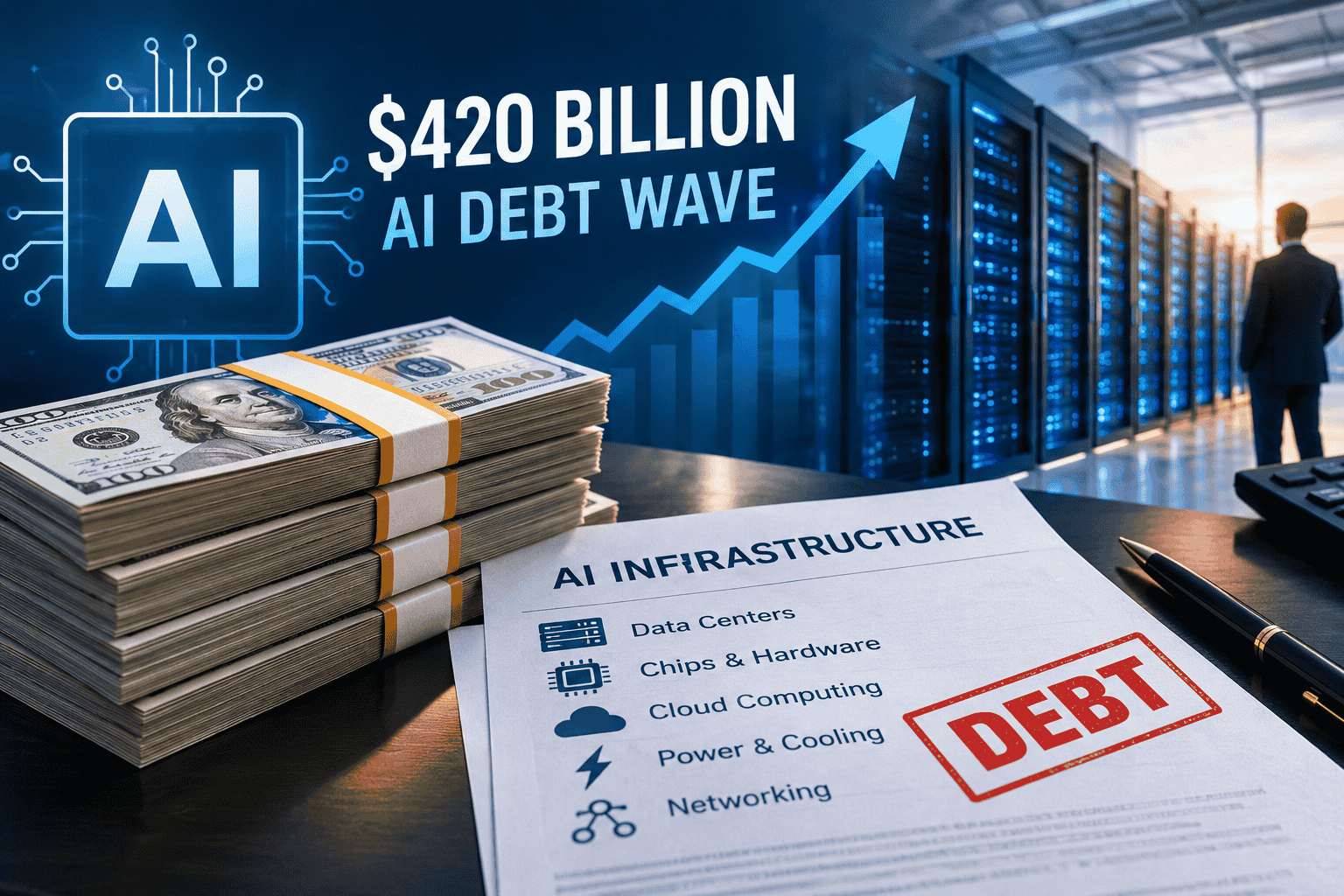
The artificial intelligence boom is entering a new financial phase. As technology companies accelerate spending on data centers, AI chips, cloud infrastructure and power capacity, the industry is increasingly relying on debt to finance its expansion.
According to Goldman Sachs data cited by Reuters, gross debt issuance by major AI hyperscalers is expected to reach $420 billion in 2027, representing a 60% increase from 2026 estimates. The scale of borrowing is prompting bond investors to become more selective, particularly as questions grow around how quickly massive AI infrastructure investments will generate returns.
The development does not mean investors believe major technology companies are approaching widespread default. Instead, the concern is increasingly focused on debt supply, concentration risk, financing structures, interest costs and the visibility of future returns.
What Is the $420 Billion AI Debt Wave?
The $420 billion figure refers to expected gross debt issuance by hyperscale technology companies in 2027.
Hyperscalers are the large technology companies operating enormous cloud and computing infrastructure networks. Their AI investments require extraordinary amounts of capital because advanced AI systems depend on:
- Data centers
- GPUs and AI accelerators
- Networking equipment
- Electricity and grid connections
- Cooling infrastructure
- Cloud computing capacity
- High-speed storage
- Semiconductor supply chains
Instead of financing all of this investment through operating cash flow, companies are increasingly turning to bond markets, private credit, structured finance and other funding mechanisms.
The Bank of England reported in July that AI companies had accelerated their use of external financing during the first half of 2026. It also noted that more than half of the external financing required for global data-center investment between 2026 and 2028 could potentially come through debt.
Why AI Infrastructure Requires So Much Debt
AI infrastructure is one of the most capital-intensive technology expansions in modern history.
Building a conventional software business can often be accomplished with relatively modest physical investment. AI at hyperscale is different.
Training and operating frontier AI models requires thousands or even hundreds of thousands of advanced processors, while the data centers supporting them require enormous amounts of electricity, cooling equipment and networking infrastructure.
The investment cycle also moves quickly. Companies cannot necessarily wait years to generate enough internal cash before expanding because competitors are simultaneously building their own AI capacity.
That creates a financing gap.
Debt can allow technology companies to build infrastructure today and potentially generate revenue from that infrastructure over many years.
However, it also creates a second question for investors:
Will the revenue and cash flow generated by AI ultimately be large enough to justify the infrastructure spending and associated financing costs?
That question is becoming increasingly important in credit markets.
AI Bond Issuance Is Changing the Corporate Debt Market
The AI infrastructure boom is already becoming significant enough to affect the broader corporate bond market.
The Bank of England reported that five major AI hyperscalers accounted for only about 3% of outstanding U.S. investment-grade debt at the end of 2025, but represented more than 15% of year-to-date issuance by early May 2026. It also cited analysis estimating that approximately $240 billion of AI hyperscaler investment needs in 2026 could be financed through investment-grade credit.
That means AI companies are becoming a much larger source of bond supply.
For investors, this creates an important portfolio-management issue.
Even companies with strong balance sheets can become less attractive if too much debt from the same sector arrives in the market at once.
Why Bond Investors Are Becoming More Selective
Reuters reported in September that AI-related bonds were receiving more cautious treatment than debt from several traditional industries.
AI-related issuers were reportedly offering wider spreads and larger pricing concessions to attract investors, while some traditional corporate borrowers continued to receive strong demand. Reuters reported spreads of around 115 basis points for AI-related issuers, compared with approximately 78 basis points for the broader investment-grade market.
The distinction is important.
Investors are not necessarily saying:
AI companies cannot repay their debt.
Instead, they are asking for greater compensation for taking on additional exposure to an industry where capital spending is expanding rapidly and future returns remain difficult to estimate.
This is a classic credit-market response to increased supply and uncertainty.
The Return-on-Investment Problem
One of the biggest questions surrounding AI infrastructure is the timing of returns.
Companies can spend billions of dollars on data centers and computing equipment long before those assets generate their full economic value.
The Bank of England has warned that increasing AI financing requirements could create risks around medium-term debt servicing, particularly if future earnings fail to develop as expected or refinancing conditions become less favorable.
S&P Global has also warned that hyperscaler credit quality is gradually weakening as capital expenditures rise faster than previously anticipated and financing structures become more complicated.
For investors, the central issue is therefore shifting from “How large is AI?” to “How efficiently can AI spending turn into sustainable cash flow?”
Interest Rates Add Another Layer of Risk
AI companies are building infrastructure during a period when financing costs remain an important market consideration.
Long-term data centers and power infrastructure are particularly sensitive to borrowing costs because their economics depend on large upfront investments followed by revenue generated over many years.
Research from the Federal Reserve System has highlighted the potential impact of AI-related debt issuance on the supply of long-duration corporate bonds and U.S. interest-rate markets.
If borrowing costs remain elevated, companies may have to spend more money servicing debt.
That could reduce the cash available for:
- Share buybacks
- Acquisitions
- Research and development
- Dividends
- Additional AI investment
At the same time, companies may continue borrowing because slowing infrastructure spending could allow competitors to gain technological or market advantages.
The Hidden Risk: Complex AI Financing Structures
Another emerging issue is the increasing complexity of AI financing.
AI infrastructure is not being financed solely through conventional corporate bonds.
The Bank of England highlighted growing use of private credit, leveraged finance, structured finance, securitization, special-purpose vehicles and asset-backed structures in the AI ecosystem.
These structures can help companies raise capital without relying entirely on traditional corporate debt.
But they can also make it harder for investors to determine exactly where financial risk sits.
A data center, for example, may involve a technology company, a specialized infrastructure operator, lenders, private-credit funds, equipment suppliers and long-term customer contracts.
Understanding the credit exposure therefore requires looking beyond the headline debt figure.
Concentration Risk Is Becoming More Important
Another concern is concentration.
Many investors already have exposure to AI through technology stocks, semiconductor companies, cloud providers and corporate bonds.
If they also purchase large quantities of AI-related debt, their overall portfolio exposure to the same economic theme can become much larger than it initially appears.
Reuters reported that some institutional investors are approaching exposure limits after accounting for debt issued through related structures connected to major technology companies.
This helps explain why investors can remain confident in the financial strength of individual companies while becoming more cautious about buying additional AI debt.
Is the AI Debt Wave a Sign of an AI Bubble?
The $420 billion borrowing forecast does not by itself prove that AI is a financial bubble.
Debt can be a normal and productive way to finance infrastructure when assets generate sufficient long-term cash flow.
Airports, telecommunications networks, energy projects and cloud infrastructure have all historically relied on substantial external financing.
The key question is whether AI infrastructure produces enough economic returns to support its financing costs.
That is why credit investors may focus more closely on:
- Free cash flow
- Debt-to-EBITDA ratios
- Interest coverage
- Data-center utilization
- Customer concentration
- Long-term contracts
- Power costs
- GPU depreciation
- Refinancing requirements
- Expected AI revenue growth
These metrics can provide a clearer picture of financial sustainability than AI spending figures alone.
Why the Debt Wave Matters for Investors
The implications extend beyond the technology sector.
If AI companies issue hundreds of billions of dollars of additional debt, they compete with banks, industrial companies, pharmaceutical firms and other borrowers for investor capital.
That could influence corporate borrowing costs across the market.
The Federal Reserve research has already identified potential duration-supply effects from the AI infrastructure investment cycle.
At the same time, investors may increasingly differentiate between AI companies based on balance-sheet strength and infrastructure economics rather than simply buying exposure to the broader AI theme.
What Investors Will Watch Next
Several indicators could become increasingly important through 2027.
AI Capital Expenditure
Investors will monitor whether hyperscalers continue increasing spending at the same pace.
Free Cash Flow
Strong operating cash generation can provide companies with greater flexibility to finance infrastructure without excessive borrowing.
Bond Spreads
Widening spreads can indicate that investors require greater compensation for holding AI-related debt.
Data-Center Utilization
Infrastructure needs to generate sufficient revenue to justify its construction and financing costs.
Refinancing Conditions
Companies that depend heavily on repeated debt issuance could become more sensitive to changes in interest rates and credit-market conditions.
AI Revenue Growth
Ultimately, the ability to monetize AI services will determine whether enormous infrastructure investments produce adequate economic returns.
FAQ: $420 Billion AI Debt Wave
What is the $420 billion AI debt wave?
It refers to Goldman Sachs’ forecast that major AI hyperscalers could issue approximately $420 billion of gross debt in 2027, about 60% above its 2026 estimate.
Why are AI companies borrowing so much?
They are financing large investments in data centers, AI chips, cloud infrastructure, networking, electricity and other physical infrastructure required for AI development and deployment.
Are investors worried that AI companies will default?
Current reporting indicates that investor caution is primarily related to the volume and unpredictability of borrowing, concentration risk and uncertainty around investment returns rather than an expectation of widespread defaults.
Does AI debt mean the AI boom is ending?
No. Rising debt does not necessarily indicate an end to AI growth. It does indicate that investors are paying greater attention to how the industry’s infrastructure spending is financed and whether those investments can generate sufficient returns.
Why does AI infrastructure need so much capital?
Advanced AI requires large-scale computing facilities, specialized chips, electricity, cooling, networking and storage. These physical requirements make AI significantly more capital-intensive than many earlier software-driven technology cycles.
Conclusion: AI’s Next Test Is Financial Efficiency
The $420 billion AI debt wave represents an important transition in the artificial intelligence investment cycle.
The first phase of the AI boom was largely about technological capability: building increasingly powerful models, acquiring GPUs and establishing cloud infrastructure.
The next phase is increasingly about economics.
Investors want to know how much infrastructure is required, how it will be financed, how quickly it will generate revenue and whether that revenue can support both operating costs and debt obligations.
For the world’s largest technology companies, access to capital remains substantial. But the bond market is beginning to demand more differentiation.
That means the next major AI debate may not simply be about who builds the biggest model or data center.
It may be about who can convert unprecedented AI infrastructure spending into durable cash flow and sustainable returns.
About the Author
Anam Younas
Editor of Daily Press Release
I write about technology, AI, business, finance, and global news, bringing readers clear insights into the latest trends and developments.
For more informative content Follow the Daily Press Release channel on WhatsApp: https://whatsapp.com/channel/0029Vb8gRyoIHphMqA6T2w0U