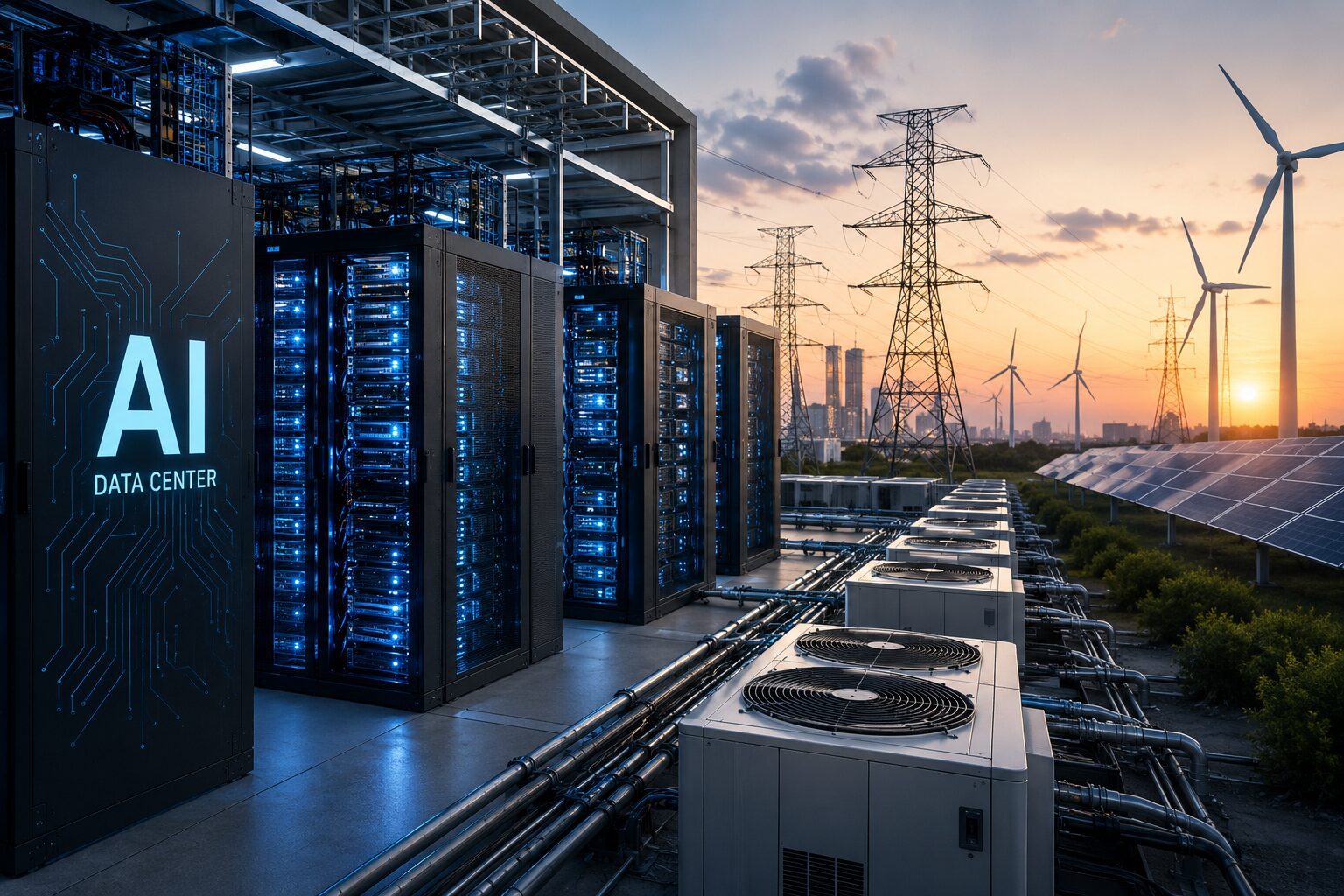
Artificial intelligence is transforming businesses, industries, and everyday life at an unprecedented pace. From AI-powered search engines and virtual assistants to automated business systems and advanced data analysis, the demand for artificial intelligence is growing rapidly. However, behind every AI application is a massive physical infrastructure that requires enormous amounts of computing power.
This is why AI data centers are becoming one of the most important technology and business stories of 2026. As companies invest billions in artificial intelligence, electricity, cooling systems, networking equipment, and data-center capacity are becoming critical resources. The next major technology competition may not only be about developing better AI models—it may also be about securing enough power and infrastructure to run them.
The Growing Demand for AI Data Centers
Traditional data centers already consume significant amounts of electricity, but AI workloads can require considerably more computing power. Training advanced AI models involves processing enormous datasets through powerful processors, while running AI services for millions of users requires continuous computing capacity.
Modern AI systems commonly depend on specialized processors and high-performance servers. These machines generate substantial heat and therefore require sophisticated cooling systems. As AI adoption expands, companies need larger facilities equipped to handle increasing computational workloads.
The result is a growing demand for AI data center infrastructure, including servers, power systems, cooling equipment, fiber networks, and specialized computing hardware.
For technology companies, having access to sufficient data-center capacity can directly influence how quickly they can develop and deploy new AI products.
Why Electricity Has Become a Technology Issue
For decades, electricity was largely treated as a background requirement for the technology industry. Today, that is changing.
Large AI data centers can require vast amounts of electricity, creating new challenges for utilities, governments, and technology companies. In regions experiencing rapid data-center development, existing power infrastructure may not have enough capacity to support additional facilities without significant investment.
This makes electricity availability an increasingly important factor when companies decide where to build new data centers.
Access to reliable power can influence everything from construction timelines to operating costs. If a region cannot provide sufficient electricity, a company may need to invest in new energy infrastructure or consider another location.
The Role of Data Center Cooling
Electricity is not the only infrastructure challenge. Cooling is another major concern.
AI processors operate at high performance and generate substantial heat. Keeping these systems within safe operating temperatures requires advanced cooling technologies.
Traditional air-cooling systems may become less practical as computing density increases. This has encouraged greater interest in liquid cooling and other advanced solutions designed to remove heat more efficiently.
Efficient cooling can help data-center operators reduce energy consumption while maintaining reliable performance. As AI infrastructure becomes more powerful, cooling technology is likely to become an increasingly important part of data-center design.
AI Infrastructure Is Creating New Business Opportunities
The expansion of AI data centers is not benefiting only major technology companies. It is creating opportunities across numerous industries.
Companies involved in construction, electrical equipment, power generation, cooling technology, networking, cybersecurity, real estate, and semiconductor manufacturing can all benefit from increased investment in AI infrastructure.
For example, data-center construction requires specialized contractors, engineers, electrical systems, backup power solutions, cooling equipment, security systems, and network infrastructure.
This creates a broader AI infrastructure economy in which businesses that support data centers can experience increased demand even if they do not develop AI software themselves.
The Semiconductor Connection
AI data centers also depend heavily on the semiconductor industry.
Advanced AI workloads require powerful processors capable of handling large-scale calculations. Graphics processing units (GPUs), AI accelerators, memory technologies, and networking chips have therefore become essential components of modern AI infrastructure.
As demand for AI computing increases, semiconductor manufacturers are under pressure to increase production and develop more powerful and energy-efficient hardware.
This creates a connection between AI models, semiconductor manufacturing, data centers, and electricity infrastructure. A shortage in any one of these areas can potentially limit the growth of the wider AI ecosystem.
The Importance of Renewable Energy
The rapid expansion of AI data centers is also raising questions about sustainability.
As electricity demand increases, technology companies are exploring ways to secure reliable power while reducing the environmental impact of their operations. Renewable energy sources such as solar and wind are becoming increasingly relevant to long-term data-center strategies.
However, renewable energy can be intermittent, which means data centers may require a combination of energy sources, storage technologies, and grid infrastructure to maintain consistent operations.
The challenge is not simply producing more electricity. Companies need reliable, scalable, and economically sustainable energy systems capable of supporting continuous computing workloads.
Governments Face New Infrastructure Challenges
The growth of AI data centers is also becoming a policy issue.
Governments must balance technological development with the needs of local communities and existing industries. New facilities can bring investment, construction activity, jobs, and tax revenue, but they can also increase pressure on electricity grids, water resources, and local infrastructure.
Policymakers may therefore need to consider how data-center development fits into broader energy and economic strategies.
Countries and regions that can provide reliable infrastructure may become attractive destinations for technology investment. At the same time, inadequate power capacity could make certain locations less competitive.
Will AI Change the Future of Energy?
The relationship between artificial intelligence and energy could become increasingly important over the next decade.
AI companies need electricity to operate their systems, while energy companies can use AI to improve forecasting, grid management, equipment maintenance, and energy efficiency. This creates a two-way relationship between the technology and energy sectors.
AI could ultimately help optimize energy systems while simultaneously increasing overall electricity demand.
The companies that successfully manage this balance may gain a competitive advantage as AI adoption continues.
What This Means for Businesses
Businesses should view AI infrastructure as more than a technology issue. It is becoming an important economic and strategic consideration.
Companies adopting AI may need to evaluate computing costs, cloud infrastructure, cybersecurity, data storage, and energy consumption. Larger organizations may also consider where their technology providers operate their data centers and how infrastructure limitations could affect future AI services.
For investors and entrepreneurs, the development of supporting industries could create opportunities beyond the most visible AI companies. Infrastructure providers, energy businesses, semiconductor manufacturers, cooling technology companies, and data-center specialists may all play important roles in the AI economy.
Conclusion
The AI revolution depends on much more than sophisticated software and powerful algorithms. Behind every AI application is a complex network of data centers, processors, electricity systems, cooling technologies, telecommunications infrastructure, and specialized equipment.
As artificial intelligence continues to expand, AI data centers and electricity infrastructure are becoming strategic resources. Technology companies will increasingly compete not only to develop the best AI models but also to secure the computing capacity and energy required to operate them.
The next phase of the AI revolution could therefore be shaped by an unexpected question: Who has access to enough power and infrastructure to run the future of artificial intelligence?
For businesses, governments, investors, and technology companies, preparing for this infrastructure challenge may be just as important as developing the next generation of AI itself.