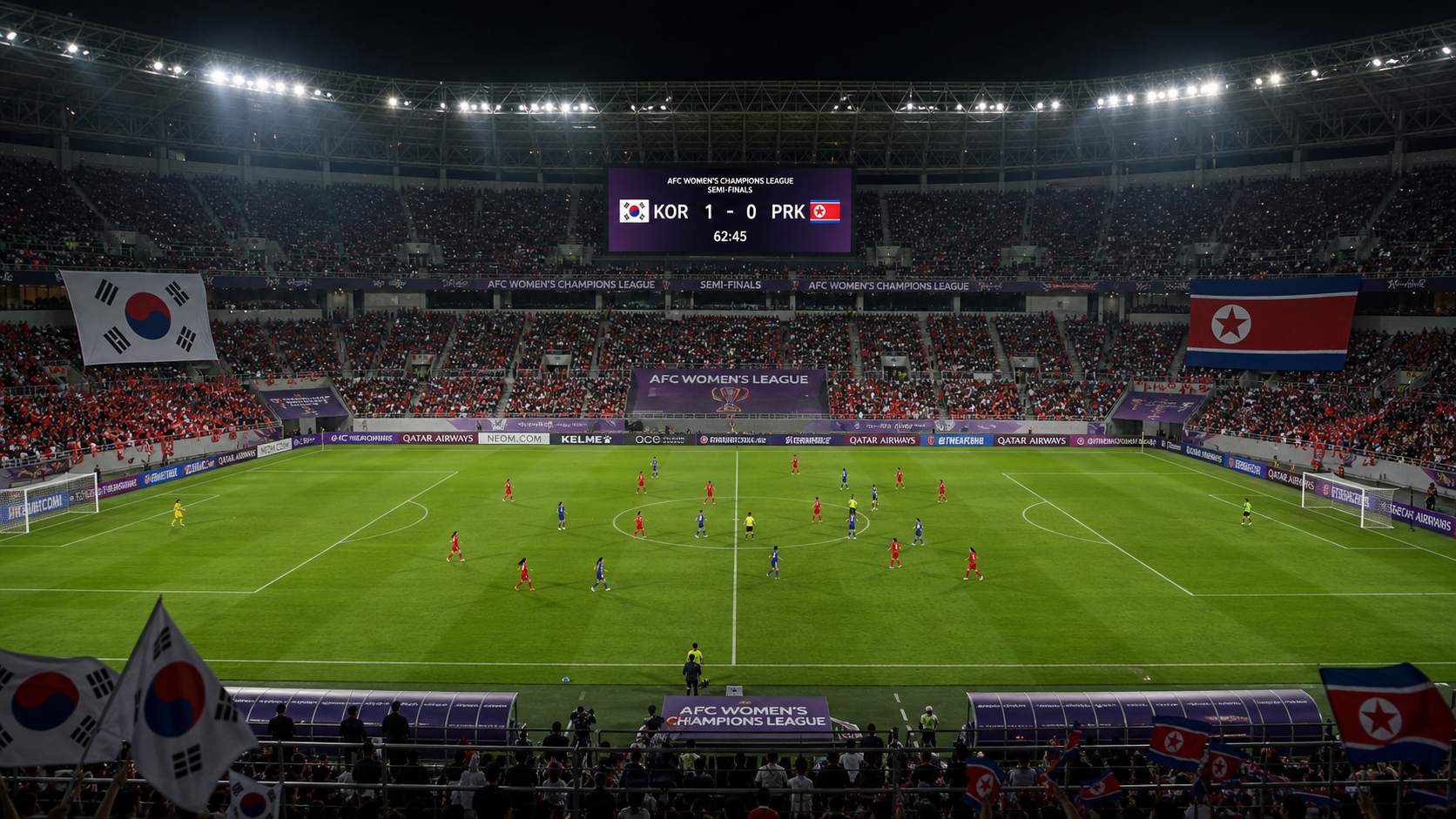
North Korea secured a dramatic victory in the AFC Women’s Champions League semifinal during a rare and historically significant visit to South Korea, marking the first time in more than seven years that North Korean athletes have competed on southern soil. The match was more than just a sporting contest—it unfolded against a backdrop of political tension, frozen diplomacy, and cautious global attention, turning it into one of the most symbolic football events in recent years.
A Rare Crossing of Borders
The arrival of North Korea’s Naegohyang Women’s Football Club in South Korea captured global headlines even before the first whistle was blown. The team traveled via Beijing and landed at Incheon International Airport under tight security and heavy media scrutiny. Their visit marked the first instance since late 2018 that athletes from North Korea had entered the South, highlighting the rarity of the occasion.
Relations between the two Koreas have significantly deteriorated in recent years. Political dialogue has stalled, communication lines have been cut, and rhetoric from both sides—particularly from Pyongyang—has grown increasingly hostile. Earlier this year, North Korea formally labeled South Korea as its “principal enemy,” reinforcing a deep ideological divide.
Against this tense geopolitical backdrop, the presence of North Korean players on South Korean soil carried profound symbolic weight. While officials emphasized that the visit was strictly for sporting purposes, the broader implications were impossible to ignore.
Football Over Politics
Despite the charged political atmosphere, the North Korean team made it clear that their focus remained solely on football. During pre-match engagements, team representatives avoided any political commentary and reiterated their commitment to performing on the pitch.
Naegohyang FC entered the semifinal in strong form, having previously delivered a convincing 3-0 victory against Vietnam’s Ho Chi Minh City Women’s Club. Their disciplined playing style, tactical awareness, and physical intensity had already positioned them as serious contenders in the tournament.
The semifinal match against South Korea’s Suwon FC Women was held in a packed stadium, with tickets selling out rapidly. The atmosphere was electric, fueled by curiosity, anticipation, and the event’s historical significance. Fans from both sides, along with neutral spectators, gathered not just to witness a football match but to be part of a rare moment of interaction between two divided nations.
A High-Stakes Semifinal Clash
From the opening minutes, the match showcased a high level of intensity and technical quality. Suwon FC, backed by home support, started aggressively, pressing high and attempting to control possession. However, Naegohyang quickly demonstrated its resilience and tactical discipline.
North Korea’s defensive organization proved difficult to break down, while their counterattacks were swift and purposeful. Midfield control was crucial, with Naegohyang’s players maintaining composure under pressure and capitalizing on key opportunities.
The breakthrough came through a well-coordinated attacking move that exposed gaps in Suwon’s defense. A precise through ball and clinical finishing gave Naegohyang the lead, shifting momentum in their favor. Despite several attempts by the South Korean side to equalize, the North Korean defense held firm.
As the match progressed, Naegohyang maintained their advantage through disciplined gameplay and strategic substitutions. When the final whistle blew, it confirmed a historic victory for the North Korean side, sending them into the AFC Women’s Champions League final.
Symbolism Beyond the Scoreline
While the match result was significant in sporting terms, its symbolic impact extended far beyond the scoreboard. This encounter represented one of the few remaining channels of engagement between North and South Korea—international sports competitions.
Sports diplomacy has historically played a role in easing tensions on the Korean Peninsula. Events such as the 2018 Winter Olympics in PyeongChang had previously opened the door to dialogue and cooperation. However, in recent years, such opportunities have become increasingly scarce.
This semifinal match served as a reminder that even in periods of political hostility, sport can provide a neutral ground for interaction. The joint presence of fans, the players’ respectful conduct, and the global attention all contributed to a moment that transcended typical competition.
Limited Diplomatic Impact
Despite the positive optics, experts remain cautious about interpreting the event as a sign of broader political change. There has been no indication from either government that this sporting exchange will lead to renewed dialogue or policy shifts.
North Korea has continued to emphasize its hardline stance, focusing on military preparedness and national security. Meanwhile, South Korea has maintained its openness to dialogue but has received little in return.
In this context, the football match appears to be an isolated instance of engagement rather than the beginning of a sustained diplomatic thaw. Nevertheless, it highlights the unique role that international sports can play in maintaining minimal levels of contact.
Looking Ahead to the Final
With their semifinal victory, Naegohyang FC now advances to face Japan’s Tokyo Verdy Beleza in the tournament final. The upcoming match promises to be another high-level contest, as both teams are known for their technical quality and competitive experience.
For North Korea, reaching the final is not only a sporting achievement but also an opportunity to demonstrate its capabilities on the international stage further. Their performance so far has showcased a blend of tactical discipline, physical strength, and mental resilience.
The final will also draw continued attention from global audiences, particularly given the unique circumstances surrounding North Korea’s participation in the tournament.
The Role of Women’s Football
Another notable aspect of this event is the spotlight it brings to women’s football in Asia. The AFC Women’s Champions League continues to grow in importance, providing a platform for clubs across the region to compete at a high level.
North Korea has long been recognized for its strength in women’s football, with a history of strong performances in international competitions. This semifinal victory reinforces their reputation as a formidable force in the sport.
At the same time, the event highlights the increasing visibility and commercial potential of women’s football. High attendance, strong media coverage, and global interest indicate a growing audience for the game.
An Uncertain Yet Memorable Moment
The historic visit of North Korea’s women’s football team to South Korea will likely be remembered as a rare moment of interaction amid prolonged tension. While its long-term political impact remains uncertain, its significance as a sporting and symbolic event is undeniable.
For fans, players, and observers alike, the match offered a glimpse of what engagement between the two Koreas can look like—even if only on the football field. It demonstrated that competition and cooperation can coexist, at least temporarily, within the framework of international sport.
As the tournament progresses and attention shifts to the final, the legacy of this semifinal will endure as a powerful example of how sports can intersect with history, politics, and human connection in unexpected ways.