Artificial intelligence is rapidly transforming industries, but the future of AI depends on more than sophisticated software. Powerful AI systems require advanced processors, semiconductor manufacturing, data centers, and reliable computing infrastructure. As demand for artificial intelligence continues to grow, access to advanced chips has become one of the most important strategic issues in the technology industry.
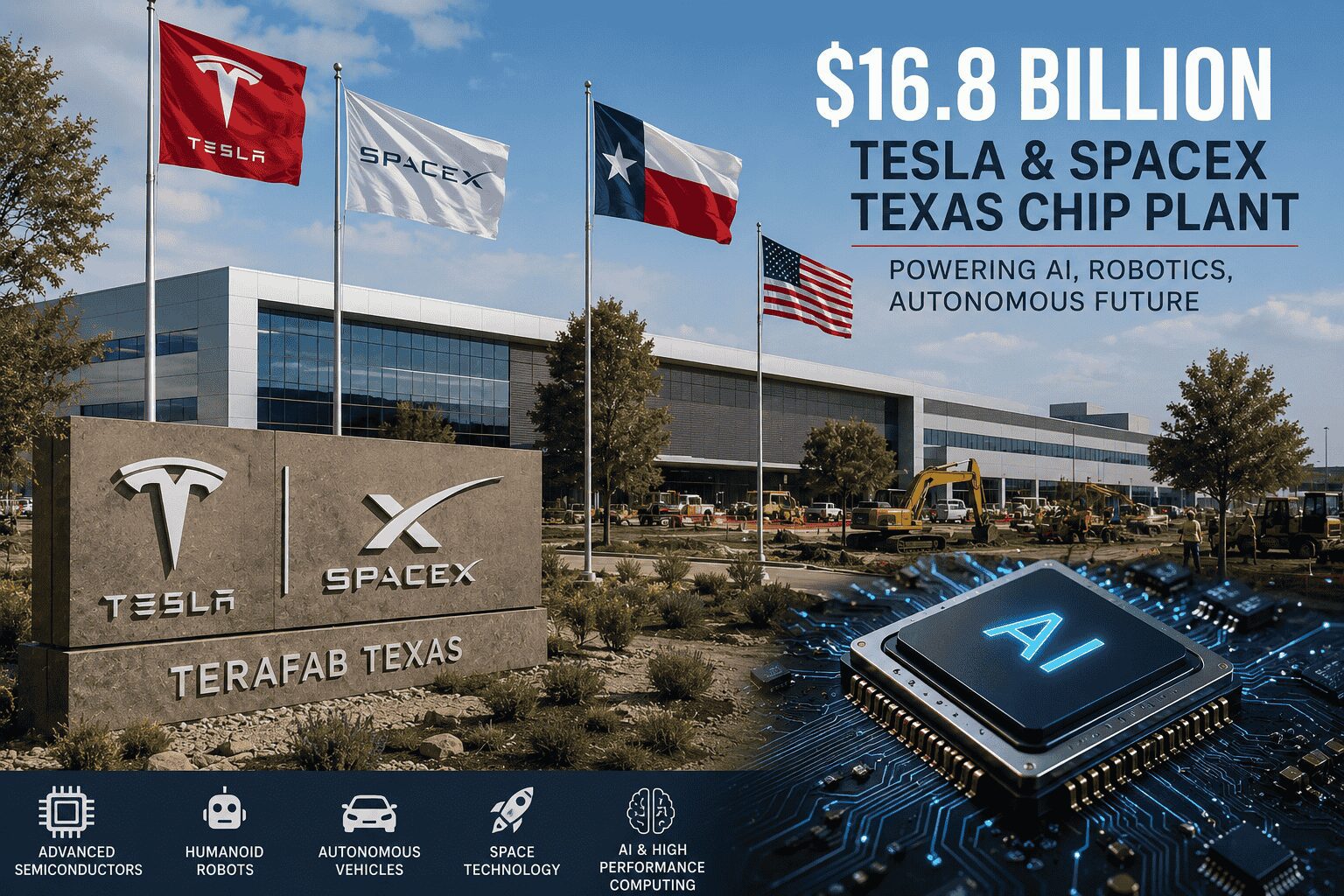
One of the latest developments in this race is the $16.8 billion Terafab semiconductor project in Texas, being developed by Tesla and SpaceX. The project represents an ambitious move toward greater control over chip manufacturing and could have significant implications for artificial intelligence, robotics, autonomous vehicles, and space technology.
What Is Tesla and SpaceX’s Terafab Chip Plant?
Terafab is a planned semiconductor manufacturing facility being developed by Tesla and SpaceX in Grimes County, Texas. The companies have announced an initial investment of approximately $16.8 billion in the project.
The facility is expected to cover around 100 million square feet and create at least 3,000 jobs. Rather than focusing on a single type of technology, the project is intended to support several areas of Tesla and SpaceX’s long-term technological ambitions.
What Will Terafab Produce?
The planned facility is expected to manufacture advanced semiconductor technologies for applications including:
- Artificial intelligence
- Humanoid robots
- Autonomous vehicles
- Space technology
- Advanced computing systems
- Future data-center applications
Tesla is expected to use the chips for its robotics and autonomous-driving ambitions, while SpaceX plans to use advanced computing hardware for future space-related systems.
The companies are also pursuing a more integrated manufacturing model involving chip fabrication, memory, packaging, and testing.
Why AI Chips Are Becoming So Important
Artificial intelligence requires enormous computing power. Training advanced AI models involves processing huge amounts of data, while operating AI services for millions of users requires powerful processors capable of handling continuous workloads.
AI Depends on Specialized Processors
Traditional computer processors are not always optimized for large-scale AI workloads. Modern AI systems increasingly rely on specialized hardware, including GPUs and other AI accelerators.
These processors can perform large numbers of mathematical calculations simultaneously, making them suitable for machine learning and other AI applications.
As companies invest more heavily in artificial intelligence, demand for these specialized chips is also increasing.
Chip Supply Has Become a Strategic Issue
The global semiconductor industry relies on complex supply chains involving chip designers, manufacturers, equipment suppliers, packaging companies, and testing facilities.
Any disruption in one part of this chain can affect the availability of advanced processors.
For technology companies developing AI products, greater control over semiconductor production could potentially provide advantages in supply security, product development, and long-term planning.
Why Tesla Is Investing in Semiconductor Manufacturing
Tesla has increasingly expanded beyond electric vehicles into artificial intelligence, autonomous driving, robotics, and advanced computing.
Its ambitions in these areas require significant amounts of specialized hardware.
Supporting Autonomous Vehicles
Autonomous vehicles depend on powerful computers capable of processing information from cameras, sensors, and other systems in real time.
Developing specialized chips could allow Tesla to design processors specifically around the requirements of its autonomous-driving technology.
Greater control over hardware could potentially improve performance, energy efficiency, and integration between Tesla’s software and physical systems.
Powering Humanoid Robots
Tesla’s Optimus humanoid robot project is another potential application for advanced AI chips.
Humanoid robots require onboard computing to understand their surroundings, process information, make decisions, and control movement.
As Tesla attempts to scale robotics technology, access to specialized processors could become increasingly important.
Why SpaceX Needs Advanced Chips
SpaceX has different requirements from Tesla, but advanced semiconductor technology is also important to its future plans.
The company is exploring increasingly sophisticated computing applications connected to space technology and future space-based infrastructure.
Computing in Space
Space-based computing systems could require specialized hardware designed to operate under demanding conditions.
Factors such as power efficiency, reliability, heat management, radiation exposure, and physical size can influence the design of computing systems intended for space environments.
By gaining greater control over semiconductor development, SpaceX could potentially develop hardware tailored to its specific requirements.
How Terafab Could Change Semiconductor Manufacturing
One of the most significant aspects of the Terafab project is its focus on vertical integration.
Traditional semiconductor supply chains often involve different companies handling chip design, fabrication, memory, packaging, and testing.
Bringing More Processes Together
Terafab is planned as a highly integrated manufacturing complex that could bring several stages of semiconductor production together.
This approach could potentially provide several advantages:
- Greater control over production
- Reduced dependence on external suppliers
- Faster coordination between hardware and software teams
- More secure supply chains
- Potentially shorter development cycles
- Greater customization of chips
However, building and operating a semiconductor facility at this scale is extremely complex.
The Impact on the Global Semiconductor Industry
The Terafab project comes as semiconductors become increasingly important to the global economy.
AI companies, automobile manufacturers, cloud providers, consumer electronics companies, and other technology businesses all require advanced chips.
More Companies May Invest in Chip Production
Tesla and SpaceX’s approach could encourage other technology companies to explore greater control over their semiconductor supply chains.
If the project proves successful, it could demonstrate that large technology companies can benefit from investing directly in specialized chip manufacturing rather than relying entirely on external suppliers.
This could increase competition within the semiconductor industry and encourage further investment in domestic manufacturing.
Why Texas Is Important to the Project
Texas has become an increasingly important center for technology, manufacturing, energy, and semiconductor development.
The Terafab project could further strengthen the state’s position as a technology and advanced-manufacturing hub.
Potential Economic Benefits
A project of this scale could create opportunities beyond direct employment.
Local and regional businesses could benefit from increased demand for:
- Construction services
- Engineering
- Manufacturing
- Electrical infrastructure
- Transportation
- Equipment maintenance
- Technology services
- Energy and utility services
The development could therefore have a broader economic impact across the surrounding region.
Challenges Facing the Terafab Project
Despite its potential, Terafab will face significant challenges.
Semiconductor manufacturing requires highly specialized equipment, advanced engineering capabilities, carefully controlled environments, and highly trained employees.
High Costs and Technical Complexity
Building a semiconductor manufacturing facility requires enormous capital investment. The companies must also maintain high production standards and adapt to rapidly changing semiconductor technologies.
Simply constructing a large facility does not guarantee that it will successfully produce advanced chips at the required scale and quality.
Energy and Infrastructure Requirements
Large semiconductor facilities also require reliable electricity, water, transportation networks, and supporting infrastructure.
As AI and semiconductor manufacturing expand, energy availability could become an increasingly important factor in determining where technology companies build new facilities.
How Terafab Could Influence the Future of AI
The significance of Terafab goes beyond chip manufacturing.
The project demonstrates how the AI industry is becoming increasingly connected to physical infrastructure.
The AI Race Is Becoming an Infrastructure Race
Companies competing in artificial intelligence need more than advanced algorithms. They also need:
- High-performance chips
- Data centers
- Electricity
- Cooling systems
- Networking infrastructure
- Semiconductor manufacturing
- Advanced research facilities
This means that the companies capable of securing these resources could gain an important competitive advantage.
AI Hardware and Software Are Becoming More Connected
Future AI development is likely to involve closer cooperation between hardware and software.
Companies that can design AI models, develop specialized processors, and build the infrastructure needed to operate them may be able to optimize their technology more effectively.
Terafab could therefore represent an important step toward a more vertically integrated AI ecosystem.
What Tesla and SpaceX’s Investment Means for Businesses
The project also offers an important lesson for businesses outside the semiconductor industry.
Artificial intelligence is creating demand across a wide range of sectors, including infrastructure, energy, cybersecurity, construction, manufacturing, cloud computing, and technology services.
Companies that support the AI ecosystem may benefit even if they do not develop AI products themselves.
For investors and entrepreneurs, this creates opportunities to look beyond well-known AI software companies and consider the businesses providing the physical infrastructure behind the technology.
Conclusion: Is Terafab the Future of AI Chip Manufacturing?
Tesla and SpaceX’s $16.8 billion Texas chip plant represents a major investment in semiconductor manufacturing and the future of artificial intelligence.
For Tesla, advanced chips could support autonomous vehicles, robotics, and other AI-powered technologies. For SpaceX, specialized computing hardware could contribute to future space and data-center ambitions.
More broadly, Terafab highlights an important shift in the technology industry. The future of AI will not depend solely on developing smarter algorithms. It will also depend on access to powerful processors, reliable energy, manufacturing capacity, and advanced infrastructure.
If Tesla and SpaceX successfully execute their ambitious plans, Terafab could become an important example of how technology companies are attempting to control more of the hardware supply chain.
The AI race is no longer simply about who can build the smartest AI system. Increasingly, it may also be about who can manufacture the chips and infrastructure needed to power it.