Introduction
The U.S. artificial intelligence boom in 2026 has reached a remarkable scale. American technology companies are investing hundreds of billions of dollars in AI chips, data centers, cloud infrastructure, electricity generation and advanced software. Investors continue to place enormous value on companies connected to artificial intelligence, while startups are raising billions based on expectations of future growth.
But a major question is becoming harder to ignore: Is the U.S. AI boom a genuine technological revolution, or is America heading toward an artificial intelligence bubble?
The answer is complicated. There is strong evidence that AI is creating real business value, but there are also signs of speculative investment, extremely high valuations, rising infrastructure costs and uncertain returns. In 2026, the AI market appears to contain both a genuine technological transformation and some characteristics of a financial bubble.
Why the U.S. AI Boom Is So Large
Artificial intelligence has moved from an experimental technology to a major corporate investment priority.
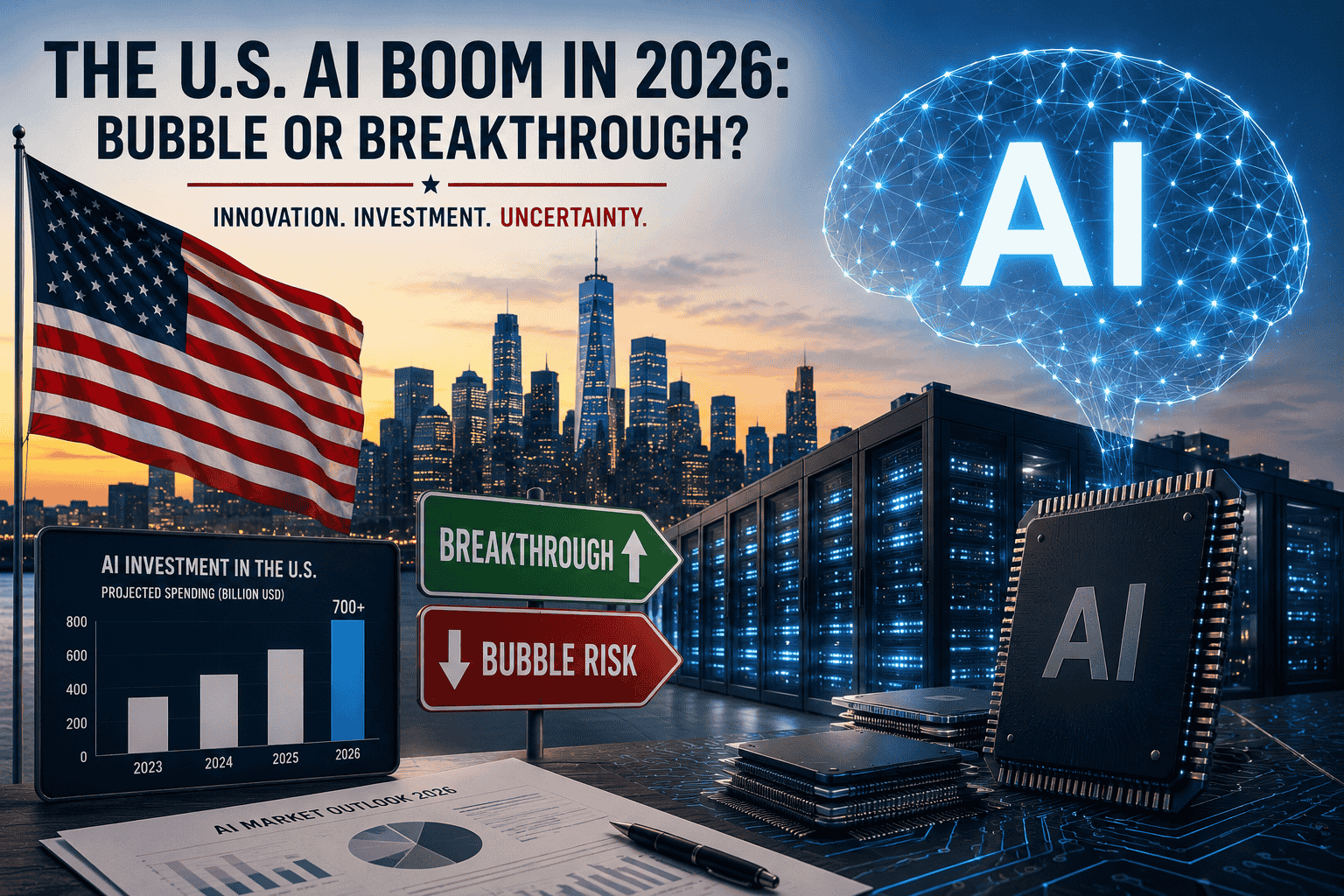
Companies such as Microsoft, Amazon, Alphabet, Meta and Nvidia are spending enormous amounts on AI infrastructure. The combined AI-related investment plans of several major U.S. technology companies are expected to reach more than $700 billion during 2026, demonstrating the extraordinary scale of the current spending cycle.
The investment covers much more than AI applications.
Companies need:
- Advanced AI chips
- Massive data centers
- High-speed networking
- Cloud computing infrastructure
- Electricity and cooling systems
- AI software
- Specialized employees
- New models and computing platforms
This infrastructure is becoming one of the largest investment themes in the American economy.
Nvidia Has Become a Symbol of the AI Boom
Few companies represent the AI investment surge better than Nvidia.
The company has become the leading supplier of advanced processors used to train and operate sophisticated AI systems. Its market value has reached roughly $5 trillion, making it one of the most valuable companies in history.
Nvidia’s growth demonstrates that there is genuine demand for AI computing.
However, its enormous valuation also illustrates the expectations built into the AI market. Investors are assuming that demand for AI computing will remain extremely strong for years.
That creates an important question: What happens if AI spending grows more slowly than expected?
Even a highly profitable company can experience significant market pressure if investors believe future growth will not justify current expectations.
The Data Center Investment Explosion
The AI revolution requires physical infrastructure.
Large AI models require enormous computing power, which means companies are building new data centers across the United States.
This has created opportunities for construction companies, semiconductor manufacturers, energy providers, cloud businesses and equipment suppliers.
It has also created new problems.
Data centers consume huge amounts of electricity and require sophisticated cooling systems. Several U.S. states are now facing debates about how much power should be allocated to rapidly expanding data-center projects.
The infrastructure buildout is therefore becoming an economic and political issue, not simply a technology story.
Why Some Investors Are Worried About an AI Bubble
The strongest argument for an AI bubble is the enormous amount of money being invested before the full economic returns are known.
Companies are spending heavily today because they expect AI to generate much larger revenues tomorrow.
That expectation may eventually prove correct.
But if AI adoption fails to generate sufficient profits, some investments could become difficult to justify.
This is similar to previous technology booms, when investors correctly identified a revolutionary technology but overestimated how quickly individual companies would become profitable.
The internet transformed the global economy, for example, but many internet companies that attracted enormous investment eventually failed.
The same distinction matters for AI.
AI can be revolutionary while some AI investments are still overvalued.
AI Startups Are Attracting Huge Valuations
Another warning sign is the extraordinary amount of capital flowing into private AI companies.
Some AI startups are achieving multibillion-dollar valuations despite having relatively short operating histories.
Investors are betting that these companies will eventually become major platforms or infrastructure providers.
There are legitimate reasons for optimism. AI adoption is expanding rapidly across software development, finance, healthcare, customer service, advertising, cybersecurity and other industries.
However, valuations can become disconnected from current revenue when investors compete aggressively to gain exposure to the next major AI company.
That creates the possibility of a correction if growth expectations change.
The AI Bubble Debate Is Different From the Dot-Com Bubble
Comparing today’s AI market with the dot-com boom is tempting, but the situations are not identical.
Many AI companies have genuine customers, significant revenues and rapidly growing demand.
Nvidia, for example, is not simply a company promising future technology. It is already generating substantial revenue from AI infrastructure.
Major technology companies also have enormous cash flows and established businesses that can finance AI investment.
This provides a stronger foundation than many internet startups had during the late 1990s.
However, that does not mean the entire AI market is safe from a correction.
Individual companies, infrastructure projects and speculative investments can still fail even if artificial intelligence itself becomes one of the most important technologies of the century.
Debt Is Becoming an Important Risk
One of the newest concerns surrounding the AI boom is how infrastructure is being financed.
Building enormous data centers requires billions of dollars.
Technology companies are increasingly using a combination of corporate cash, borrowing, partnerships, private financing and specialized financial structures to fund expansion.
This can accelerate growth, but it also increases financial exposure.
If AI revenues grow rapidly, these investments could generate strong returns.
If demand slows unexpectedly, companies could be left with expensive infrastructure and financing obligations.
That is why financial regulators and economists are increasingly paying attention to the pace of AI investment.
Energy Could Become the Biggest Limitation
AI requires enormous amounts of electricity.
As more data centers are built, electricity demand is increasing in areas where AI infrastructure is concentrated.
This creates opportunities for utilities, nuclear power developers, renewable-energy companies and natural-gas producers.
But it also creates challenges.
If electricity infrastructure cannot expand quickly enough, data-center construction could face delays.
Higher electricity demand could also increase costs for businesses and households in some regions.
In other words, the future of AI may depend partly on something outside the technology industry: America’s ability to produce and deliver enough power.
What Happens If the AI Bubble Bursts?
If AI investment falls sharply, the consequences could spread across financial markets and the technology industry.
AI chip companies could experience declining orders.
Data-center construction could slow.
Startups could struggle to raise new funding.
Highly valued technology stocks could experience major corrections.
Companies that rely heavily on AI spending could reduce hiring and investment.
However, a correction would not necessarily mean that artificial intelligence had failed.
The technology could continue expanding while investors simply become more selective about which companies deserve high valuations.
This happened with many previous technological revolutions.
Why the AI Boom Could Still Continue
Despite the risks, there are strong reasons to believe AI investment will remain important.
Businesses are already using AI to automate repetitive tasks, analyze information, develop software, improve customer service and increase productivity.
AI is also moving beyond chatbots into AI agents, robotics, healthcare systems, cybersecurity and industrial automation.
If these technologies produce measurable productivity improvements, companies could justify much of today’s infrastructure spending through future revenue and cost savings.
The key issue is whether those economic benefits arrive quickly enough to support current investment levels.
Three Possible Futures for the U.S. AI Market
1. Sustainable AI Growth
AI continues generating strong productivity and revenue gains. Infrastructure investment produces attractive returns, and the market grows without a major crash.
2. Selective Correction
Some AI companies and projects prove overvalued, causing a market correction. Strong companies survive and continue growing while weaker businesses disappear.
3. Major AI Bubble Burst
AI revenues fail to meet expectations, investment slows dramatically and heavily financed infrastructure projects become difficult to support. Technology stocks fall sharply and the wider economy feels the effects.
The second scenario may ultimately be the most realistic. Technological revolutions often involve periods of excessive optimism followed by market corrections.
Conclusion
The U.S. AI boom in 2026 is too large to dismiss as simple hype. Artificial intelligence is already changing businesses, investment patterns, productivity and infrastructure across America.
At the same time, the scale of investment creates legitimate concerns. Companies are spending enormous sums on data centers and AI systems, private startups are receiving extraordinary valuations, and investors are making aggressive assumptions about future growth.
So, is America heading toward an AI bubble?
Possibly—but the more important point is that a bubble can exist within a genuine technological revolution. AI itself does not have to fail for some AI investments to collapse.
The next phase will be determined by one crucial factor: whether AI can turn extraordinary investment into extraordinary economic returns.
If businesses begin generating measurable productivity gains and sustainable profits, today’s enormous spending could eventually look justified. If revenues fail to keep pace with investment, 2026 could be remembered as the year when AI enthusiasm reached unsustainable levels.
For now, America’s AI revolution is continuing at full speed. The real test is no longer whether AI will transform the economy—it is how much investors are willing to pay for that transformation, and whether the returns will justify it.