Introduction
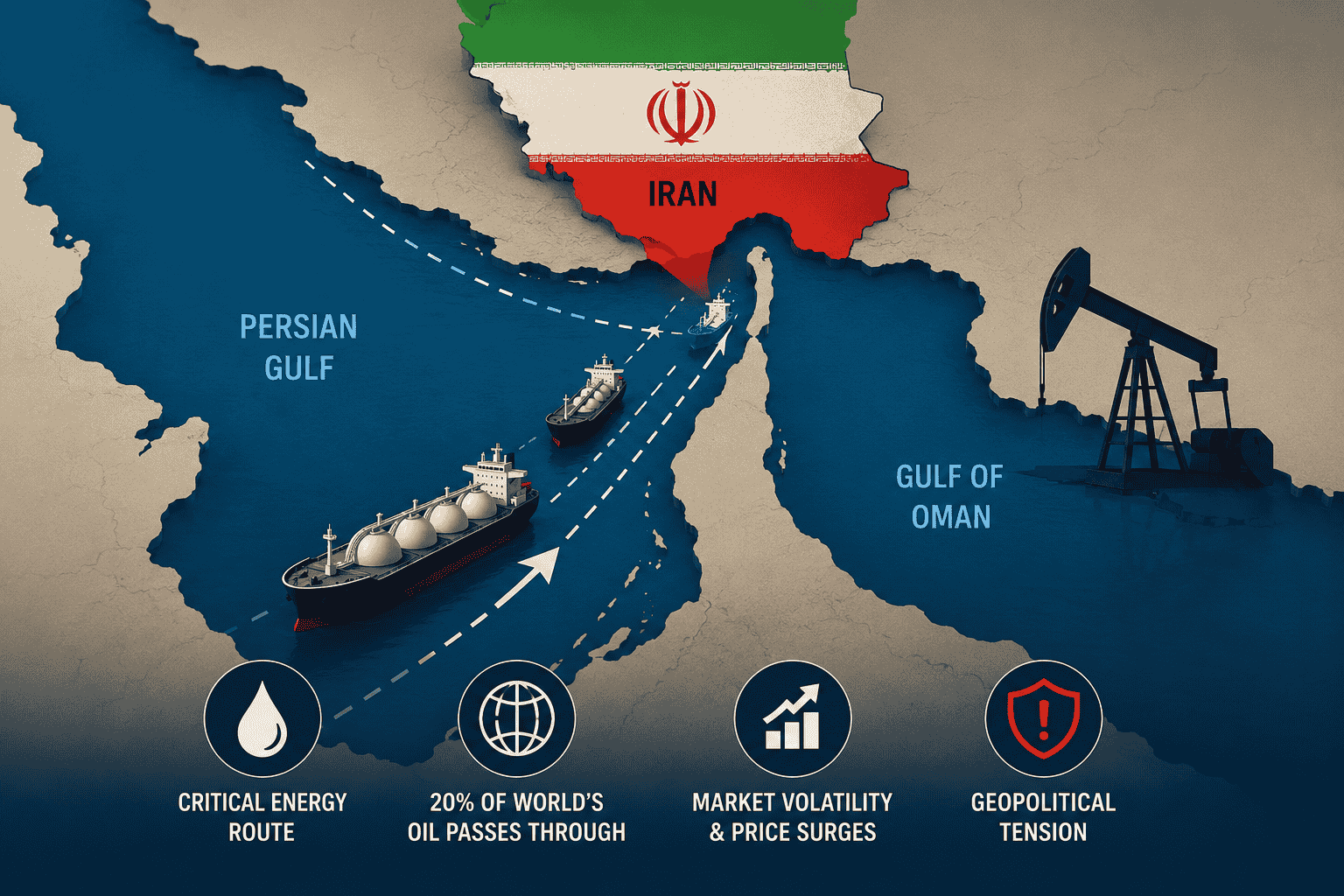
Few waterways on Earth carry as much economic weight as the Strait of Hormuz. This narrow channel between Iran and Oman connects the oil-rich Persian Gulf to the open ocean, and for decades it has served as the single most important artery for global energy trade. Since late February 2026, that artery has been under unprecedented strain. Following the outbreak of the US-Israel war on Iran, Tehran has asserted de facto control over the strait, demanding that vessels seek permission and pay transit fees before passing through. The result has been the largest disruption to global energy flows in recorded history, sending shockwaves through shipping, oil markets, and economies far beyond the Middle East.
Why the Strait of Hormuz Matters So Much
The Strait of Hormuz is barely 21 miles wide at its narrowest point, yet it normally carries roughly a fifth of the world’s oil supply and close to a fifth of global liquefied natural gas shipments. Tankers loaded in Saudi Arabia, the UAE, Kuwait, Qatar, and Iraq all depend on this single passage to reach international buyers. There is no comparable alternative route with anywhere near the same capacity, which is exactly why any disruption here ripples so quickly through global markets. Before the current conflict, roughly 130 vessels transited the strait each day. That number has collapsed to a small fraction of pre-war levels, with some days seeing barely a handful of ships attempt the crossing.
How the Crisis Unfolded
The trouble began when US and Israeli military operations against Iran started in late February 2026. Tehran responded by threatening, and in several cases carrying out, attacks on commercial shipping in and around the strait, effectively asserting the right to control who could pass and under what conditions. The United States answered by reimposing a naval blockade and launching further airstrikes, turning one of the world’s busiest shipping lanes into an active conflict zone.
A brief window of hope opened in June, when Washington and Tehran signed a memorandum of understanding aimed at reopening Hormuz to commercial traffic. That agreement collapsed almost immediately after disputes emerged over which specific routes ships would be permitted to use. Iran pushed for vessels to sail through its territorial waters, while the US and its allies favored a route hugging the Omani coastline. Talks between Iran and Oman have continued since, reportedly edging toward a compromise in which inbound cargo would pass through Iranian waters and outbound cargo through Omani waters. But as of mid-August, no final deal has been signed, and Iranian officials have continued to attach conditions to any reopening, including demands that Washington lift its naval blockade, ease sanctions, and pay war reparations.
Adding to the uncertainty, Iranian state media published a draft framework that would bar US and Israeli vessels from the strait entirely, block ships belonging to any nation deemed to have harmed Iran until compensation is paid, and impose steep financial penalties on violators. Details like these have repeatedly derailed optimism in the negotiations and kept markets on edge.
The Ripple Effect on Oil and Gas Prices
Energy markets have swung wildly in response to every twist in the negotiations. Brent crude, the global benchmark, spiked above $100 a barrel earlier in the year as the conflict intensified, and by mid-August it was trading close to $90 a barrel, still roughly a quarter higher than before the war began. Prices have moved sharply on nearly every headline: they fall when officials hint a deal is close, then jump again when talks stall or new attacks occur. At one point, one prominent energy analyst warned that a prolonged near-closure of the strait could push prices toward $150 to $200 a barrel, a scenario that would ripple through inflation, consumer fuel costs, and central bank policy worldwide.
The US Energy Information Administration has projected that Middle East oil production will not return to anywhere near pre-conflict levels until early 2027, underscoring how long this disruption is expected to last. In the meantime, some producers have been forced to reroute shipments overland or through alternative ports, such as Yanbu on Saudi Arabia’s Red Sea coast, though these workarounds cannot come close to matching the volume the strait once handled.
Wider Economic and Shipping Consequences
Beyond crude oil, the crisis has hit natural gas markets, shipping insurance costs, and global supply chains. Insurers have sharply raised war-risk premiums for vessels attempting the passage, adding significant cost to every voyage that still goes through. Shipping companies that can avoid the strait entirely are rerouting where possible, lengthening voyage times and adding to fuel and logistics costs that eventually reach consumers. Countries heavily reliant on Gulf energy imports, particularly across Asia and Europe, are facing higher energy bills and renewed pressure to diversify their supply sources, whether through liquefied natural gas from other regions, increased renewable investment, or strategic reserves.
The conflict has also reignited debate over the fragility of relying on a single geographic chokepoint for such a large share of the world’s energy trade. Policymakers and energy companies are once again examining pipeline alternatives that bypass the strait, though building out that kind of infrastructure takes years, not months, meaning the world is unlikely to reduce its dependence on Hormuz in the near term.
What Comes Next
The path forward hinges almost entirely on diplomacy. Iran and Oman appear closer than Iran and the US to some kind of workable arrangement on transit routes, but a durable resolution will likely require Washington and Tehran to bridge much larger gaps over sanctions, military posture, and compensation demands. Until an agreement holds and shipping volumes meaningfully recover, expect continued volatility in oil markets, elevated shipping costs, and a global economy that remains unusually sensitive to news out of the Persian Gulf.
For now, the Strait of Hormuz stands as a stark reminder of how a single, narrow stretch of water can hold enormous sway over the world’s energy security and economic stability. Businesses, governments, and consumers alike are left watching the same 21 miles of ocean, waiting to see whether diplomacy can succeed where military pressure has so far failed.