Introduction
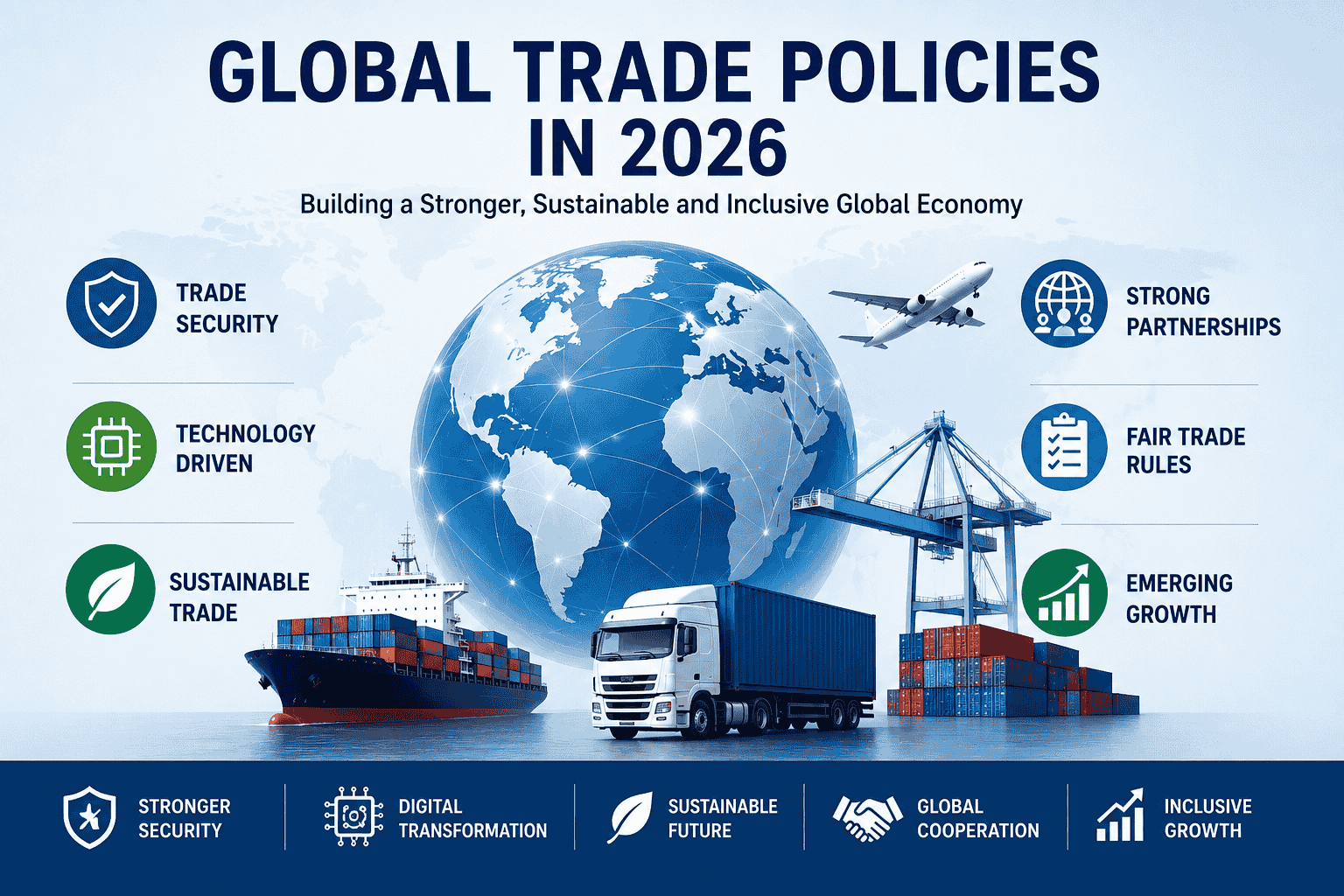
Global trade is undergoing one of the most significant transformations in modern history. In 2026, international commerce is no longer driven solely by lower tariffs, cheaper manufacturing, and unrestricted globalization. Governments are redefining trade policies to address national security concerns, technological competition, supply chain vulnerabilities, climate change, and economic resilience.
For decades, globalization encouraged businesses to manufacture products wherever production costs were lowest. This strategy created highly interconnected supply chains that increased efficiency and reduced consumer prices. However, recent disruptions, including geopolitical conflicts, transportation challenges, energy market instability, and shifting diplomatic relationships, have exposed weaknesses in the traditional model of global trade.
Today, policymakers are attempting to create a new trade framework that balances international cooperation with domestic economic interests. Trade agreements are becoming more complex, and businesses are adapting to new regulations that affect manufacturing, technology, environmental standards, and cross-border commerce.
Understanding the future of global trade policies is essential for governments, investors, businesses, and consumers. The decisions made today will influence economic growth, employment, technological development, and international relations for many years.
The End of Traditional Globalization
For more than three decades, globalization was the dominant economic model.
Countries reduced trade barriers, signed free-trade agreements, and encouraged companies to expand internationally. Manufacturing moved to regions with lower labor costs, allowing businesses to increase profits and consumers to purchase products at more affordable prices.
However, the traditional globalization model began to face increasing criticism.
Several challenges contributed to this shift:
- Overdependence on international supply chains
- Rising geopolitical tensions
- Manufacturing concentration in a limited number of countries
- Economic inequality
- National security concerns
The global economy is now moving toward a more strategic model in which governments prioritize resilience alongside economic efficiency.
Instead of asking, “Where can products be manufactured most cheaply?” policymakers are increasingly asking, “How can supply chains remain secure during periods of uncertainty?”
This change represents one of the most important developments in global trade policy.
The Rise of Economic Nationalism
Economic nationalism has become one of the defining characteristics of international trade in 2026.
Governments are implementing policies designed to protect domestic industries and reduce dependence on foreign markets.
Economic nationalism includes strategies such as:
- Import restrictions
- Domestic manufacturing incentives
- Export controls
- Industrial subsidies
- Strategic investments
Several countries have introduced policies that encourage businesses to relocate manufacturing facilities and invest in local production.
Supporters argue that these measures strengthen economic security and create employment opportunities.
Critics believe they may reduce competition, increase production costs, and weaken international cooperation.
Regardless of the debate, economic nationalism is becoming a permanent component of modern trade policy.
Supply Chain Diversification and Regionalization
One of the most important lessons learned during recent global disruptions is that relying on a single manufacturing region creates significant risks.
Businesses are responding by diversifying supply chains and reducing dependence on individual suppliers.
Three important strategies are emerging.
Nearshoring
Nearshoring involves relocating production closer to consumers.
For example, a company that previously manufactured products on another continent may choose to move production to a neighboring country.
Benefits include:
- Faster transportation
- Lower shipping costs
- Greater supply-chain reliability
Friend-Shoring
Friend-shoring encourages businesses to manufacture products in countries that maintain strong political and economic relationships.
This strategy reduces geopolitical risks and strengthens trade partnerships.
Regionalization
Regionalization involves building manufacturing networks within specific geographic regions.
Instead of relying on global supply chains, companies are developing local production ecosystems that can operate more efficiently during periods of disruption.
These strategies are fundamentally changing the geography of global commerce.
Technology Is Creating a New Trade Environment
Technology has become one of the most influential factors shaping trade policies.
Artificial intelligence, robotics, automation, cloud computing, and digital platforms are transforming how products are manufactured and distributed.
Governments are creating new regulations to address several technology-related challenges.
Artificial Intelligence and Trade
AI is improving manufacturing efficiency through:
- Predictive maintenance
- Automated quality control
- Production optimization
- Supply-chain forecasting
Countries that lead in AI development may gain significant economic advantages.
Semiconductor Competition
Semiconductors have become one of the world’s most strategically important products.
Modern economies depend on semiconductor technology for:
- Smartphones
- Computers
- Automobiles
- Medical equipment
- Defense systems
As a result, governments are investing heavily in domestic semiconductor manufacturing.
Digital Trade Agreements
Traditional trade agreements focused on physical products.
Modern agreements increasingly regulate:
- Cross-border data transfers
- Digital services
- Online marketplaces
- Cloud computing
- Intellectual property
Digital commerce is becoming an increasingly important component of international trade.
Green Trade Policies and Environmental Regulations
Climate change is transforming global trade policies.
Governments are introducing environmental regulations that affect every stage of production.
Several environmental policies are becoming more common.
Carbon Border Adjustments
Some countries are introducing carbon-related tariffs on imported products.
These policies encourage manufacturers to reduce emissions and adopt cleaner production methods.
Sustainable Manufacturing
Businesses are investing in environmentally responsible production techniques.
Sustainable manufacturing includes:
- Renewable energy
- Energy-efficient technologies
- Waste reduction
- Resource conservation
Green Supply Chains
Companies are redesigning supply chains to reduce environmental impacts.
Consumers are increasingly demanding sustainable products, and governments are responding with stricter regulations.
Environmental policies are becoming an essential component of international trade negotiations.
Geopolitical Competition Is Reshaping Trade
Geopolitics has become one of the most powerful influences on international commerce.
Trade relationships are increasingly shaped by diplomatic alliances, security concerns, and strategic competition.
Several geopolitical factors are influencing trade policies.
Energy Security
Energy remains one of the most important components of global trade.
Oil, natural gas, and renewable energy technologies significantly influence economic growth.
Disruptions affecting energy markets can create immediate consequences for:
- Manufacturing
- Transportation
- Inflation
- Consumer prices
Strategic Resources
Rare-earth minerals are becoming increasingly valuable because they are essential for advanced technologies.
These minerals support industries such as:
- Electric vehicles
- Renewable energy
- Artificial intelligence
- Consumer electronics
Competition for strategic resources is expected to intensify during the coming years.
International Sanctions
Economic sanctions have become a powerful foreign-policy tool.
Governments are increasingly using trade restrictions to influence political behavior.
As a result, businesses must carefully evaluate geopolitical risks before expanding into international markets.
The Evolution of Free-Trade Agreements
Free-trade agreements remain important, but they are evolving.
Modern agreements extend far beyond tariff reductions.
New trade agreements often include provisions related to:
| Traditional Agreements | Modern Agreements |
| Tariffs | Digital trade |
| Import quotas | Data protection |
| Market access | Environmental standards |
| Customs procedures | Labor rights |
| Goods transportation | Technology regulations |
Future agreements will likely become even more comprehensive.
Trade negotiations will increasingly involve technology, environmental policy, cybersecurity, and artificial intelligence.
Emerging Economies Are Becoming More Influential
Emerging economies are playing a larger role in international trade.
Countries across Asia, Africa, and Latin America are strengthening manufacturing capabilities and expanding regional trade partnerships.
Several factors are contributing to this transformation.
Growing Consumer Markets
Developing economies are creating large consumer markets that attract international investment.
Industrial Development
Governments are investing in infrastructure, education, and manufacturing.
Increased Regional Cooperation
Regional trade agreements are strengthening economic relationships between neighboring countries.
These developments are creating new opportunities for global businesses.
Emerging economies are becoming active participants in shaping international trade policies rather than simply adapting to decisions made by developed nations.
Challenges Facing Global Trade in 2026
Despite significant opportunities, several challenges remain.
Rising Protectionism
Trade barriers continue to increase.
Regulatory Complexity
Businesses must comply with increasingly complicated regulations.
Cybersecurity Risks
Digital trade creates new security vulnerabilities.
Transportation Challenges
Shipping disruptions continue to affect international commerce.
Political Uncertainty
Geopolitical conflicts create unpredictable market conditions.
Companies that fail to adapt to these challenges may struggle to remain competitive.
Predictions for the Future of Global Trade
Several trends are likely to define international trade during the next decade.
- Greater regionalization
- Increased investment in domestic manufacturing
- Stronger environmental regulations
- Expanded digital trade agreements
- Continued technological competition
- Greater use of artificial intelligence
- More diversified supply chains
The future of trade will emphasize resilience as much as efficiency.
Governments will continue searching for ways to protect domestic industries while maintaining access to international markets.
Conclusion
The future of global trade policies in 2026 reflects a fundamental transformation in the international economic system.
Globalization is evolving into a more strategic and security-focused model that prioritizes resilience, technological leadership, environmental responsibility, and supply-chain stability.
Trade policies are no longer limited to tariffs and customs regulations. They now influence technology, energy, manufacturing, cybersecurity, climate change, and geopolitical relationships.
Businesses that understand these changes and adapt their strategies accordingly will be better positioned for long-term success.
As governments continue to rewrite trade rules, one thing remains certain: international commerce will continue to evolve, creating both challenges and opportunities in an increasingly interconnected world.