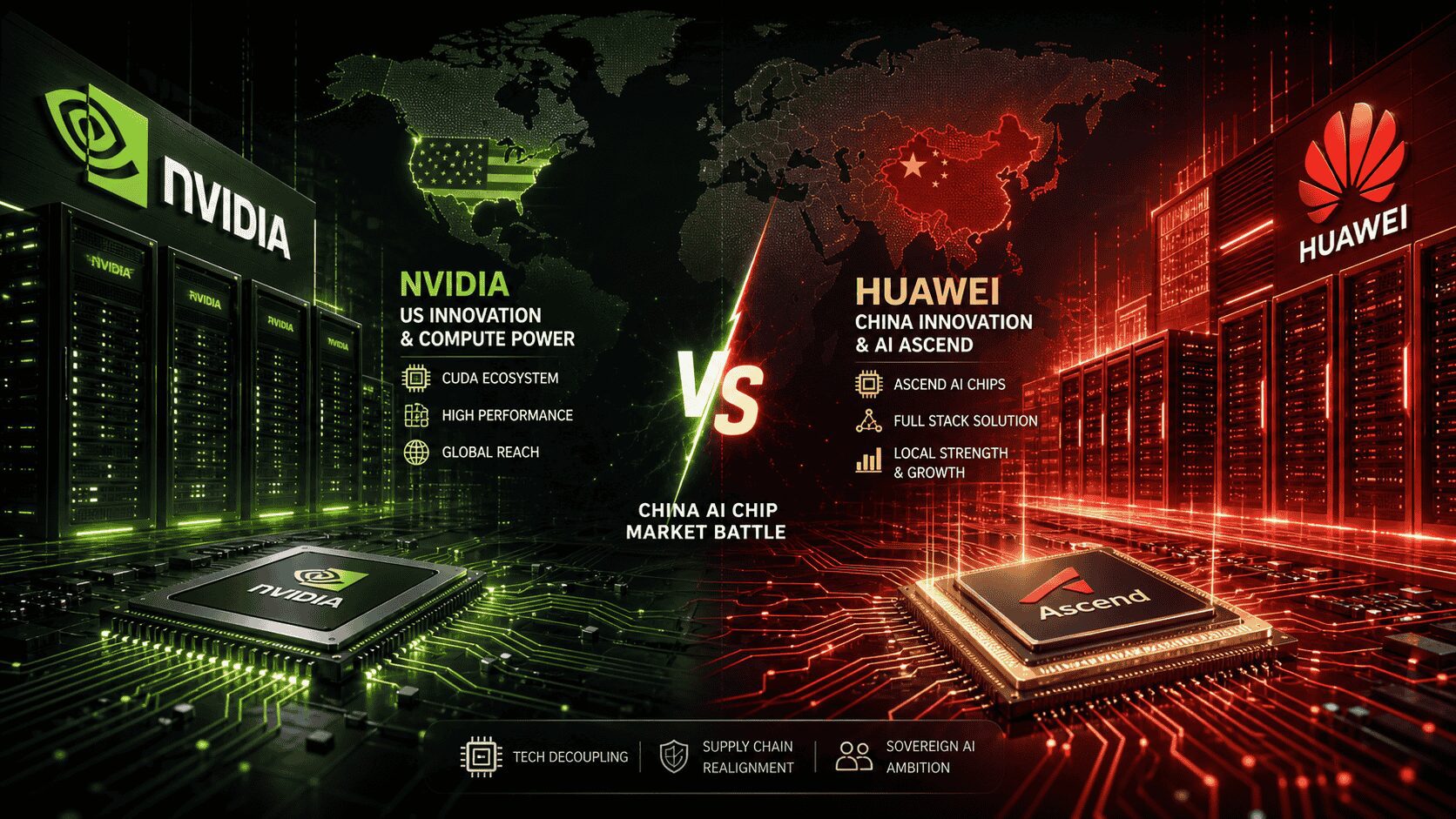
China AI chip market, NVIDIA has effectively withdrawn from the China AI chip market, with CEO Jensen Huang confirming that the company now expects no meaningful business from the region due to ongoing U.S. export controls.
The statement underscores a major shift in the global semiconductor landscape, where geopolitical policy is increasingly shaping competition and market access.
Record Revenue Without China Contribution
Despite losing access to the China AI chip market, Nvidia continues to post exceptional financial results. The company reported a record $81.6 billion in quarterly revenue, driven by strong global demand for AI infrastructure.
However, Huang emphasized that China is no longer part of Nvidia’s growth outlook. The company has advised investors to assume zero approvals for future exports of advanced AI chips to Chinese customers.
This marks a dramatic decline from previous years, when China accounted for a significant share of Nvidia’s data center business.
Approved Deals, But No Deliveries
Conflicting signals from regulators and the market complicate the situation. Several major Chinese technology firms—including Alibaba, Tencent, ByteDance, and JD.com—have reportedly received approval to purchase Nvidia’s H200 AI chips.
On the U.S. side, export conditions include strict compliance requirements, volume limits, and additional costs. On the Chinese side, authorities appear to be slowing or blocking purchases to prioritize domestic semiconductor development.
Further reducing the likelihood of fulfillment, Nvidia has already halted production of the H200 chips and reallocated manufacturing capacity to its next-generation AI platforms.
Policy Uncertainty Reshapes the Market
U.S. semiconductor policy toward China has shifted multiple times in recent months. While there were brief indications of easing restrictions, new rules—including tariffs, export caps, and tighter controls—have created uncertainty for both suppliers and buyers.
This inconsistency has made it difficult for companies like Nvidia to plan long-term operations in China, effectively forcing a strategic retreat from the market.
Huawei Emerges as the Clear Winner
As Nvidia steps back, Huawei has rapidly strengthened its position in China AI chip industry. Backed by government support and protected from foreign competition, the company is scaling its AI hardware ecosystem at a pace.
Industry forecasts suggest Huawei could capture a dominant share of China AI chip market by the end of 2026.
Huang acknowledged the competitive reality, noting that Huawei has become a formidable force with strong momentum in both technology and market adoption.
A Shift in Global AI Competition
NVIDIA’s exit from China highlights a broader trend of technological decoupling between the United States and China. While Nvidia remains the global leader in China’s AI chip market, its absence from one of the world’s largest markets could have long-term implications.
At the same time, China’s push for semiconductor self-sufficiency is accelerating, with domestic players gaining ground in both capability and scale.
NVIDIA’s decision to “largely concede” China’s AI chip market to Huawei marks a pivotal moment in the global technology and semiconductor landscape. This shift reflects not only intense geopolitical pressure but also the rapid rise of China’s domestic AI hardware ecosystem, with Huawei emerging as the primary beneficiary.
NVIDIA steps back from China.
NVIDIA CEO Jensen Huang has acknowledged that the company now expects little to no business from China’s advanced AI chip market, as U.S. export controls severely restrict the sale of high-end GPUs to Chinese firms. He has told investors and media that Nvidia is effectively planning its future as if approvals to resume advanced chip exports to China will not materialize. This is a dramatic reversal for a company that once relied on China as a key growth driver for its data center and AI segments.
Despite this retreat, Nvidia’s global performance remains exceptionally strong. The company continues to post record revenue, driven by massive demand for AI infrastructure in the U.S., Europe, and other regions, as it races to build large-scale models and data centers. In practical terms, Nvidia is exchanging short‑term access to a major market for long‑term stability under U.S. regulatory expectations, even if that means leaving China to local champions.
Export controls and stalled shipments
The root of this shift lies in U.S. export controls targeting advanced AI chips destined for China. Washington has tightened rules to prevent Chinese companies from accessing cutting‑edge accelerators that could be used for military or strategic applications, placing strict performance thresholds and licensing requirements on products like Nvidia’s H200 series. At various points, U.S. authorities signaled partial approvals with conditions, including tariffs, volume caps, and end‑use certifications, but the underlying uncertainty has never gone away.
Reports indicate that several major Chinese tech firms were granted permission to purchase Nvidia’s chips under these frameworks, but actual deliveries stalled. Beijing has reportedly held back on approving or prioritizing such imports, pushing domestic firms instead to rely more heavily on homegrown solutions. At the same time, Nvidia has shifted its production roadmap away from older export‑constrained parts and toward newer architectures for markets with lower regulatory risk. The net effect is a policy‑driven deadlock that leaves Chinese buyers without fresh Nvidia supply and Nvidia without meaningful revenue in China.
Huawei’s rapid ascent in AI chips
As Nvidia pulls back, Huawei has seized the opportunity to solidify its position as a China AI chip market supplier. The company has invested heavily in its Ascend series and related infrastructure, aligning closely with Beijing’s broader goal of semiconductor self‑reliance. Industry estimates now suggest that Huawei could command a majority of the China AI chip market data center chip market within the next couple of years, backed by strong demand from domestic cloud providers and internet platforms.
Huang himself has acknowledged Huawei’s strength, describing the company as “very, very strong” in the AI space and noting that it has become the default choice for many Chinese customers who previously used Nvidia. This is not just a simple market-share shift; it represents the consolidation of an entire AI ecosystem around a domestic champion, from chips and servers to software stacks optimized for local requirements.
Fragmentation of the global AI ecosystem
The divergence between Nvidia and Huawei in China underscores a broader fragmentation of the global AI ecosystem. On one track, Nvidia continues to dominate AI computing in the U.S., Europe, and many other markets, powering leading cloud platforms, startups, and enterprises building frontier models. On another track, China AI chip market is increasingly building a parallel stack based on domestic silicon, local cloud infrastructure, and software tuned to run on non‑U.S.
This split has long‑term implications. For developers and enterprises, it could mean more compatibility issues, duplicated engineering effort, and region‑specific AI stacks. For governments, it raises strategic questions about technological dependence, supply chain resilience, and the balance between national security and open global markets. And for companies like Nvidia, it forces a strategic calculation: accept regulatory limits and focus on allied markets, or push for policy changes and risk political backlash.
What this means for the future
NVIDIA’s near‑zero presence in the China AI chip market does not threaten its immediate global leadership, but it does cap its long‑term upside in a massive and fast‑growing region. At the same time, Huawei’s rise highlights how quickly domestic players can scale when geopolitical pressure and national policy align behind them. If current trends continue, the world may end up with two largely separate AI hardware spheres—one dominated by Nvidia and other Western suppliers, and another led by Chinese firms such as Huawei.
For now, Nvidia is signaling to investors that it can thrive without China, while China AI chip market is signaling to the domestic industry that it can build a competitive AI stack without unrestricted access to U.S. chips. Between them, Huawei stands out as the clearest winner from this realignment, turning export controls intended to slow China’s progress into a powerful catalyst for its own AI ambitions.