The global artificial intelligence race is entering a new phase, and electricity is becoming one of its most valuable resources. While technology companies have spent billions of dollars securing advanced processors, building data centers and developing increasingly powerful AI models, another challenge is becoming impossible to ignore: finding enough electricity to operate the infrastructure behind artificial intelligence.
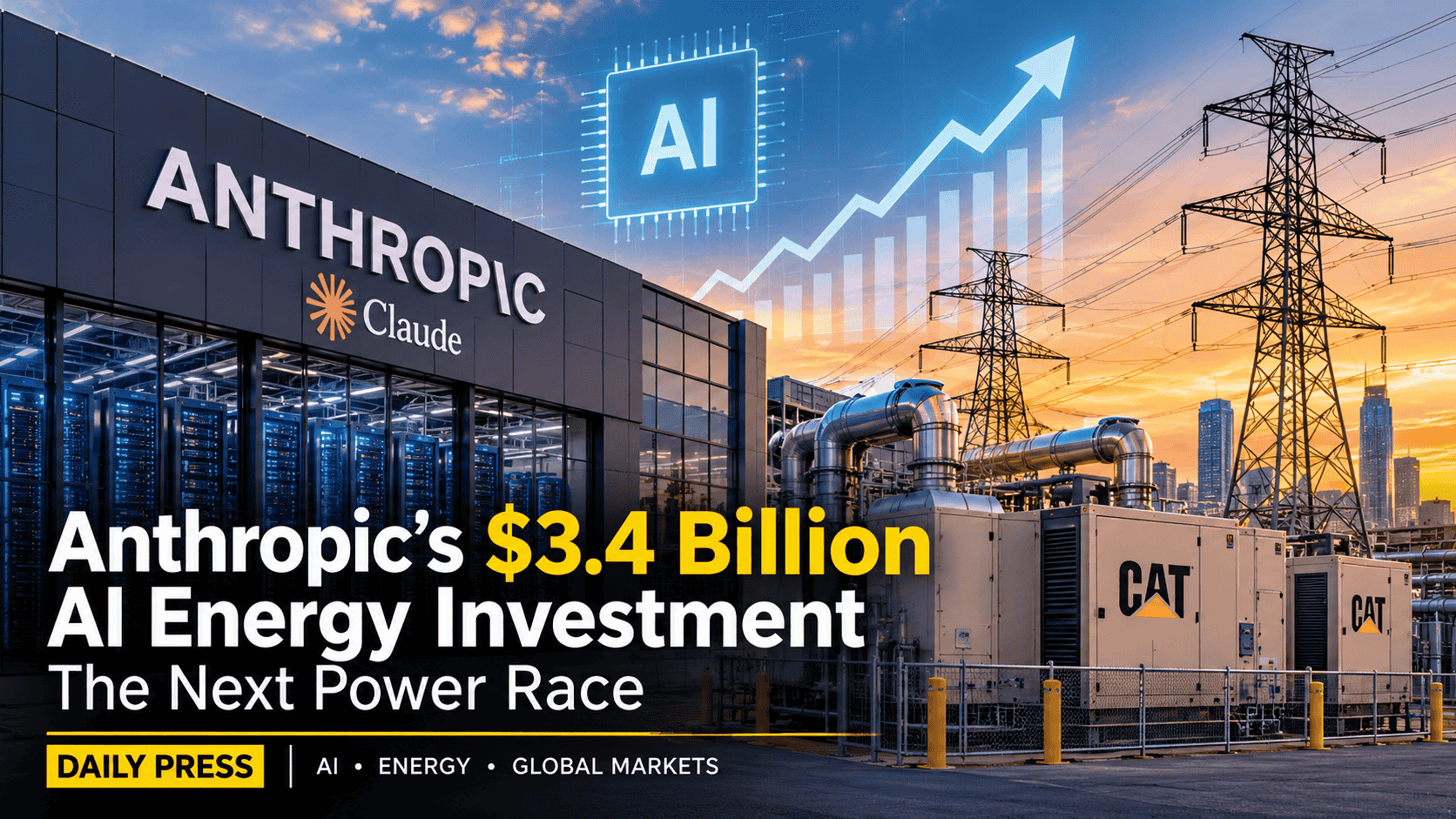
Anthropic, the company behind Claude AI, has reportedly made a major move to address this challenge. According to a Financial Times report published on November 8, 2026, the company agreed to spend approximately $3.4 billion to secure commitments for 1.7 gigawatts of gas-fired generators through Texas-based OnePWR Solutions.
The reported transaction represents a significant development in the economics of artificial intelligence. It suggests that leading AI companies may increasingly need to secure their own energy infrastructure rather than depend entirely on traditional electricity providers.
For investors, the development raises an important question: Is the next major AI investment opportunity shifting from semiconductor manufacturing toward electricity generation and energy infrastructure?
Anthropic’s $3.4 Billion Generator Deal Explained
According to the Financial Times, Anthropic reached the agreement in late September 2026, taking over existing orders for Caterpillar gas-fired generators that had previously been placed by OnePWR Solutions.
The reported agreement covers approximately 1.7 gigawatts of generation capacity and includes engineering and construction capabilities needed to install the equipment. The generators are expected to become available over the next two years.
Importantly, Anthropic reportedly did not acquire OnePWR itself. Instead, it took over the equipment commitments while the supplier remained an independent business.
Neither Anthropic nor OnePWR publicly confirmed the reported transaction when the initial coverage appeared. Reuters also reported that it could not independently verify the Financial Times account.
Nevertheless, the reported scale of the arrangement highlights how seriously AI developers are approaching electricity availability.
A 1.7-gigawatt generation commitment represents substantial potential capacity. For comparison, one gigawatt equals 1,000 megawatts, making Anthropic’s reported arrangement equivalent to 1,700 megawatts of generating capacity.
This is not simply another technology procurement decision. It is a strategic infrastructure investment designed to address one of the biggest constraints on AI expansion.
Why Artificial Intelligence Is Creating an Electricity Crisis
Modern AI systems require enormous computing resources. Training advanced models involves thousands of specialized processors operating simultaneously, while serving millions of users requires continuous computing capacity.
These operations depend on large data centers containing servers, networking equipment, cooling systems and supporting infrastructure.
Every additional server requires electricity. More powerful processors also generate additional heat, increasing the energy required for cooling and facility operations.
As AI adoption expands across financial services, healthcare, manufacturing, education and software development, demand for computing infrastructure is increasing.
The challenge is that electricity infrastructure cannot always expand as quickly as technology companies want to build new data centers.
Power-grid connections require planning, regulatory approvals, transmission upgrades and coordination with utility providers. In some locations, these processes can delay major infrastructure projects.
For AI companies competing to introduce new models and services, waiting years for sufficient electricity could become a commercial disadvantage.
Anthropic’s reported generator commitment illustrates a possible solution: securing electricity-generation equipment directly to gain greater control over future energy availability.
Why Gas Generators Instead of Renewable Energy?
The reported decision to secure gas-fired generators raises important questions about the relationship between artificial intelligence and the global energy transition.
Natural gas offers several operational advantages. Gas-powered generation can provide dispatchable electricity, meaning output can be adjusted according to demand and operational requirements. It can also be deployed independently of weather conditions, unlike solar and wind generation.
For data centers that require reliable electricity around the clock, these characteristics can be attractive.
However, gas generation also creates challenges.
Natural gas is a fossil fuel, and burning it produces carbon dioxide emissions. Additional environmental concerns include methane leakage throughout the gas supply chain, local air pollution, water requirements and permitting restrictions.
AI companies therefore face a difficult balancing act. They need reliable electricity to support business expansion, but they also face increasing pressure from governments, investors and environmental organizations to reduce emissions.
Gas generators may provide a practical short-term solution in certain locations, but they do not eliminate the need for long-term investment in cleaner electricity.
A more diversified energy strategy could combine natural gas, renewable generation, battery storage, nuclear power and improved grid connections.
The Investment Opportunity: AI Is Expanding Beyond Semiconductor Stocks
For several years, investors have largely associated the AI boom with semiconductor manufacturers, cloud-computing companies and technology platforms.
Companies supplying advanced processors, memory, networking equipment and data-center infrastructure have attracted considerable market attention.
However, the next stage of AI expansion could create opportunities across a much wider industrial ecosystem.
1. Energy generation companies
Growing demand for reliable electricity could benefit companies involved in gas turbines, industrial generators and power-generation equipment.
2. Electrical infrastructure manufacturers
Data centers require transformers, switchgear, cables, cooling systems and power-management equipment. Companies supplying these products could benefit from continued infrastructure investment.
3. Natural gas producers
If gas-fired generation becomes a larger part of data-center electricity strategies, natural gas demand could receive additional support in relevant markets.
4. Renewable energy and storage providers
AI companies seeking to reduce emissions may increase investment in solar, wind, battery storage and other low-carbon electricity solutions.
5. Engineering and construction businesses
Large-scale data-center projects require specialized construction, electrical engineering and energy-infrastructure expertise. These businesses could become increasingly important to the AI supply chain.
For investors, the central opportunity is understanding that AI infrastructure is not limited to computer chips. It also includes the physical systems that keep those chips operating.
Environmental and Financial Risks Investors Should Consider
Despite the potential opportunities, the expansion of gas-powered AI infrastructure carries meaningful risks.
The first concern is environmental regulation. Governments may introduce stricter emissions standards, permitting requirements or restrictions on new fossil-fuel generation projects.
Such policies could increase construction costs and affect the long-term economics of gas-powered facilities.
The second concern is natural gas pricing. Electricity generated from gas depends partly on fuel availability and market prices. Unexpected increases in natural gas costs could affect operating expenses.
The third risk involves infrastructure financing.
A multibillion-dollar equipment commitment does not automatically guarantee that a project will become operational on schedule. Companies must still manage installation, construction, fuel supply, maintenance and regulatory requirements.
Investors should also distinguish between announced infrastructure commitments and completed projects generating commercial returns.
The reported $3.4 billion arrangement should therefore be understood as an equipment-related commitment, not as a disclosed electricity purchase price or proof that 1.7 gigawatts of power are already available.
Could Other AI Companies Follow Anthropic?
Anthropic is not operating in isolation. The broader technology industry is increasingly exploring ways to secure electricity and reduce dependence on conventional grid infrastructure.
Major technology companies are investing in data-center development, long-term energy agreements, nuclear power, renewable generation and other electricity solutions.
The underlying business problem is straightforward: computing capacity has limited value if sufficient electricity is unavailable to operate it.
As AI adoption accelerates, securing energy could become a competitive advantage.
Companies with access to reliable, affordable and scalable electricity may be able to develop infrastructure faster, serve customers more efficiently and manage operating costs more effectively.
This could also change the relationship between technology companies and traditional energy businesses. Instead of remaining simple electricity customers, major AI developers may become increasingly involved in financing, developing and securing energy-generation assets.
What This Means for Global Investors
Anthropic’s reported generator deal highlights an important change in the investment landscape.
The AI industry is moving beyond the initial race to develop advanced models and secure computing hardware. It is increasingly becoming an infrastructure business involving electricity, construction, industrial manufacturing and energy financing.
Investors should pay attention to companies positioned across these interconnected industries.
However, strong demand does not automatically make every infrastructure investment profitable. Valuations, financing costs, project execution, energy prices and future AI demand will remain important factors.
The biggest opportunity may belong to businesses that can provide essential infrastructure without taking excessive financial or operational risks.
Final Outlook: Electricity Could Become the Next Competitive Advantage in AI
Artificial intelligence is transforming the global technology industry, but its expansion depends on physical resources that cannot be created through software alone.
Anthropic’s reported $3.4 billion commitment for 1.7 gigawatts of gas-fired generators demonstrates how electricity availability is becoming a strategic concern for AI developers.
The next phase of competition may not be determined exclusively by who builds the most advanced AI model or designs the fastest processor. Access to affordable electricity, reliable infrastructure and scalable computing capacity could become equally important.
For global investors, this creates a broader investment narrative connecting artificial intelligence, energy security, industrial manufacturing and infrastructure development.
The future of AI will depend not only on smarter machines, but also on the energy systems capable of keeping them running.
Frequently Asked Questions (FAQs)
1. Why is Anthropic investing in gas-fired generators?
According to the Financial Times, Anthropic agreed to secure 1.7 gigawatts of gas-fired generator commitments to support its growing data-center infrastructure and improve access to reliable electricity.
2. How much is Anthropic’s reported energy deal worth?
The reported agreement is valued at approximately $3.4 billion and involves generator commitments through Texas-based OnePWR Solutions.
3. Why do AI data centers require so much electricity?
AI data centers operate large numbers of specialized processors, servers and cooling systems. Training and running advanced AI models requires substantial computing power and continuous electricity.
4. Could gas-powered generators benefit the AI industry?
They could provide dispatchable electricity and help address power shortages or grid delays. However, fuel costs, emissions, environmental regulation and construction requirements remain important considerations.
5. Which industries could benefit from rising AI electricity demand?
Potential beneficiaries include power-generation equipment manufacturers, natural gas producers, electrical infrastructure suppliers, renewable energy companies, battery storage providers and data-center construction businesses.
6. Is energy becoming as important as semiconductors in the AI race?
Energy is becoming an increasingly important strategic requirement. Advanced chips provide computing performance, but reliable electricity is necessary to operate them at scale.
Follow Daily Press on X for the latest news and updates: @dailypressit.