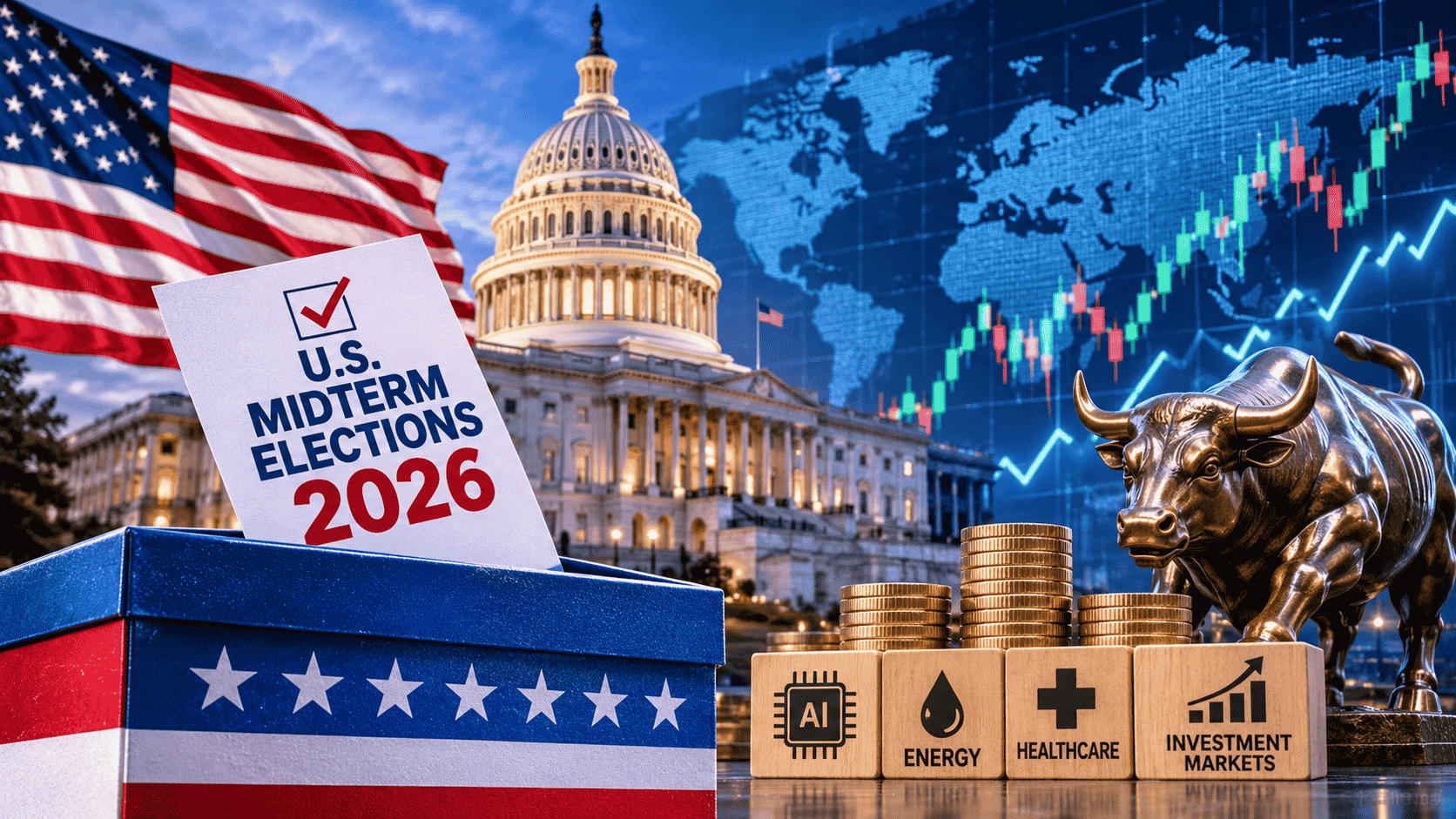
The 2026 U.S. midterm elections have introduced a new political dynamic into financial markets, raising important questions about technology regulation, government spending, energy policy, international trade, and global investment strategies.blu-9ehze4wm
The 2026 U.S. midterm elections have created a significant political shift in Washington, potentially changing the direction of America’s economic and investment policies. Democrats have secured control of both the House of Representatives and the Senate, while President Donald Trump remains in the White House. This outcome introduces a divided-government environment that could influence financial markets, corporate investment decisions, and international economic relationships.
For global investors, the election is more than a political development. It represents a potential turning point for several industries that depend heavily on federal policy, including artificial intelligence, semiconductor manufacturing, healthcare, renewable energy, defense, and infrastructure.
The immediate market reaction has already demonstrated how sensitive investors are to political uncertainty. However, the longer-term consequences will depend on how effectively Congress and the administration manage disagreements over economic priorities.
2026 U.S. Midterm Election Results and Their Economic Significance
The Democratic victory has changed the balance of political power in Washington. With Republicans controlling the presidency and Democrats controlling both chambers of Congress, major legislative decisions could become more difficult.
A divided government does not necessarily mean economic instability. In some circumstances, political gridlock can limit sudden policy changes, creating a more predictable environment for businesses and investors. However, disagreements over taxation, government spending, tariffs, and regulatory priorities could also complicate economic planning.
According to Reuters reporting following the election, investors are particularly focused on the consequences for AI investment, federal deficits, and future debt-ceiling negotiations.
The new political arrangement could also influence regulatory appointments, congressional investigations, and budget negotiations. These developments matter because financial markets respond not only to policies that become law but also to expectations about future government decisions.
Artificial Intelligence and Technology Stocks Face a New Political Challenge
One of the most closely watched consequences of the 2026 midterm elections involves America’s artificial intelligence industry.
Over the past several years, AI investment has become a major driver of stock market growth. Companies such as Nvidia, Microsoft, Amazon, Alphabet, and Meta have committed enormous financial resources to developing AI infrastructure, advanced chips, cloud computing systems, and large-scale data centers.
However, the industry’s expansion increasingly faces questions about electricity consumption, water requirements, environmental impact, and community concerns.
Democratic lawmakers are expected to increase scrutiny of AI infrastructure development, potentially introducing tougher oversight of data-center construction and advanced AI systems.
For investors, the biggest concern is whether additional regulation could increase project costs or delay infrastructure development.
A slower expansion of AI infrastructure could affect semiconductor manufacturers, cloud service providers, electricity suppliers, construction companies, and technology equipment producers.
Nevertheless, tighter regulation does not automatically mean the end of AI investment. Clearer rules could improve public confidence, encourage responsible development, and establish more sustainable conditions for long-term industry growth.
My investment perspective: Investors should distinguish between companies with sustainable AI revenue models and businesses whose valuations depend primarily on aggressive future spending. The political environment may change, but the long-term commercial value of artificial intelligence will ultimately depend on productivity, profitability, and real-world demand.
Energy Markets Could Experience Another Major Shift
Energy policy represents another important area where the election outcome could influence investment decisions.
The United States remains a major participant in global oil and natural gas markets. Changes in domestic energy regulation, international relations, renewable energy incentives, and infrastructure development can influence investment decisions across the global energy industry.
The election has also generated expectations about a possible change in the direction of U.S. foreign policy concerning the Iran conflict.
Following the Democratic victory, oil prices experienced downward pressure as traders considered the possibility of diplomatic developments and reduced geopolitical risks.
However, investors should not interpret short-term oil price movements as evidence that energy uncertainty has disappeared. Middle Eastern security, shipping disruptions, global production levels, and international demand remain important factors.
Renewable energy companies could also receive greater attention if Democrats pursue stronger clean-energy policies and incentives.
For international investors, the opportunity may extend beyond traditional oil producers to include solar technology, battery storage, electricity infrastructure, and energy-efficient data-center solutions.
Healthcare and Pharmaceutical Companies Could Benefit From Policy Changes
Healthcare is another sector that could experience meaningful changes under a Democratic-controlled Congress.
Lawmakers may seek to revisit healthcare funding, Medicaid support, Affordable Care Act subsidies, and federal healthcare spending priorities.
Such developments could create opportunities for hospital operators, healthcare service providers, pharmaceutical businesses, and medical technology companies.
However, the impact will not be equally positive across the industry. Healthcare companies that depend heavily on government reimbursement programs may experience different financial outcomes from pharmaceutical manufacturers and privately funded medical technology businesses.
Investors should pay attention to budget negotiations because proposed healthcare spending changes could influence company revenues, operating margins, and long-term valuations.
The broader implication is that political developments can create investment opportunities even in industries that receive less attention than technology and energy.
U.S. Government Debt and Interest Rates Remain Major Investor Concerns
Government borrowing and fiscal policy will remain central issues for financial markets after the elections.
The United States already faces substantial debt obligations, and investors are increasingly sensitive to government borrowing costs, Treasury yields, and long-term fiscal sustainability.
A divided Congress could make major budget negotiations more complicated. Disagreements over federal spending, healthcare funding, taxation, and government borrowing could increase uncertainty surrounding future fiscal policy.
At the same time, a slower pace of government spending or greater scrutiny of federal expenditure could potentially improve expectations about future deficits.
The bond market has already demonstrated its sensitivity to these developments. Following the election, the 10-year U.S. Treasury yield declined, reflecting changing investor expectations and demand for government bonds.
Interest rates also matter beyond the United States. Treasury yields influence international borrowing costs, currency valuations, mortgage markets, and investment flows.
Emerging economies can be particularly sensitive to changes in U.S. financial conditions because higher American yields can attract international capital away from riskier markets.
For global investors, monitoring U.S. Treasury yields and Federal Reserve decisions will remain essential.
What the Election Means for Global Investment Markets
The economic consequences of American political decisions extend far beyond U.S. borders.
The United States remains one of the world’s largest consumer markets and an important source of international capital. Changes in its trade policies, technology regulations, energy strategy, and monetary environment can influence investment decisions across Europe, Asia, the Middle East, and emerging economies.
For Asian semiconductor manufacturers, increased scrutiny of American AI infrastructure could influence chip demand and supply-chain investment.
European businesses may face new opportunities or challenges depending on future U.S. trade and industrial policies.
Meanwhile, emerging markets could experience changes in capital flows as investors reassess the dollar, Treasury yields, and global risk appetite.
International companies with significant exposure to American consumers or technology supply chains should also monitor potential changes in tariffs and regulatory requirements.
The central issue is not simply which political party controls Congress. It is how the new political environment changes the financial assumptions on which businesses and investors have based their strategies.
Investor Strategy: Where Should Capital Move After the 2026 Elections?
The election results create both opportunities and risks. However, investors should avoid making major portfolio decisions based entirely on political headlines.
Several areas deserve closer attention:
1. Artificial intelligence and semiconductors: Focus on businesses with established customers, sustainable earnings, and competitive technological advantages rather than speculative valuations alone.
2. Renewable energy and infrastructure: Companies involved in electricity generation, grid modernization, battery storage, and energy efficiency could benefit from changing policy priorities.
3. Healthcare and pharmaceuticals: Monitor companies that could benefit from changes in government healthcare funding and reimbursement policies.
4. Government bonds: Treasury yields, inflation expectations, and federal borrowing requirements will remain important indicators for fixed-income investors.
5. International diversification: Investors should consider exposure to different regions and industries instead of concentrating their portfolios around a single political or economic outcome.
Diversification and careful risk management remain more important than attempting to predict every political decision.
Conclusion: A New Political Era for Global Investment Decisions
America’s 2026 midterm elections have introduced a new chapter in the relationship between politics and financial markets. Democratic control of Congress alongside a Republican presidency could create legislative disagreements, greater regulatory scrutiny, and changing expectations across major industries.
Artificial intelligence, energy, healthcare, government borrowing, and international trade are likely to remain important areas of investor attention.
However, the election should not automatically be interpreted as a signal to abandon U.S. markets. American businesses continue to benefit from technological innovation, deep capital markets, strong entrepreneurial activity, and significant consumer demand.
The real challenge for investors is identifying which companies can adapt to changing regulations, maintain profitability, and generate sustainable growth.
My final view: The biggest investment opportunity after the 2026 U.S. midterm elections may not come from predicting which political party wins the next policy debate. It may come from identifying businesses that can remain profitable regardless of who controls Washington. In an increasingly uncertain global economy, financial discipline, diversification, and long-term thinking will be more valuable than political speculation.