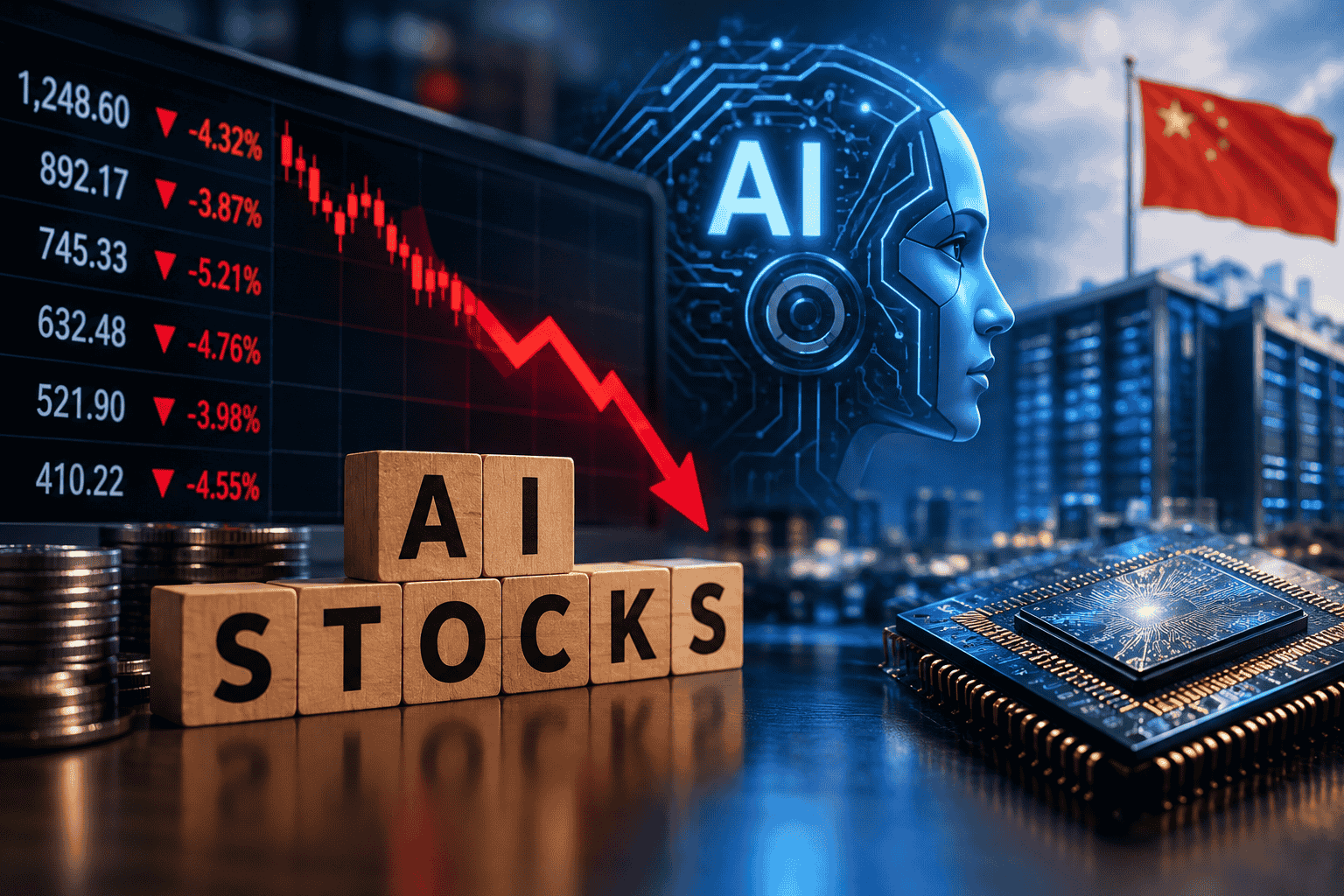
The global artificial intelligence (AI) industry is facing a critical market test as investors reconsider the valuations, spending plans, and long-term profitability of companies driving the AI revolution. On October 13, 2026, a sharp sell-off in semiconductor stocks across Asian markets highlighted growing concerns about AI infrastructure costs, rising competition from China, and whether future earnings can justify the sector’s rapid rise.
South Korea’s technology-heavy Kospi index fell sharply, while major chipmakers including Samsung Electronics and SK Hynix suffered significant losses. U.S. technology stocks also came under pressure as investors reassessed the outlook for the AI trade. These developments suggest that market enthusiasm is becoming more selective, particularly toward businesses whose valuations depend on continued rapid growth.
The central question is no longer whether AI will transform the economy. It is whether AI companies can generate enough sustainable profit to justify the enormous investments being made today.
Why Are AI Stocks Falling in 2026?
Several factors are contributing to the latest AI stock sell-off, creating uncertainty for investors, financial institutions, and technology companies.
1. Growing Concerns About AI Valuations
AI-related stocks have attracted substantial investor capital as businesses increase spending on advanced chips, cloud computing, data centers, and generative AI systems. However, when stock prices rise faster than company earnings, valuations become vulnerable to disappointment.
Investors are increasingly asking whether expected future profits can support current market prices. Even companies with strong technology and growing revenue may experience share-price declines if their results fail to exceed elevated expectations.
This does not automatically mean the entire AI sector is in a bubble. Instead, it suggests that investors are becoming more careful about how much they are willing to pay for future growth.
2. China’s Semiconductor Industry Is Increasing Competition
Competition from China has become another source of pressure on AI-related stocks. Reports of progress by Chinese memory-chip maker ChangXin Memory Technologies (CXMT) have raised concerns about the competitive position of established semiconductor suppliers.
Memory chips are essential for the servers and computing systems that support AI applications. If Chinese manufacturers improve performance, expand production, and compete more aggressively on price, established companies could face pressure on their market share and profit margins.
For investors, the implications extend beyond individual chipmakers. Increased competition could change expectations for the wider AI supply chain, from semiconductor manufacturing to data-center infrastructure.
3. Massive AI Infrastructure Spending Raises Questions
Technology companies are committing enormous resources to AI infrastructure. Data centers require advanced processors, networking equipment, electricity, cooling systems, and substantial capital investment.
These investments may support long-term growth, but they also create financial risks. Companies must generate enough revenue from AI services to cover operating costs, depreciation, financing expenses, and ongoing technology development.
Investors are therefore paying closer attention to capital expenditure, cash flow, debt levels, and returns on invested capital. A company can report strong demand for AI products while still struggling to turn that demand into sustainable free cash flow.
4. Higher Financing Costs Could Slow Expansion
AI infrastructure projects are expensive, and some businesses rely on borrowing or external investment to fund expansion. Higher interest rates and more demanding credit conditions can increase the cost of building new facilities.
If financing becomes more expensive, companies may delay projects, reduce spending, or demand stronger commercial commitments before expanding capacity. This could affect suppliers that have priced in years of uninterrupted growth.
The risk is particularly important for infrastructure businesses whose profitability depends on high utilization rates and long-term customer contracts.
Is the AI Boom Turning Into an AI Bubble?
A market sell-off alone cannot establish that a bubble exists. A more useful assessment compares company valuations with revenue growth, earnings, cash flow, competitive advantages, and the realistic size of future demand.
The AI industry has genuine commercial applications. Businesses are using AI for customer service, software development, research, fraud detection, logistics, and financial analysis. These applications could support productivity improvements and create new revenue streams over time.
However, a transformative technology does not guarantee that every company associated with it will be a successful investment. During periods of rapid innovation, investors may overestimate how quickly adoption will occur or underestimate the cost of delivering profitable services.
Three questions are especially important:
- Revenue: Are customers paying for AI products at a scale that supports long-term growth?
- Profitability: Can companies earn attractive margins after accounting for computing, energy, staffing, and financing costs?
- Valuation: Do current share prices leave room for slower growth, stronger competition, or disappointing earnings?
If the answers become less convincing, investors may reduce exposure even while AI adoption continues to expand.
What the AI Sell-Off Means for Global Financial Markets
The latest volatility matters because AI-related companies have become important components of major stock indexes and global investment portfolios.
United States
The United States remains a central market for AI developers, semiconductor companies, cloud providers, and data-center operators. A prolonged decline in leading technology stocks could weigh on investor sentiment, technology-sector valuations, and capital-raising activity.
It could also influence retirement accounts, exchange-traded funds, and diversified portfolios with substantial exposure to large technology companies. Investors will be watching earnings reports and company guidance for evidence that AI spending is translating into durable commercial returns.
China
China’s semiconductor progress could intensify competition across the global AI supply chain. Domestic chip development may support China’s technology ambitions, while established international suppliers could face greater pressure to improve efficiency, pricing, and product performance.
Nevertheless, technical progress does not immediately eliminate challenges involving manufacturing scale, advanced production equipment, software ecosystems, and access to international markets.
Europe
European investors are exposed through semiconductor equipment manufacturers, technology suppliers, banks, and diversified equity funds. A slowdown in AI infrastructure spending could affect companies supplying equipment and services to global data-center projects.
At the same time, businesses that adopt AI effectively may benefit from improved productivity and lower operating costs, creating opportunities beyond the companies building AI infrastructure.
Asia and Emerging Markets
Asian markets are particularly sensitive to semiconductor supply chains, given the importance of South Korea, Taiwan, Japan, and China to chip manufacturing and related industries.
For emerging economies, including Pakistan, the effects could be mixed. Lower technology valuations may reduce some investment pressures, but weaker global sentiment can also affect capital flows, currencies, and business confidence. Companies adopting affordable AI tools could benefit from productivity improvements, provided that implementation costs and infrastructure limitations remain manageable.
How Investors Should Respond to AI Market Volatility
The sell-off highlights the importance of distinguishing between a promising technology and an attractively priced investment. Investors should avoid making decisions based solely on market excitement or short-term price movements.
First, examine financial performance. Revenue growth should be assessed alongside profit margins, operating cash flow, capital expenditure, and debt obligations.
Second, assess valuation risk. Even a strong business can deliver disappointing investment returns if its share price already assumes exceptionally high growth.
Third, diversify portfolios. Concentrating investments in a narrow group of AI stocks increases exposure to a single sector, valuation trend, and set of market expectations.
Fourth, evaluate the full AI ecosystem. Chipmakers and data-center operators face different risks from software companies, enterprise AI providers, and businesses using AI to improve existing operations.
Finally, maintain a long-term perspective. Short-term volatility does not necessarily invalidate the commercial potential of AI. Investors should consider whether a company’s underlying business remains competitive rather than reacting automatically to every market decline.
These considerations are general investment principles, not personalized financial advice.
What Businesses Should Learn From the AI Stock Sell-Off
The market correction also offers lessons for business leaders. Companies considering AI investments should prioritize measurable commercial outcomes rather than adopting new technology simply to follow a trend.
Before committing substantial budgets, businesses should identify specific problems AI can solve, estimate implementation and operating costs, establish performance benchmarks, and assess data security and regulatory requirements.
Projects that reduce administrative workloads, improve customer service, accelerate research, or strengthen decision-making may provide clearer value than expensive initiatives without defined objectives.
For executives and financial managers, the goal should be to connect AI adoption with productivity, customer value, and sustainable profitability. A disciplined investment strategy can help businesses benefit from innovation while limiting unnecessary financial exposure.
What Happens Next for AI Stocks?
The next phase of the AI market will likely depend on corporate earnings, spending guidance, financing conditions, competitive developments, and evidence of real customer demand.
If technology companies demonstrate that AI services can generate strong recurring revenue and healthy cash flow, investor confidence could recover. If spending continues to rise faster than commercial returns, valuations may face further pressure.
Competition from Chinese semiconductor manufacturers will also remain an important variable, particularly for memory chips and other components used in AI infrastructure.
Investors should therefore watch several indicators: AI-related revenue growth, data-center investment plans, operating margins, financing costs, chip demand, and the ability of customers to turn AI adoption into measurable business results.
The long-term AI opportunity remains significant, but market participants may increasingly distinguish between companies that can convert technological progress into profits and those relying primarily on expectations.
Frequently Asked Questions
Are investors losing confidence in the AI boom?
The latest sell-off suggests that some investors are becoming more cautious about AI valuations, infrastructure spending, and future profitability. It does not necessarily mean that confidence in AI technology itself has disappeared.
Why did AI and semiconductor stocks fall in October 2026?
Concerns include stronger competition from China, expensive AI infrastructure projects, elevated valuations, and uncertainty about whether future earnings will justify current share prices.
Does the AI stock sell-off mean an AI bubble has burst?
Not necessarily. A sell-off can reflect a market correction or changing expectations. Determining whether the sector is in a bubble requires examining valuations, earnings, cash flow, and underlying business demand.
Which companies could be affected by an AI market correction?
Potentially affected businesses include semiconductor manufacturers, memory-chip suppliers, cloud-computing providers, data-center operators, and companies whose valuations depend heavily on AI-related growth.
Is AI still a long-term investment opportunity?
AI may continue to create opportunities across industries, but outcomes will vary by company. Investors need to evaluate commercial adoption, competitive advantages, financial performance, and valuation rather than assuming all AI-related stocks will benefit equally.
Conclusion: The AI Market Is Entering a More Demanding Phase
The October 2026 AI stock sell-off illustrates a shift in investor priorities. Market participants are increasingly focused on profitability, cash flow, financing costs, and competitive risks—not just the promise of artificial intelligence.
AI could remain a major driver of technological and economic change, but that does not eliminate the possibility of market corrections. Companies that demonstrate sustainable revenue, disciplined investment, and strong financial fundamentals may be better positioned to withstand volatility.
For investors and business leaders, the key lesson is clear: the future of AI may be promising, but financial success will depend on execution, realistic valuations, and measurable returns.
About the Author:
Anam Younas writes about business, finance, AI, technology, and global news for Daily Press.
Follow Daily Press on X for the latest news and updates: @dailypressit.