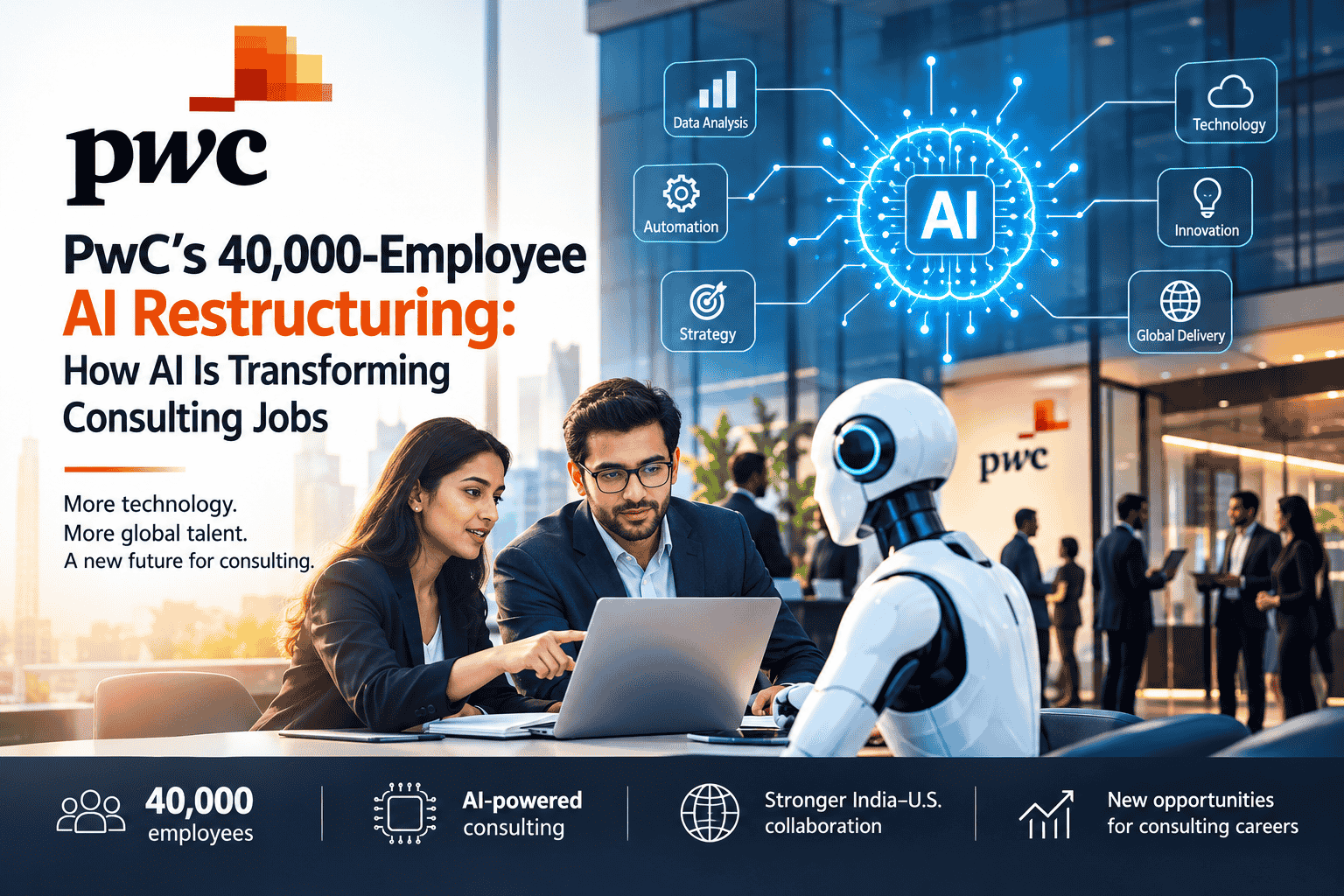
PwC’s Massive AI-Driven Consulting Restructuring
The global consulting industry is entering a major transformation as artificial intelligence changes how companies deliver professional services. One of the clearest examples is PwC, which has announced a major joint venture combining its U.S. and Indian consulting capabilities.
The new organization is expected to bring together approximately 40,000 employees, creating one of the largest consulting and technology delivery operations within the PwC network.
The combination brings together PwC India’s Consulting business and PwC US Advisory’s India-based capabilities into a single platform serving clients across India, the United States and global markets.
The announcement comes at an important moment. AI is increasingly capable of performing research, data analysis, software development, document preparation and other tasks traditionally handled by large teams of junior consultants and analysts.
PwC’s restructuring therefore represents more than a corporate reorganization. It reflects how professional-services companies are adapting their workforce and business models for an AI-driven economy.
Why PwC Is Restructuring Its Workforce
Traditional consulting has depended heavily on large teams performing repetitive analytical and administrative work.
Consultants might spend hours collecting information, preparing spreadsheets, analyzing documents, creating presentations and producing reports. Generative AI and AI agents can increasingly automate portions of these processes.
That creates an important economic question for consulting firms: If AI can perform more work with fewer people, how should consulting companies organize their workforce?
PwC’s answer appears to be greater integration between consulting professionals, technology specialists, engineers and AI capabilities.
Rather than treating technology teams as separate support organizations, the new structure is designed to bring these capabilities closer together.
The 40,000-Employee Joint Venture
The scale of the announcement is significant.
The joint venture combines PwC India’s Consulting business with PwC US Advisory’s India-based operations. It is expected to start with approximately 40,000 employees.
The new organization is expected to be led by PwC India leadership, while PwC US will retain majority voting control. The transaction remains subject to regulatory approvals and is expected to be completed during the first half of 2027.
The organization is intended to provide a more integrated delivery model for multinational companies, Indian businesses and global clients.
This could also strengthen India’s position as a major center for AI-enabled consulting, engineering and business services.
AI Is Changing the Traditional Consulting Model
For decades, consulting firms have operated around a pyramid-shaped workforce.
A relatively small number of senior consultants manage projects while larger numbers of junior employees handle research, analysis and execution.
AI is challenging that structure.
An AI system can potentially analyze thousands of documents in minutes, summarize large datasets, generate first drafts and assist with coding or financial analysis.
That does not necessarily mean consultants disappear.
Instead, the value of consulting work could shift toward strategy, judgment, client relationships, industry expertise and complex decision-making.
The consultant of the future may spend less time producing information and more time interpreting AI-generated information and turning it into business decisions.
AI Could Reshape Entry-Level Consulting Jobs
One of the biggest concerns surrounding AI is its effect on entry-level employment.
Junior consultants traditionally learn the profession by performing basic research, preparing presentations and analyzing information.
Those are precisely the areas where generative AI is becoming increasingly capable.
This means the traditional career path in consulting could change significantly.
Instead of spending their first years mainly performing repetitive research and analytical work, junior consultants may increasingly be expected to supervise AI systems, validate their outputs, work with data and focus on higher-value problem solving.
The result could be fewer traditional entry-level tasks but greater demand for workers who understand both business and artificial intelligence.
India’s Role Is Becoming More Important
The PwC restructuring also highlights India’s expanding role in the global professional-services industry.
India has traditionally been an important destination for offshore technology and business-process work. But the country’s role is increasingly moving beyond low-cost delivery.
India has developed a huge ecosystem of technology professionals, engineers, consultants and Global Capability Centres supporting multinational companies.
Many of these operations are now moving toward artificial intelligence, cloud computing, software engineering, cybersecurity and advanced analytics.
PwC’s new structure fits directly into this broader transformation.
The goal is not simply to provide cheaper labor. It is to combine AI, engineering, consulting and industry expertise at global scale.
PwC Is Not Alone
PwC’s move comes as other professional-services and technology companies accelerate their own AI strategies.
Major consulting, accounting and technology companies are investing heavily in AI training and automation.
Some companies are using AI to increase employee productivity rather than immediately replacing workers. Others are redesigning departments around AI-powered systems.
This illustrates an emerging pattern across the services industry.
AI can make existing employees more productive while simultaneously reducing demand for certain repetitive tasks.
The result could be a workforce that is smaller in some functions but more technically sophisticated in others.
What This Means for Consulting Careers
The traditional consulting career path could look very different over the next five years.
Future consultants will likely need a combination of:
- AI literacy
- Data analysis
- Industry expertise
- Strategic thinking
- Communication skills
- Client management
- Technology knowledge
- Critical judgment
Knowing how to use AI tools may become as fundamental as knowing how to use spreadsheets and presentation software.
However, simply knowing how to generate AI content will not be enough.
Companies will increasingly value professionals who can determine whether AI-generated information is accurate, understand its business implications and make sound decisions.
The Business Impact of PwC’s Strategy
For clients, the biggest potential benefit is speed.
A more integrated organization could reduce internal barriers between consulting teams, technology specialists and offshore delivery centers.
That could allow companies to move from strategy to implementation more quickly.
It could also reduce costs while expanding the amount of technology and AI expertise available to clients.
For PwC, the strategy could create a more scalable consulting model at a time when clients increasingly expect measurable results from technology investments.
Will AI Replace Consultants?
AI is unlikely to eliminate consulting as a profession, but it could fundamentally change what consultants do.
The biggest risk is not necessarily that AI replaces every consultant.
The bigger risk is that AI-enabled consultants replace consultants who do not adapt to AI.
A professional who can complete a project using AI tools in hours could eventually compete against a traditional team that needs days or weeks.
This creates a powerful incentive for consulting firms to retrain employees and redesign their business models.
The Future of Consulting Is Human + AI
PwC’s 40,000-person restructuring provides a glimpse into the future of professional services.
The company is bringing together consulting, technology, engineering and AI capabilities under a more integrated structure.
The move also demonstrates that AI transformation is no longer limited to technology companies.
Accounting firms, banks, law firms, consulting companies and other professional-services businesses are now redesigning their organizations around artificial intelligence.
The next phase of the AI revolution may therefore be less about chatbots and more about how entire companies reorganize their employees around intelligent machines.
For consultants, the message is clear: AI is changing the job, not simply the tools used to perform it.
For businesses, PwC’s strategy signals that the competitive advantage of the future may come from combining human expertise, global talent and artificial intelligence into one operating model.
FAQs
How many employees will PwC’s new joint venture have?
The new PwC U.S.–India joint venture is expected to launch with approximately 40,000 employees.
Why is PwC creating the joint venture?
The organization is designed to integrate consulting, technology and delivery capabilities, improve global client service and strengthen PwC’s ability to compete in an increasingly AI-driven consulting market.
Will PwC’s restructuring eliminate consulting jobs?
The 40,000-employee figure does not represent 40,000 job cuts. Instead, it represents the approximate workforce expected to be part of the new organization. However, AI is expected to change which consulting tasks require human workers and which can be automated.
What does PwC’s move mean for India’s technology sector?
It reinforces India’s growing position as a global center for consulting, technology, engineering and AI-enabled business services.
Is AI replacing consultants?
AI is increasingly automating repetitive consulting tasks, but human judgment, strategy, client relationships and industry expertise remain important. The consulting profession is likely to become increasingly AI-assisted rather than entirely AI-replaced.