Introduction
AI Shopping Agents: The retail industry is experiencing one of the most significant technological revolutions in its history. Artificial intelligence is rapidly transforming how consumers discover products, compare prices, make purchasing decisions, and interact with online stores. Among the most influential innovations driving this transformation are AI shopping agents.
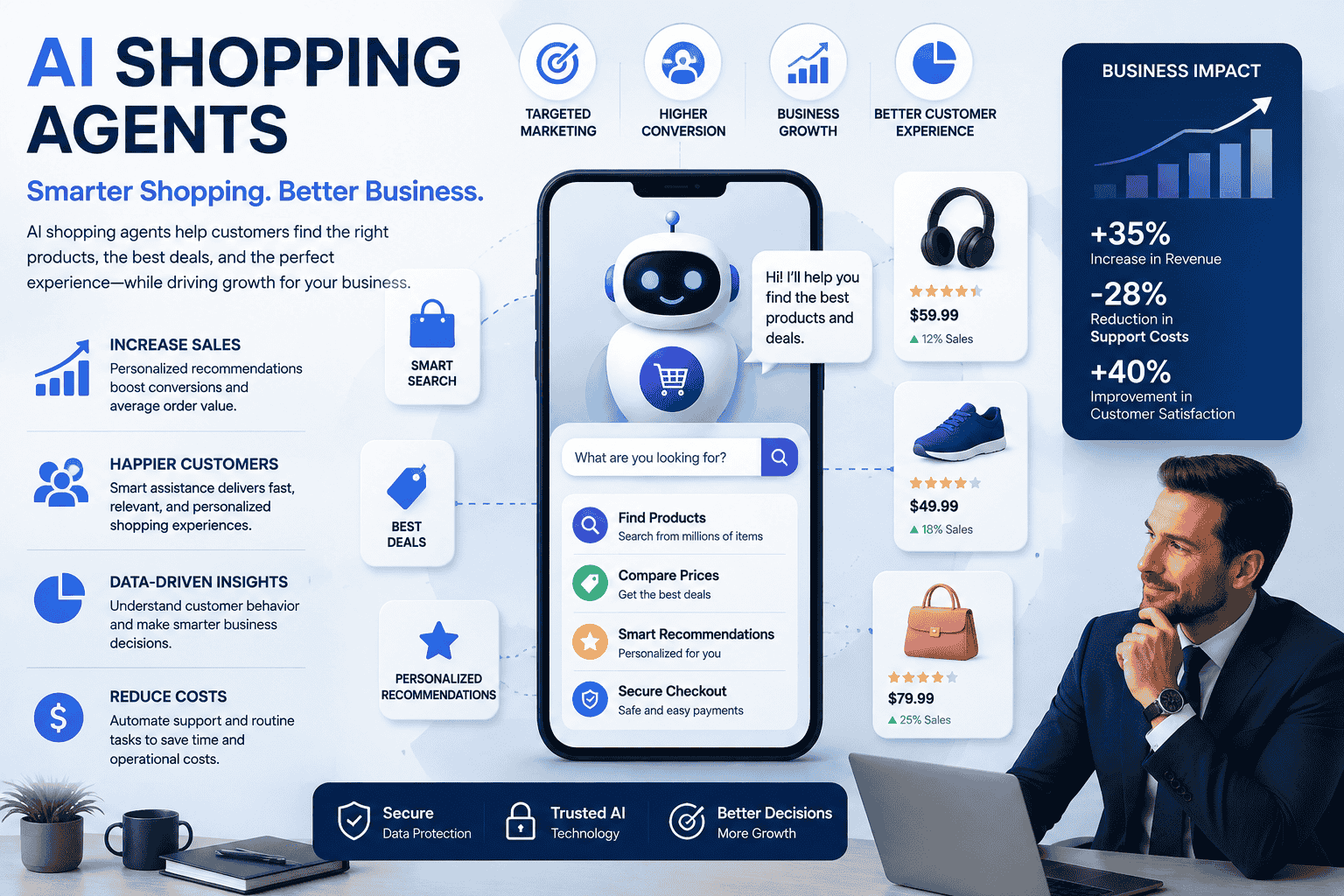
AI shopping agents are intelligent digital assistants designed to simplify the shopping experience by automating product searches, offering personalized recommendations, comparing prices, and helping consumers make informed decisions. Unlike traditional search tools, these systems can understand user preferences, analyze large amounts of information, and provide customized shopping experiences in real time.
Modern consumers expect convenience, speed, and personalization. They no longer want to spend hours comparing products across multiple websites or reading hundreds of customer reviews. AI shopping agents address these challenges by acting as personal shopping assistants that can perform complex tasks within seconds.
As artificial intelligence continues to evolve, shopping agents are becoming more sophisticated and capable of understanding customer behavior, predicting purchasing patterns, and creating highly personalized experiences. Businesses that adopt this technology are gaining a competitive advantage in an increasingly digital marketplace.
This article explores the growing importance of AI shopping agents, their key features, benefits, challenges, and their potential impact on the future of e-commerce.
What Are AI Shopping Agents?
AI shopping agents are software applications powered by artificial intelligence technologies such as machine learning, natural language processing, data analytics, and predictive algorithms.
These digital assistants help consumers throughout the shopping journey by performing tasks that traditionally required manual effort.
An AI shopping agent can:
- Search for products
- Compare prices
- Analyze customer reviews
- Recommend products
- Track discounts
- Monitor inventory
- Suggest alternatives
- Complete purchases
Unlike traditional shopping platforms that rely on keyword-based searches, AI shopping agents understand context and user intent.
For example, instead of searching for “running shoes,” a consumer can ask an AI assistant to find lightweight running shoes suitable for long-distance training within a specific budget.
The AI agent can then analyze thousands of products and present the most relevant options.
How AI Shopping Agents Work
AI shopping agents operate through a combination of advanced technologies that allow them to collect, analyze, and interpret information.
Natural Language Processing
Natural language processing enables AI systems to understand human language.
Consumers can communicate with AI shopping agents through text or voice commands using everyday language instead of technical search terms.
This creates a more natural and interactive shopping experience.
Machine Learning
Machine learning allows AI shopping agents to improve their performance over time.
By analyzing customer behavior, previous purchases, browsing history, and interactions, AI systems can identify patterns and deliver increasingly accurate recommendations.
Predictive Analytics
Predictive analytics enables AI shopping agents to anticipate future behavior.
These systems can identify products that consumers are likely to purchase based on historical data and personal preferences.
Data Integration
AI shopping agents collect information from multiple sources, including:
- Product databases
- Customer reviews
- Retail websites
- Inventory systems
- Pricing platforms
This comprehensive analysis helps consumers make informed purchasing decisions.
Personalized Shopping Experiences
One of the most important advantages of AI shopping agents is personalization.
Traditional online stores often present the same products to every visitor. AI systems take a different approach by customizing recommendations according to individual preferences.
Personalized recommendations are based on factors such as:
- Previous purchases
- Browsing history
- Search behavior
- Price preferences
- Favorite brands
- Shopping frequency
For example, a customer who frequently purchases fitness products may receive recommendations for sports equipment, nutritional supplements, and workout accessories.
This level of personalization improves customer satisfaction while increasing conversion rates for retailers.
AI Shopping Agents and Product Discovery
Finding the right product can be one of the most frustrating aspects of online shopping.
Consumers often face challenges such as:
- Too many product choices
- Inconsistent reviews
- Confusing specifications
- Unclear pricing
AI shopping agents simplify product discovery by filtering unnecessary information and presenting the most relevant options.
Instead of reviewing hundreds of products, consumers receive a carefully selected list based on their preferences.
Visual search technology is further improving product discovery.
Consumers can now upload photographs and ask AI systems to identify similar products.
This feature is particularly valuable in industries such as fashion, home decoration, and consumer electronics.
Intelligent Price Comparison
Price comparison has become an essential component of online shopping.
Many consumers visit multiple websites to find the best deals.
AI shopping agents automate this process by continuously monitoring product prices across different platforms.
These systems can:
- Compare prices
- Detect discounts
- Identify promotional offers
- Monitor price fluctuations
- Notify users about price reductions
Consumers no longer need to manually search for bargains because AI assistants can automatically identify cost-saving opportunities.
This functionality helps customers maximize value while reducing the time required to complete purchases.
AI Shopping Agents and Customer Support
Customer service is another area experiencing significant improvements through artificial intelligence.
Traditional customer support often involves long waiting times and limited availability.
AI-powered shopping assistants provide immediate assistance through:
- Chatbots
- Virtual assistants
- Automated messaging systems
Customers can receive answers to common questions related to:
- Shipping
- Returns
- Product specifications
- Warranty information
- Payment methods
Advanced AI systems can even detect customer emotions and adjust their responses accordingly.
Twenty-four-hour customer support improves the overall shopping experience while reducing operational costs for businesses.
Benefits of AI Shopping Agents for Businesses
AI shopping agents provide several advantages for retailers and e-commerce platforms.
Increased Sales
Personalized recommendations encourage customers to purchase additional products.
Cross-selling and upselling strategies become more effective when supported by artificial intelligence.
Improved Customer Retention
Consumers are more likely to return to platforms that provide personalized experiences.
AI shopping agents strengthen customer relationships by understanding individual preferences.
Better Inventory Management
Artificial intelligence can analyze demand patterns and predict future purchasing behavior.
This information helps businesses maintain optimal inventory levels.
Enhanced Marketing Strategies
AI systems provide valuable insights into customer behavior.
Retailers can use this information to develop targeted marketing campaigns and improve advertising performance.
Challenges and Limitations
Despite their many advantages, AI shopping agents also present several challenges.
Privacy Concerns
AI systems require access to customer data to provide personalized recommendations.
Many consumers remain concerned about how their information is collected, stored, and shared.
Businesses must prioritize transparency and data protection.
Algorithmic Bias
Artificial intelligence depends on data.
If training data contains biases, AI systems may generate inaccurate or unfair recommendations.
Developers must continuously monitor algorithms to ensure fairness and accuracy.
Reduced Human Interaction
Some consumers still prefer traditional shopping experiences that involve direct communication with human representatives.
Businesses must strike a balance between automation and personal interaction.
Security Risks
Cybersecurity remains a major concern in digital commerce.
AI shopping agents process sensitive information, including payment details and personal data.
Protecting this information requires strong security protocols and continuous monitoring.
The Future of AI Shopping Agents
The future of AI shopping agents extends far beyond product recommendations.
Emerging technologies will introduce new capabilities, including:
Autonomous Purchasing
Future AI assistants may independently purchase products after receiving user approval.
For example, a household AI system could automatically reorder groceries when supplies become low.
Augmented Reality Shopping
Artificial intelligence combined with augmented reality will allow consumers to visualize products before making purchasing decisions.
Customers may virtually try on clothing, test furniture placement, or evaluate home improvements.
Voice Commerce
Voice-based shopping will continue to expand.
Consumers will increasingly rely on conversational AI to search for products and complete transactions.
Hyper-Personalization
Future AI systems will create shopping experiences that adapt in real time.
Recommendations will become more accurate as AI assistants develop a deeper understanding of individual behavior.
Conclusion
AI shopping agents are redefining the online shopping experience by combining automation, personalization, and intelligent decision-making.
These digital assistants simplify product discovery, improve customer support, automate price comparisons, and create highly customized shopping experiences.
For consumers, AI shopping agents offer convenience, efficiency, and better purchasing decisions.
For businesses, they provide valuable insights, stronger customer relationships, and increased sales opportunities.
Although challenges related to privacy, security, and algorithmic bias remain, artificial intelligence will continue to transform the retail industry.
As technology advances, AI shopping agents will evolve from simple recommendation systems into fully autonomous digital assistants capable of managing every stage of the shopping journey.
The future of e-commerce will be shaped by intelligent systems that understand consumers, anticipate their needs, and deliver seamless shopping experiences unlike anything previously imagined.