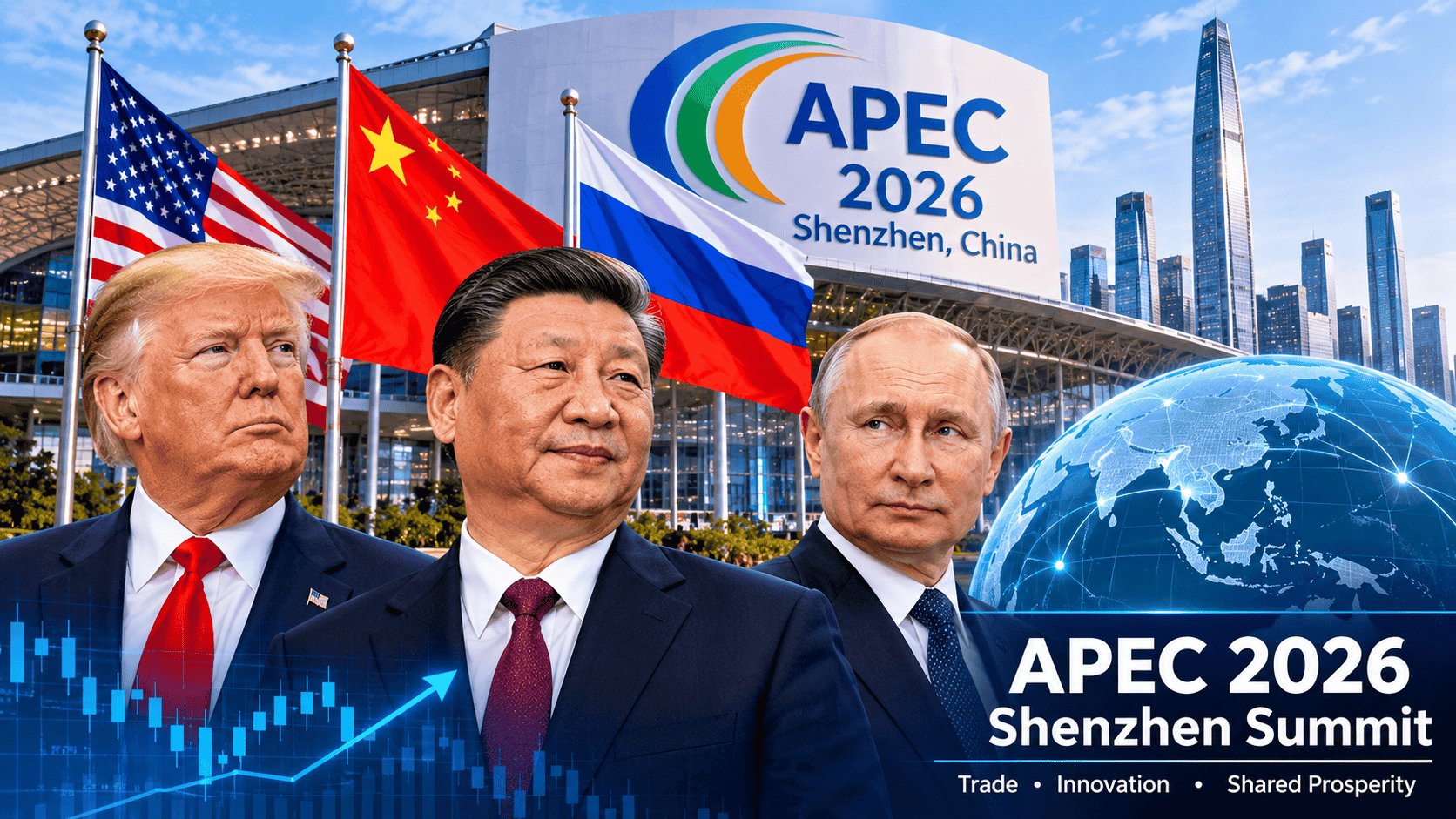
Introduction: Shenzhen Becomes the Center of Global Economic Diplomacy
The international business community is turning its attention toward Shenzhen, China, as the Asia-Pacific Economic Cooperation (APEC) 2026 summit prepares to bring together political leaders, policymakers and corporate executives from across the world.
Scheduled for November 18–19, the 33rd APEC Economic Leaders’ Meeting is taking place at a particularly important moment for the global economy. Trade uncertainty, competition over artificial intelligence, semiconductor restrictions, energy security and geopolitical tensions are influencing investment decisions across major markets.
However, this year’s gathering is attracting additional international attention because of a planned meeting involving three influential world leaders: US President Donald Trump, Chinese President Xi Jinping and Russian President Vladimir Putin.
China’s Foreign Ministry confirmed that Xi will host Trump and Putin for a trilateral meeting in Shenzhen on November 19. The meeting is expected to address international security and strategic issues, although no major agreement has been announced in advance.
For international investors and business leaders, the summit represents more than a diplomatic gathering. It provides an opportunity to assess the direction of relations between major economies and understand how political decisions could influence global commerce, technology and financial markets.
Why the APEC 2026 Summit Matters to the Global Economy
APEC is an economic cooperation forum involving 21 member economies across the Asia-Pacific region. Its members account for a substantial share of global economic activity, international trade and investment.
China is hosting the forum under the theme “Building an Asia-Pacific Community to Prosper Together.”
The Chinese government has identified three major priorities for its 2026 APEC year:
- Openness and international trade.
- Innovation and technological development.
- Regional and international cooperation.
According to China’s Foreign Ministry, more than 300 meetings and events have already taken place during the APEC China Year, involving over 10,000 participants.
The November leaders’ meeting is expected to focus on trade, connectivity, the digital economy and artificial intelligence.
For businesses, these discussions matter because regional cooperation can influence market access, supply-chain development, investment conditions and technology partnerships.
A successful economic dialogue could help improve business confidence, although any meaningful changes will depend on the agreements governments actually implement.
Trump, Xi and Putin: An Unprecedented Trilateral Meeting
One of the most closely watched developments surrounding the Shenzhen summit is the planned meeting between Donald Trump, Xi Jinping and Vladimir Putin.
The White House and Kremlin have confirmed plans for the three leaders to meet on November 19. China’s Foreign Ministry has also announced the gathering.
The meeting brings together the leaders of three countries with significant influence over international trade, energy markets, military security and global diplomatic relationships.
Several important issues could shape their discussions.
US-China relations and international trade
The economic relationship between Washington and Beijing remains one of the most important factors influencing global markets.
Both countries are major trading powers, with businesses worldwide depending on their manufacturing networks, technology industries and consumer markets.
Although the two governments have previously taken steps toward reducing trade tensions, disagreements remain over tariffs, semiconductor exports, industrial competition and technology restrictions.
Trump and Xi will have an opportunity to discuss these issues during their broader diplomatic engagement.
For multinational businesses, the direction of US-China relations could influence manufacturing decisions, international sourcing, export opportunities and investment planning.
Nuclear security and strategic stability
Nuclear arms control is another important subject surrounding the planned trilateral meeting.
The previous US-Russia New START treaty expired in February 2026, removing the existing limits on the two countries’ strategic nuclear arsenals.
The Trump administration has expressed interest in developing a broader nuclear arms framework that also involves China.
However, Beijing has shown limited interest in participating in negotiations that would place restrictions on its substantially smaller nuclear arsenal compared with those of Washington and Moscow.
According to reporting by the Associated Press, US officials view the Shenzhen meeting as an opportunity to begin discussions rather than announce an immediate agreement.
The Iran conflict and energy security
The conflict involving Iran and the wider Middle East could also influence discussions between the three leaders.
Energy security is a major international concern because instability in the region can affect oil transportation, shipping insurance, fuel prices and international trade.
China is an important buyer of Middle Eastern energy, while Russia and the United States are major participants in global energy markets.
Any diplomatic progress that reduces geopolitical uncertainty could influence investor expectations and energy-market sentiment.
However, the summit should not be interpreted as a guarantee of a ceasefire or immediate changes in energy supply.
Artificial Intelligence and Semiconductor Competition Take Center Stage
Beyond traditional diplomacy, artificial intelligence could become one of the most important economic subjects surrounding APEC 2026.
The United States and China are competing to strengthen their positions in advanced computing, semiconductor manufacturing, AI infrastructure and next-generation technologies.
US restrictions on advanced semiconductor exports have become a major point of disagreement between the two countries.
American policymakers have argued that export controls are necessary to protect national security, while China continues investing in domestic chip manufacturing and technological independence.
According to Reuters reporting published November 16, discussions surrounding the Shenzhen summit could include AI safety cooperation and communication mechanisms designed to prevent serious AI-related incidents from escalating into international security problems.
The discussions may also cover safeguards against the misuse of advanced AI systems and approaches to testing increasingly powerful models.
For technology investors, three developments deserve attention:
- Semiconductor supply chains: Whether US-China discussions create greater clarity around advanced chip exports and international manufacturing.
- AI safety cooperation: Whether the countries establish practical communication channels for serious AI incidents.
- Digital economy investment: Whether APEC members support stronger regional cooperation in AI infrastructure investment, digital services and technology development.
Even limited cooperation could matter to technology companies operating across international markets.
Global Business Leaders Look Toward Shenzhen
The APEC summit is not exclusively a political event. It is also an important gathering for international businesses seeking investment opportunities and stronger commercial relationships.
Reuters reported on November 16 that senior executives from major American and Chinese companies are expected to participate in the Shenzhen meetings.
The Chinese business delegation includes representatives from major financial institutions and technology companies, including:
- Industrial and Commercial Bank of China
- Bank of China
- Agricultural Bank of China
- BYD
- CATL
- Baidu
- Xiaomi
American business participants include representatives from Visa, Mastercard, UPS, PwC, Deloitte and Boeing.
These companies operate across financial services, transportation, manufacturing, technology and international commerce.
Their participation highlights the importance of business-to-business relationships even when governments face political disagreements.
For international investors, the corporate gathering could provide insights into future partnerships, technology investment and opportunities within the Asia-Pacific region.
What the Summit Could Mean for Global Financial Markets
Financial markets are particularly sensitive to developments involving the United States, China and Russia.
The three countries influence global economic activity through trade, commodities, financial policy, industrial production and international security.
The Shenzhen summit could affect several important investment areas.
1. Stock markets and investor confidence
Any indication of improved US-China relations could influence sentiment toward companies exposed to international trade.
Technology manufacturers, semiconductor businesses, industrial companies and multinational retailers may benefit from reduced uncertainty.
However, if discussions reveal continuing disagreements, investors could remain cautious about businesses dependent on cross-border supply chains.
2. Oil prices and energy investments
Energy markets will be watching diplomatic developments involving Iran, Russia and China.
A reduction in geopolitical tensions could support more stable oil transportation and lower risk premiums.
Conversely, unresolved conflicts or renewed restrictions could maintain uncertainty around crude oil, natural gas and shipping costs.
Energy investors should distinguish between diplomatic statements and actual changes in production, exports or transportation.
3. Semiconductor and technology stocks
Technology companies could be particularly sensitive to discussions about export restrictions and AI cooperation.
Investors will want clarity on the availability of advanced processors, international manufacturing partnerships and the future regulatory environment.
However, the summit is not expected to automatically remove existing technology restrictions.
4. Currency markets and international investment
Diplomatic developments can influence expectations surrounding international capital flows and currency stability.
The US dollar, Chinese yuan and other regional currencies may respond to changes in trade expectations, economic confidence and geopolitical risk.
Long-term investment decisions will still depend on economic fundamentals, interest rates and actual policy implementation.
Why China Chose Shenzhen to Host APEC 2026
Shenzhen is an important symbol of China’s transformation into a major global manufacturing and technology economy.
Once a relatively small southern Chinese settlement, the city has developed into an international center for electronics, advanced manufacturing, technology companies and innovation.
It is home to globally recognized businesses, including Huawei, Tencent and BYD.
Its location within the Greater Bay Area also connects it to Hong Kong, Guangzhou and other major commercial centers.
Hosting APEC in Shenzhen allows China to present its technology and manufacturing capabilities to international leaders and business representatives.
The choice of location also reinforces the summit’s focus on innovation, economic openness and regional connectivity.
For foreign businesses, Shenzhen offers a useful setting to examine China’s industrial development and the opportunities and challenges associated with operating in its technology ecosystem.
Risks and Challenges: Why Investors Should Avoid Overestimating the Summit
Although the meeting has attracted considerable international attention, expectations should remain realistic.
A high-level diplomatic meeting does not automatically produce trade agreements, lower tariffs or changes in national security policies.
The United States and China continue to have differences over semiconductor exports, technology competition, trade policy and strategic influence.
Russia’s relationship with Western governments also remains complicated by the war in Ukraine and international sanctions.
Furthermore, China’s reluctance to participate in nuclear arms-control negotiations under existing proposals could limit progress on that issue.
Investors should therefore focus on confirmed announcements rather than assume that the gathering will resolve longstanding disputes.
The most important indicators will be formal declarations, specific policy commitments, commercial agreements and subsequent government actions.
What to Watch After the APEC Shenzhen Summit
The real economic impact of the November 18–19 summit will become clearer through developments following the meetings.
International investors should monitor five areas:
- Whether the United States and China announce progress on trade negotiations.
- Whether AI safety cooperation produces a practical agreement.
- Whether semiconductor export restrictions remain unchanged or enter further discussions.
- Whether the three leaders make progress on nuclear security and diplomatic communication.
- Whether Chinese and American companies announce new commercial partnerships or investment commitments.
The APEC Shenzhen Declaration will also be important because it could outline the participating economies’ shared priorities for regional economic cooperation.
Final Outlook: Could Shenzhen Influence the Next Phase of Global Economic Relations?
The APEC 2026 summit arrives at a time when the global economy is facing several interconnected challenges. Trade uncertainty, technological competition, energy security and geopolitical tensions are influencing decisions made by governments, multinational corporations and institutional investors.
The planned meeting between Donald Trump, Xi Jinping and Vladimir Putin adds another important dimension to the gathering.
While expectations of immediate diplomatic breakthroughs should remain measured, the discussions could provide valuable signals about the future direction of international relations.
For businesses, the most important questions involve market access, semiconductor supply chains, investment opportunities and the stability of global trade.
For investors, the summit offers an opportunity to evaluate geopolitical risks and identify sectors that could be affected by future policy decisions.
Ultimately, Shenzhen’s importance will not be determined by the number of world leaders attending, but by whether their discussions produce practical outcomes for international trade, technology cooperation and economic stability.
Frequently Asked Questions (FAQs)
1. When is the APEC 2026 Shenzhen summit?
The 33rd APEC Economic Leaders’ Meeting is scheduled for November 18–19, 2026, in Shenzhen, China.
2. Which world leaders are expected to meet in Shenzhen?
Chinese President Xi Jinping, US President Donald Trump and Russian President Vladimir Putin are scheduled to hold a trilateral meeting on November 19.
3. What are the main topics of APEC 2026?
The main priorities include international trade, economic cooperation, artificial intelligence, digital transformation, innovation and regional connectivity.
4. Why is the Trump-Xi-Putin meeting important?
The meeting brings together leaders of three influential countries to discuss strategic security and international issues, including nuclear arms control and geopolitical tensions.
5. How could APEC 2026 affect global investors?
Developments involving trade, energy security, semiconductor restrictions and AI cooperation could influence investor confidence, international supply chains and financial-market expectations.
6. Why is Shenzhen hosting the APEC summit?
Shenzhen represents China’s development in advanced manufacturing, technology and international business. Its location within the Greater Bay Area also makes it an important regional commercial center.
Author: Anam Younas | Daily Press
Follow Daily Press on X for the latest news and updates: @dailypressit.