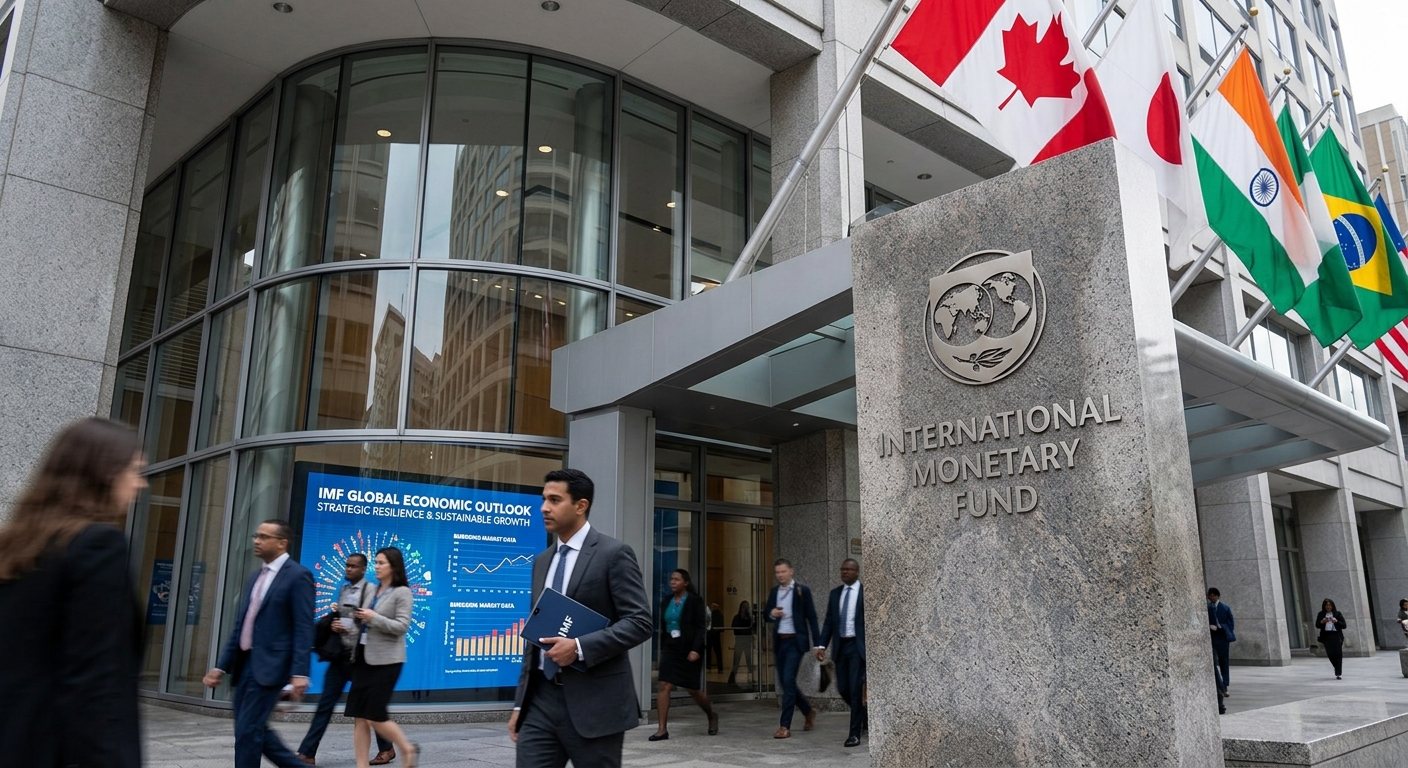
The International Monetary Fund (IMF) has warned that the global economy faces growing risks from Middle East conflict, elevated energy prices, rising government debt, and uncertainty surrounding the artificial intelligence investment boom. Although strong spending on AI infrastructure is supporting economic activity, the combination of geopolitical instability and financial market vulnerabilities could threaten global growth if conditions deteriorate.
In its October 2026 World Economic Outlook, the IMF projects global economic growth of 3.1% in 2026 and 3.4% in 2027. However, the outlook remains uneven, with energy-importing economies and financially vulnerable countries facing greater pressure than some technology-focused economies.
For investors, business leaders, and policymakers, the central question is whether investment in artificial intelligence can continue supporting economic growth while higher energy costs and mounting debt place additional pressure on the global financial system.
Why the IMF Is Warning About the Global Economy
The global economy is being shaped by two competing forces. On one side, investment in artificial intelligence, data centers, advanced semiconductors, and computing infrastructure is supporting business activity. On the other, geopolitical conflict and energy supply disruptions are increasing costs and creating uncertainty for businesses and governments.
The IMF’s latest outlook suggests that the global economy remains resilient, but that resilience should not be mistaken for an absence of risk.
Several factors are contributing to the uncertainty:
- Middle East conflict: Disruptions to energy supplies and shipping routes can increase oil prices and transportation costs.
- AI investment concentration: Heavy spending on AI infrastructure creates financial exposure if future revenues fail to meet investor expectations.
- Rising public debt: Governments have less fiscal flexibility when borrowing costs and debt-servicing expenses increase.
- Inflation pressure: Higher energy and food costs can complicate central bank decisions about interest rates.
- Uneven economic growth: Countries that import energy or have limited access to technology-driven investment may face greater difficulties.
These risks are interconnected. For example, higher oil prices can increase inflation, while persistent inflation can keep interest rates elevated and raise borrowing costs for already indebted businesses and governments.
Middle East Conflict and Oil Prices Put Pressure on Global Markets
Energy security has become a major concern for the international economy as conflict in the Middle East threatens supply chains and important shipping routes.
The Strait of Hormuz is particularly important because it connects the Persian Gulf with global maritime trade routes and carries a substantial share of internationally traded oil.
Any prolonged disruption to shipping through this passage can affect crude oil availability, freight costs, insurance premiums, and the prices paid by energy-importing countries.
Higher oil prices influence the economy through several channels. Transportation companies face increased fuel expenses, manufacturers pay more to operate energy-intensive facilities, and logistics providers may pass additional costs to customers.
These increases can eventually affect food prices, consumer goods, and business investment.
For countries dependent on imported energy, the effects can be especially challenging. Governments may need to manage rising import bills while protecting households from higher fuel and electricity costs.
The IMF’s economic outlook is therefore sensitive to how the Middle East conflict develops and whether energy supplies and shipping conditions return to more normal levels.
What If Oil Prices Remain Above $100?
If crude oil prices remain above $100 per barrel for an extended period, the global economy could face a more severe energy shock.
Higher energy costs would likely increase inflationary pressure and reduce the purchasing power of households. Businesses could also postpone expansion plans as operating expenses and financing costs rise.
The IMF has warned that a deeper and more prolonged conflict, with oil prices remaining above $130 per barrel through the first quarter of 2027, could reduce global economic growth in 2027 by approximately 0.5 percentage points relative to its baseline projection.
This scenario highlights why the duration of an energy shock matters as much as the initial price increase.
A temporary spike may have a limited economic effect, but sustained high prices can influence investment decisions, consumer behavior, inflation expectations, and monetary policy.
AI Investment Is Supporting Growth but Creating New Risks
Artificial intelligence has become a major source of investment across the global economy.
Technology companies are spending heavily on data centers, advanced chips, cloud computing capacity, electricity infrastructure, and AI software. These investments generate demand for equipment manufacturers, construction companies, semiconductor suppliers, and energy providers.
The expansion also creates opportunities for businesses that use AI to improve productivity, automate routine work, and develop new products and services.
However, the IMF has warned that financial markets may be underestimating the risks associated with a potential correction in AI-related investments.
Could the AI Boom Turn Into a Market Correction?
A market correction could occur if investors conclude that expected AI revenue and productivity gains do not justify current valuations and infrastructure spending.
For example, technology companies may continue investing billions of dollars in computing capacity, but the financial returns could arrive more slowly than anticipated.
If companies reduce their spending, semiconductor manufacturers, data center operators, cloud providers, and infrastructure suppliers could experience weaker demand.
The impact could spread beyond technology stocks. A significant decline in AI-related investment could affect corporate earnings, employment, business confidence, and the broader financial markets.
Borrowing adds another layer of risk. If companies have financed substantial infrastructure expansion with debt, weaker revenue expectations could make refinancing more expensive and increase pressure to reduce spending.
This does not mean an AI market collapse is inevitable. AI adoption could continue generating substantial productivity improvements. The concern is that financial markets may have priced in benefits that take longer to materialize or prove smaller than expected.
For investors, the distinction between long-term technological potential and short-term investment valuations is becoming increasingly important.
Rising Government Debt Creates Another Economic Challenge
Public debt is another major concern for the global economy.
Governments borrow to finance public services, infrastructure, economic support programs, and existing obligations. However, high debt levels can become more difficult to manage when interest rates rise or economic growth slows.
Higher borrowing costs increase the amount governments must spend on debt servicing, leaving less room for investment in education, healthcare, infrastructure, and economic development.
The pressure can become more severe during an energy crisis. Governments may face demands for fuel subsidies, household assistance, or emergency support for affected industries just as their financing costs increase.
For investors, rising public debt can influence government bond yields, currency markets, and assessments of sovereign credit risk.
If investors demand higher returns to compensate for perceived fiscal risks, governments and private companies may face more expensive financing.
This creates a potential feedback loop: higher borrowing costs weaken fiscal flexibility, while weaker growth makes debt burdens more difficult to manage.
The IMF’s warning reinforces the importance of credible fiscal planning and sustainable borrowing strategies, particularly during periods of geopolitical uncertainty.
How the Economic Risks Could Affect the United States
The United States occupies a central position in both the global technology industry and international financial markets.
American technology companies are major investors in AI infrastructure, while US government bond markets influence financing conditions worldwide.
Continued AI investment could support economic growth through business spending, technology development, and productivity improvements. However, a sharp reduction in AI investment could affect technology companies, suppliers, and related industries.
Higher oil prices could create additional pressure by increasing transportation costs and consumer expenses. If energy inflation persists, the Federal Reserve could face a more complicated decision about whether to reduce interest rates.
A prolonged period of elevated borrowing costs could affect mortgage payments, corporate financing, business expansion, and stock market valuations.
Investors should therefore monitor both AI-related capital expenditure and inflation indicators when assessing the outlook for US financial markets.
Europe Faces Energy Costs and Industrial Competitiveness Risks
European economies could face renewed pressure if Middle East tensions keep global energy prices elevated.
Higher fuel and electricity costs can affect industrial production, transportation, household budgets, and business confidence. Energy-intensive sectors such as chemicals, steel, and manufacturing may face particular difficulties if production expenses rise faster than those of international competitors.
Europe’s exposure varies by country, depending on its energy mix, import arrangements, industrial structure, and access to alternative supplies.
Businesses may respond by improving energy efficiency, adjusting production schedules, investing in renewable power, or passing some costs to customers.
However, these adjustments take time. If energy costs remain high, European policymakers could face difficult choices between controlling inflation, supporting industrial activity, and protecting vulnerable households.
The situation also reinforces the importance of energy diversification and long-term investment in resilient infrastructure.
Why China, India, and Other Asian Economies Matter
Asia is central to the global economic outlook because it combines major energy importers with important technology manufacturers and exporters.
China plays a significant role in manufacturing, international trade, and technology supply chains. Higher oil prices could increase industrial and transportation costs, while weaker global demand could affect exports.
India faces a different combination of opportunities and risks. Strong domestic demand and services activity can support growth, but higher crude oil prices may increase import expenses and put pressure on inflation and the currency.
South Korea and other semiconductor-producing economies may benefit from continued demand for AI hardware. However, their exposure to the technology cycle also means that a slowdown in AI infrastructure spending could weaken exports and investment.
For emerging Asian economies, the outcome depends on several factors, including energy import dependence, foreign currency reserves, public debt, domestic demand, and participation in technology-driven growth.
Countries that benefit from AI-related exports may be better positioned to withstand some external pressures, while economies with high import bills and limited fiscal flexibility may face more difficult conditions.
What the IMF’s Warning Means for Global Investors
For investors, the latest outlook highlights the need to assess both economic fundamentals and potential market shocks.
Several indicators deserve close attention.
Oil prices and energy supply: Investors should monitor crude prices, shipping conditions, inventory levels, and geopolitical developments that could affect energy availability.
AI spending and profitability: Technology companies’ capital expenditure, revenue growth, and returns on infrastructure investment can help investors evaluate whether the AI boom remains financially sustainable.
Government bond yields: Rising yields can increase borrowing costs, affect equity valuations, and create pressure for governments with substantial financing needs.
Inflation and interest rates: Persistent energy inflation may influence central bank decisions and change expectations for monetary policy.
Corporate debt and refinancing: Companies with substantial debt obligations may be more vulnerable if earnings weaken or credit conditions tighten.
Diversification and careful risk management remain important during periods of uncertainty. Investors should avoid assuming that every AI company will benefit equally from technology adoption or that all energy producers will gain from higher oil prices.
Market outcomes will depend on company fundamentals, valuations, financial leverage, and the evolution of geopolitical risks.
What Businesses Should Do to Prepare
Businesses can take practical steps to reduce their exposure to energy shocks, financing pressures, and changes in technology investment.
First, companies should review their cash flow forecasts and test how higher fuel prices, weaker demand, or increased interest expenses could affect liquidity.
Second, businesses should examine supplier dependence and consider alternative sourcing arrangements where appropriate. Diversifying suppliers and improving inventory planning can help reduce disruption risks.
Third, companies investing in AI should evaluate projects according to measurable productivity gains, operating savings, revenue potential, and implementation costs rather than following market enthusiasm alone.
Fourth, management teams should review debt maturity schedules and financing arrangements to understand how higher borrowing costs could affect future obligations.
Finally, businesses should develop contingency plans for adverse scenarios, including prolonged energy disruptions, slower customer payments, and tighter credit conditions.
These measures cannot eliminate uncertainty, but they can improve preparedness and help organizations make more disciplined financial decisions.
Conclusion: Global Growth Faces a Test of Resilience
The IMF’s October 2026 outlook highlights a global economy supported by AI investment but exposed to significant geopolitical and financial risks.
Projected growth of 3.1% in 2026 and 3.4% in 2027 suggests continued economic expansion, yet the outlook remains vulnerable to prolonged Middle East conflict, higher energy costs, rising public debt, and a potential correction in AI-related investment.
The consequences will differ across countries. Technology exporters may benefit from sustained demand for AI infrastructure, while energy-importing economies and heavily indebted governments may face greater pressure.
For investors and business leaders, the priority is to distinguish durable economic opportunities from risks that could undermine profitability and financial stability.
The future of the global economy will depend not only on the pace of AI adoption but also on energy security, responsible borrowing, effective economic policy, and the ability of businesses and governments to respond to unexpected shocks.
The central message for global markets is clear: economic resilience remains possible, but it will depend on how effectively the world manages the combined pressures of geopolitical conflict, technological change, and financial uncertainty.
Frequently Asked Questions (FAQs)
What is the IMF warning about in October 2026?
The IMF is warning that prolonged Middle East conflict, elevated energy prices, rising government debt, and a potential slowdown in AI investment could threaten global economic growth and financial stability.
What is the IMF’s global growth forecast for 2026 and 2027?
The IMF projects global economic growth of 3.1% in 2026 and 3.4% in 2027 in its October 2026 World Economic Outlook.
How could high oil prices affect the global economy?
Higher oil prices can increase transportation and production costs, raise inflation, weaken household purchasing power, and complicate central bank decisions about interest rates.
Could an AI investment slowdown trigger a stock market correction?
Yes. If investors believe AI-related revenue and productivity gains will not justify current spending and valuations, technology stocks and related industries could face pressure. The scale of any correction would depend on company earnings, debt exposure, and broader market conditions.
Which countries are most vulnerable to higher oil prices?
Countries that depend heavily on imported energy and have limited fiscal flexibility may face greater pressure. The impact varies according to domestic energy production, currency movements, government support measures, and economic structure.
What should investors watch during this period of uncertainty?
Investors should monitor oil prices, AI infrastructure spending, corporate earnings, government bond yields, inflation, interest rate expectations, and corporate debt levels.
What does the IMF outlook mean for businesses?
Businesses may need to strengthen cash flow planning, assess energy and financing exposure, diversify critical suppliers, and evaluate AI investments according to measurable commercial benefits.
About the Author:
Anam Younas writes about business, finance, AI, technology, and global news for Daily Press.
Follow Daily Press on X for the latest news and updates: @dailypressit.