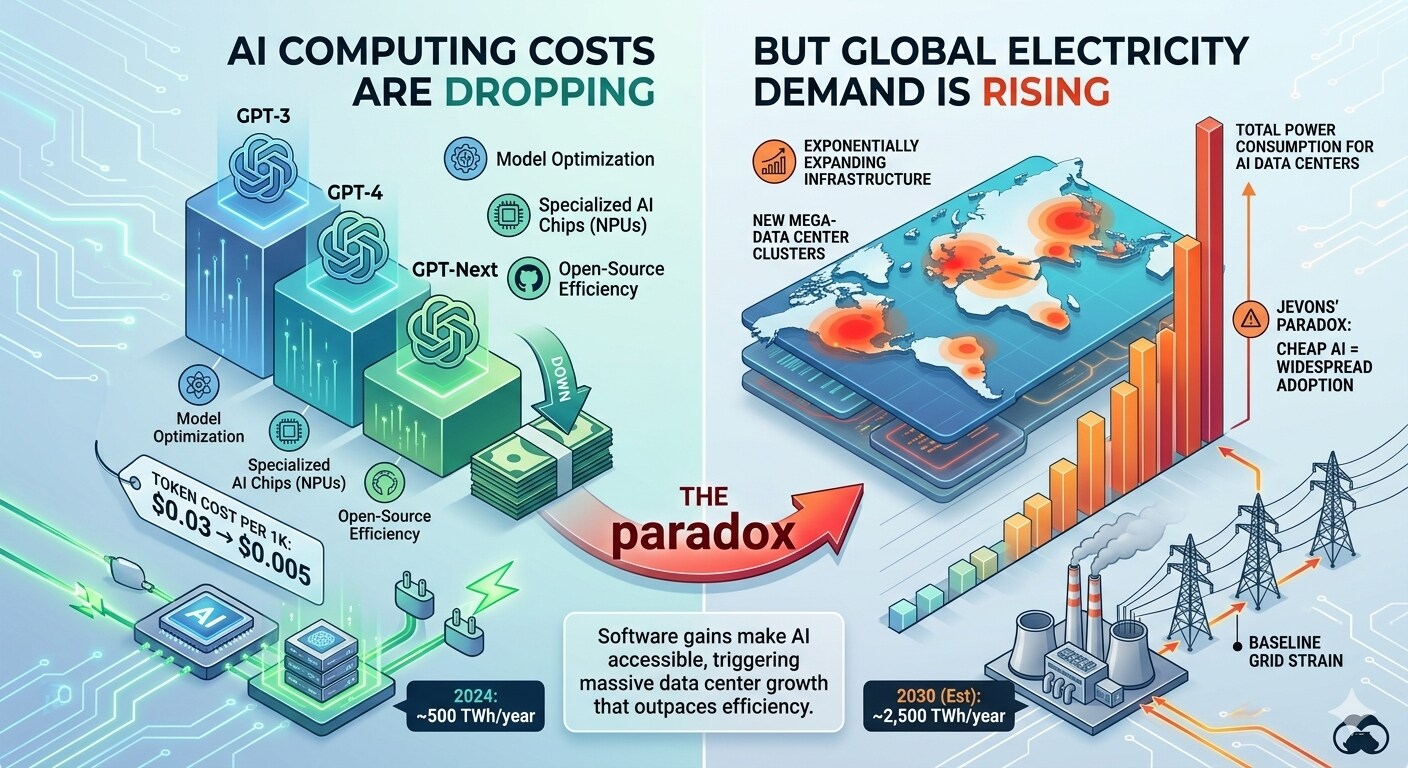
Artificial intelligence is becoming cheaper AI, faster, and more accessible. The cost of running AI models is falling as companies improve chips, software, model architectures and data-center efficiency. But instead of automatically reducing electricity consumption, cheaper AI could trigger a new surge in power demand.
That is the emerging AI efficiency paradox: when technology becomes cheaper AI to use, businesses may simply use much more of it.
For investors and financiers, the issue is becoming increasingly important because the AI boom is no longer only a technology story. It is becoming an energy, infrastructure and capital-investment story.
Why Cheaper AI Could Mean More Electricity
AI companies are aggressively improving efficiency.
New generations of processors can deliver more computing power per watt, while software optimization can reduce the resources required to produce an AI response. More efficient models can also perform certain tasks at a fraction of the computational cost of earlier systems.
Normally, greater efficiency should mean lower energy consumption.
However, AI may follow a different pattern.
If AI queries become dramatically cheaper AI, companies have a financial incentive to use AI more frequently. Instead of asking an AI system to perform a few expensive tasks, businesses can integrate AI into customer service, software development, finance, marketing, logistics, cybersecurity, and internal decision-making.
The result could be a much larger total volume of computation.
This phenomenon is often described as a rebound effect: efficiency lowers the cost of consumption, which can encourage enough additional consumption to offset some or all of the efficiency gains.
Data Centers Are Becoming Major Electricity Consumers
The scale of the coming electricity requirement is significant.
Global data-center electricity consumption is expected to rise sharply by the end of the decade, with AI emerging as one of the most important drivers of that growth.
The broader electricity market is also expanding. Electricity demand is being pushed higher by electric vehicles, industrial activity, air conditioning, heat pumps and other forms of electrification.
AI therefore does not operate in an isolated energy market. It competes for electricity alongside virtually every other major source of new demand.
The United States Faces a Particularly Large Impact
The United States is emerging as one of the most important markets in the AI-power equation.
Major technology companies are building increasingly power-intensive facilities to support AI training and inference. The growth of these facilities creates demand not only for electricity but also for transmission lines, substations, transformers, cooling systems, backup generation and new power-generation capacity.
Consequently, the AI investment cycle is spreading far beyond semiconductor companies.
Energy companies, utilities and infrastructure providers are increasingly becoming part of the AI supply chain.
AI Agents Could Make the Energy Problem Bigger
The next stage of AI adoption could be particularly important.
Traditional chatbots generally respond when a user sends a request. AI agents can potentially perform sequences of tasks autonomously, including searching for information, analyzing documents, writing software, monitoring systems and interacting with other digital tools.
That means one user instruction could generate many individual computational operations.
As cheaper AI, companies may deploy thousands or even millions of automated agents across their operations.
This creates a potentially important distinction between energy consumed per AI task and total energy consumed by AI.
The first can decline while the second increases.
For businesses, cheaper AI could therefore be extremely attractive economically while simultaneously increasing the amount of infrastructure required underneath it.
The Energy Supply Race Is Becoming an AI Investment Theme
The growing power requirement is creating opportunities across the energy sector.
The next wave of cheaper AI infrastructure could increase demand for:
- Renewable power generation
- Natural gas
- Nuclear energy
- Electricity transmission
- Grid equipment
- Transformers
- Battery storage
- Data-center cooling
- Power-management technology
The AI economy is therefore creating a second investment chain behind the semiconductor industry.
A company selling AI chips may benefit from growing AI workloads. But companies supplying the electricity and infrastructure needed to operate those chips could also become strategically important.
Cooling Is Another Hidden Energy Cost
Electricity is not consumed only by processors.
High-density AI servers generate enormous amounts of heat, requiring sophisticated cooling infrastructure.
Traditional air cooling is increasingly being supplemented or replaced by liquid-cooling technologies in high-performance AI environments.
That creates another expanding market for cooling equipment and thermal-management systems.
As AI infrastructure becomes more powerful, cooling efficiency could become almost as important as processor efficiency.
For investors, companies developing advanced cooling and thermal-management technologies could therefore become important beneficiaries of the AI infrastructure boom.
The Financial Risk: More AI Does Not Automatically Mean More Returns
The electricity challenge also creates a financial question.
AI infrastructure requires enormous upfront capital expenditure. Companies must invest in data centers, servers, networking equipment, power systems and cooling infrastructure before the resulting AI applications necessarily generate equivalent revenues.
The scale of global AI infrastructure investment could eventually reach extraordinary levels.
If AI usage grows rapidly enough, that infrastructure may generate substantial economic value.
But if electricity constraints, connection delays, rising energy prices or weak AI monetization slow deployment, investors could face longer payback periods.
That makes electricity availability an increasingly important variable in AI investment analysis.
Data Centers Are Changing Local Energy Markets
The impact is also becoming visible at the local level.
A massive data center can represent a substantial new electricity load for a particular region. Utilities may need to upgrade transmission networks, build substations or increase generation capacity.
This can create economic opportunities but also raise questions about who pays for infrastructure expansion and how electricity costs are distributed.
Communities are increasingly examining the economic benefits of data centers alongside their potential impact on electricity grids, water supplies and local infrastructure.
As AI facilities become larger, these debates could influence where companies choose to build their next generation of data centers.
What Investors Should Watch Next
The AI-energy relationship could become one of the defining infrastructure stories of the next decade.
Investors will likely be watching several indicators:
AI inference costs: How quickly does the cost of running AI applications fall?
AI utilization: Are lower costs producing dramatically more usage?
Data-center construction: How quickly can new facilities become operational?
Electricity prices: Does AI demand push power prices higher in constrained markets?
Grid investment: Can transmission and generation capacity keep pace?
Energy technology: Which combination of renewables, gas, nuclear and storage ultimately supplies AI infrastructure?
AI monetization: Can companies generate enough revenue from AI to justify the enormous infrastructure investment?
The Bigger Picture
The AI revolution is increasingly becoming an electricity revolution.
More efficient AI models and hardware could reduce the energy required for individual computations. But if those efficiency gains make AI inexpensive enough to deploy everywhere, total demand for computation—and therefore electricity—could continue climbing.
For the financial markets, this changes the AI investment equation.
The next phase of the AI boom may not be determined solely by who develops the most powerful model or the fastest chip. Access to affordable electricity, grid capacity, cooling technology and energy infrastructure could become equally important competitive advantages.
In other words, making cheaper AI may not make the AI economy smaller.
It could make it much bigger—and far more power hungry.