Artificial intelligence has moved far beyond the technology sector. It is now influencing finance, energy, manufacturing, real estate, and global investment. As businesses race to adopt AI, the biggest challenge is increasingly becoming the cost of building the infrastructure needed to run it.
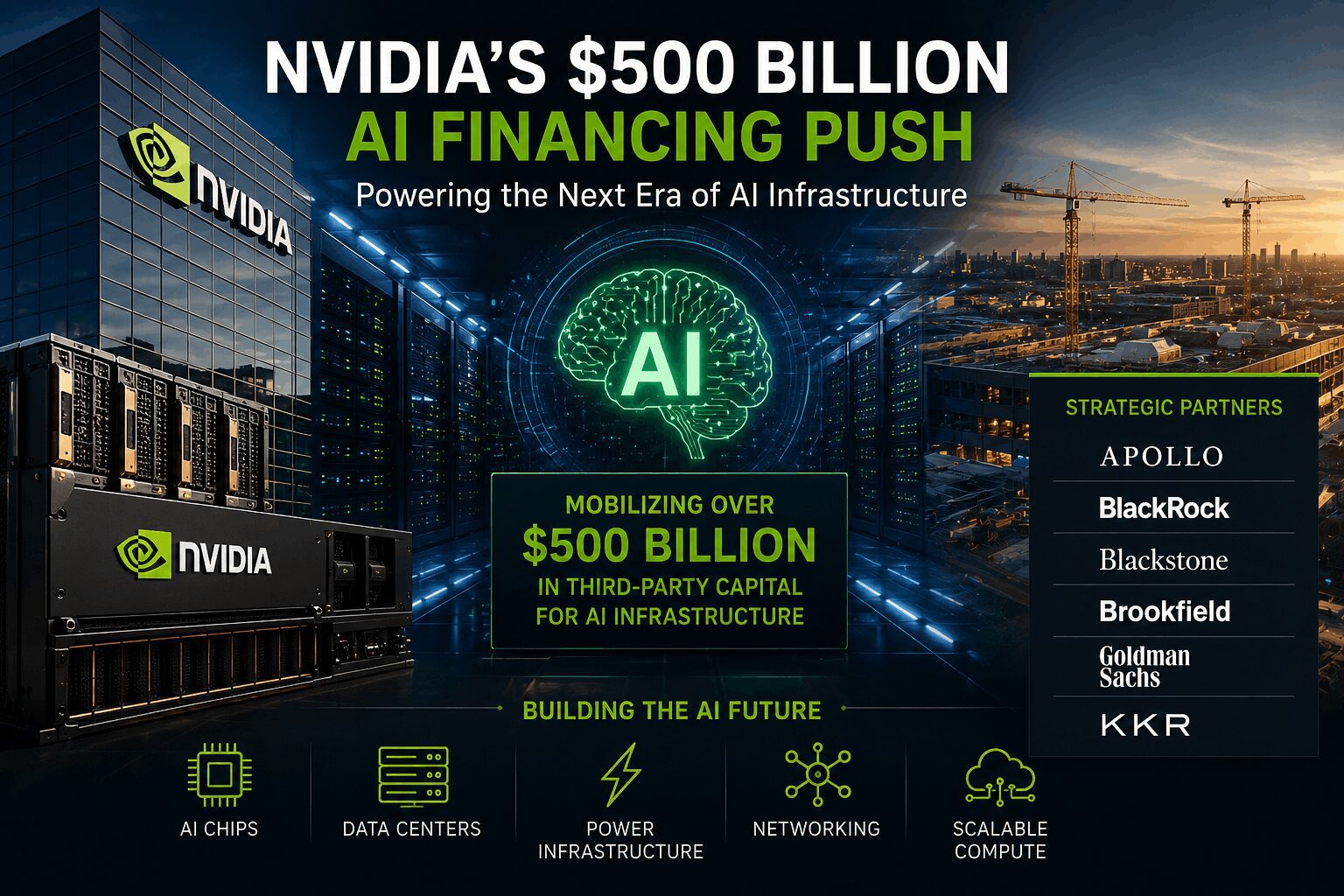
Nvidia is now taking a major step into that financial side of the AI boom. The company has announced partnerships with major financial institutions to establish independent financing platforms designed to mobilize more than $500 billion of third-party capital for AI computing infrastructure. The initiative brings together Nvidia with major firms including Apollo, BlackRock, Blackstone, Brookfield, Goldman Sachs, and KKR.
The development could change how businesses finance data centers, computing equipment, and other infrastructure required for artificial intelligence.
What Is Nvidia’s $500 Billion AI Financing Initiative?
Nvidia’s new initiative is designed to address one of the biggest obstacles facing the AI industry: access to capital.
Building large-scale AI infrastructure requires enormous investment. Companies need advanced GPUs, servers, networking systems, data centers, electricity infrastructure, and cooling systems. Instead of requiring every company to finance these investments independently, Nvidia is working with financial institutions to create financing structures that can make AI computing infrastructure easier to fund.
Nvidia Is Working With Major Financial Firms
The initiative includes partnerships with several of the world’s largest investment and financial companies.
These include:
- Apollo
- BlackRock
- Blackstone
- Brookfield
- Goldman Sachs
- KKR
The combined goal is to mobilize more than $500 billion in third-party capital for AI compute infrastructure.
This is significant because it brings traditional financial markets deeper into the AI infrastructure business.
Why Does AI Need So Much Capital?
The rapid expansion of AI has created demand for computing infrastructure on a scale that many businesses have never experienced.
Training and operating advanced AI models requires enormous computing power. Companies developing AI applications also need reliable access to GPUs and data-center capacity.
AI Infrastructure Is Expensive
A modern AI data center can require significant investment in:
- High-performance GPUs
- Servers and networking equipment
- Data-center buildings
- Electricity infrastructure
- Cooling systems
- Storage systems
- Security
- Maintenance and operations
As AI models become more sophisticated, the amount of computing capacity required can increase as well.
For businesses, this creates a major financial challenge. Buying and operating advanced computing infrastructure requires substantial upfront capital, while the returns may take years to develop.
Financing Can Accelerate AI Expansion
Nvidia’s new approach could help companies access computing capacity without having to fund every infrastructure project entirely from their own balance sheets.
Financial institutions can provide capital structures designed around long-term infrastructure investments. This could make it easier for businesses to expand AI operations while spreading costs over time.
Nvidia Wants AI Compute to Become an Investable Asset
One of the most important ideas behind the initiative is the concept of treating AI computing infrastructure as an investment asset.
Nvidia CEO Jensen Huang has argued that AI compute—including GPUs, networking, software, and related infrastructure—has characteristics that can make it financeable as a long-term productive asset.
From Technology Equipment to Infrastructure
Traditionally, GPUs were viewed primarily as technology components.
The growing AI economy is changing that perception.
Powerful GPUs can generate revenue when businesses use them to provide AI services, train models, run applications, or offer computing capacity to customers.
This creates the possibility of treating computing infrastructure more like other productive assets that generate long-term cash flows.
Why Investors Are Paying Attention
Institutional investors are constantly looking for large markets capable of generating long-term returns.
AI infrastructure could potentially represent such a market because demand for computing capacity is expected to remain strong as companies adopt artificial intelligence across different industries.
The involvement of major investment firms therefore signals that AI is becoming increasingly important to the global capital markets.
How Wall Street Is Becoming Part of the AI Boom
The Nvidia initiative demonstrates how closely technology and finance are becoming connected.
Financial Institutions Can Fund AI Infrastructure
Investment companies have already become involved in financing data centers and AI-related infrastructure. Nvidia’s latest partnerships take that trend further by creating financing platforms specifically focused on AI computing.
This could open the door for more institutional capital to flow into AI infrastructure.
Instead of AI investment being dominated by technology companies and venture capital, pension funds, asset managers, private-equity firms, and other institutional investors could increasingly participate.
What Could the $500 Billion Mean for Businesses?
The potential impact extends far beyond Nvidia.
Businesses developing AI applications need computing resources to operate their products. Access to financing could allow more companies to expand their AI capabilities without waiting until they have enough internal capital.
Startups Could Gain Greater Access to Computing
AI startups often face high infrastructure costs.
A company may have a promising AI product but struggle to scale because advanced computing resources are expensive.
New financing structures could potentially allow businesses to access computing infrastructure sooner and pay for it over a longer period.
This could make AI development more accessible to companies that cannot independently afford massive data-center investments.
Large Enterprises Could Accelerate AI Adoption
Established businesses are also investing heavily in artificial intelligence.
Banks, healthcare companies, manufacturers, retailers, logistics companies, and professional-service firms are exploring AI for automation, data analysis, customer service, software development, and decision-making.
Access to additional financing could help larger organizations expand their AI infrastructure more quickly.
The Growing Demand for AI Data Centers
Data centers are at the center of the AI infrastructure boom.
AI workloads require specialized computing systems that consume significant amounts of electricity and generate substantial heat. This creates demand for large facilities with advanced power and cooling systems.
AI Data Centers Need More Than Computers
A successful AI data center requires an entire ecosystem of infrastructure.
This includes:
- Reliable electricity
- High-speed networking
- Advanced cooling
- Backup power
- Physical security
- Fiber connections
- Specialized computing equipment
The cost of developing this infrastructure can be enormous.
Nvidia’s financing initiative could therefore benefit not only chip manufacturers but also construction companies, energy providers, data-center operators, equipment manufacturers, and infrastructure businesses.
Could Nvidia’s Strategy Change the AI Industry?
Nvidia already occupies a central position in the AI hardware ecosystem. Its GPUs are widely used for training and running advanced AI systems.
The financing initiative could strengthen that position by helping customers secure the capital necessary to purchase and deploy computing infrastructure.
A Potentially More Integrated AI Ecosystem
The strategy connects several parts of the AI economy:
Nvidia → AI chips → Data centers → Financing → AI companies → AI services
By working with financial institutions, Nvidia is becoming involved not only in supplying computing hardware but also in the financial ecosystem supporting its deployment.
This could make access to Nvidia-based infrastructure easier for companies that have strong demand but face capital constraints.
What Are the Risks?
Despite the enormous opportunity, the financing push also comes with risks.
AI infrastructure requires huge amounts of capital, and investors need confidence that the resulting computing capacity will generate sufficient revenue.
AI Demand Must Continue Growing
The success of large infrastructure investments ultimately depends on demand.
If AI adoption slows significantly, some data centers and computing facilities could face lower-than-expected utilization.
Investors must therefore evaluate whether AI infrastructure spending is supported by sustainable business demand rather than short-term enthusiasm.
Concerns About Financing Structures
The increasing connection between AI companies, chip suppliers, customers, and financial institutions has also attracted scrutiny.
Investors are paying attention to whether financing arrangements create excessive exposure to the same companies or technologies.
Nvidia has emphasized that its new platforms are intended to use independent third-party capital and investment decisions.
Why This Matters for the Global Economy
The AI boom is becoming an infrastructure investment cycle.
It is creating demand for semiconductors, electricity, construction, telecommunications, data centers, cooling systems, and financial services.
AI Could Become a Major Infrastructure Market
If AI adoption continues expanding, the infrastructure supporting it could become one of the world’s major investment markets.
This would create opportunities for businesses across multiple sectors, not just traditional technology companies.
Energy companies could benefit from increased electricity demand. Construction companies could build data centers. Financial institutions could provide project financing. Semiconductor companies could manufacture specialized processors.
The AI economy is therefore becoming increasingly interconnected.
What Businesses Should Watch Next
Companies should pay attention to how AI infrastructure financing develops over the coming years.
Businesses considering major AI investments should evaluate the cost of computing, access to infrastructure, energy requirements, cybersecurity, and long-term scalability.
AI Investment Is Becoming a Strategic Business Decision
AI is no longer simply an experimental technology.
For many businesses, it is becoming part of long-term growth strategies. However, companies need to determine whether their AI investments can generate measurable productivity improvements, revenue growth, or cost savings.
The availability of financing may make infrastructure easier to acquire, but businesses still need a clear economic case for deploying it.
Conclusion
Nvidia’s $500 billion AI financing initiative represents an important development in the evolution of the artificial intelligence industry.
By partnering with major financial institutions, Nvidia is helping create financing platforms designed to mobilize more than $500 billion in third-party capital for AI computing infrastructure.
The move highlights a broader transformation taking place across the global economy. AI is no longer simply a software story. It is becoming a major infrastructure and investment opportunity involving chips, data centers, energy, construction, finance, and enterprise technology.
If the initiative succeeds, it could help businesses gain access to the computing resources needed to expand their AI operations while giving institutional investors a larger role in the technology’s physical infrastructure.
Ultimately, the next stage of the AI boom may depend not only on who develops the most powerful models, but also on who can finance and build the infrastructure needed to run them at global scale.