Explore how rising U.S. inflation, interest rate fears, and AI infrastructure costs are driving the October 2026 stock sell-off and affecting global investors.
The global stock market is facing renewed uncertainty as rising U.S. inflation puts pressure on technology shares and raises questions about the sustainability of the artificial intelligence (AI) investment boom. On October 14, 2026, Wall Street experienced its sharpest daily decline since July, with AI infrastructure companies, semiconductor manufacturers, and technology stocks among the major losers.
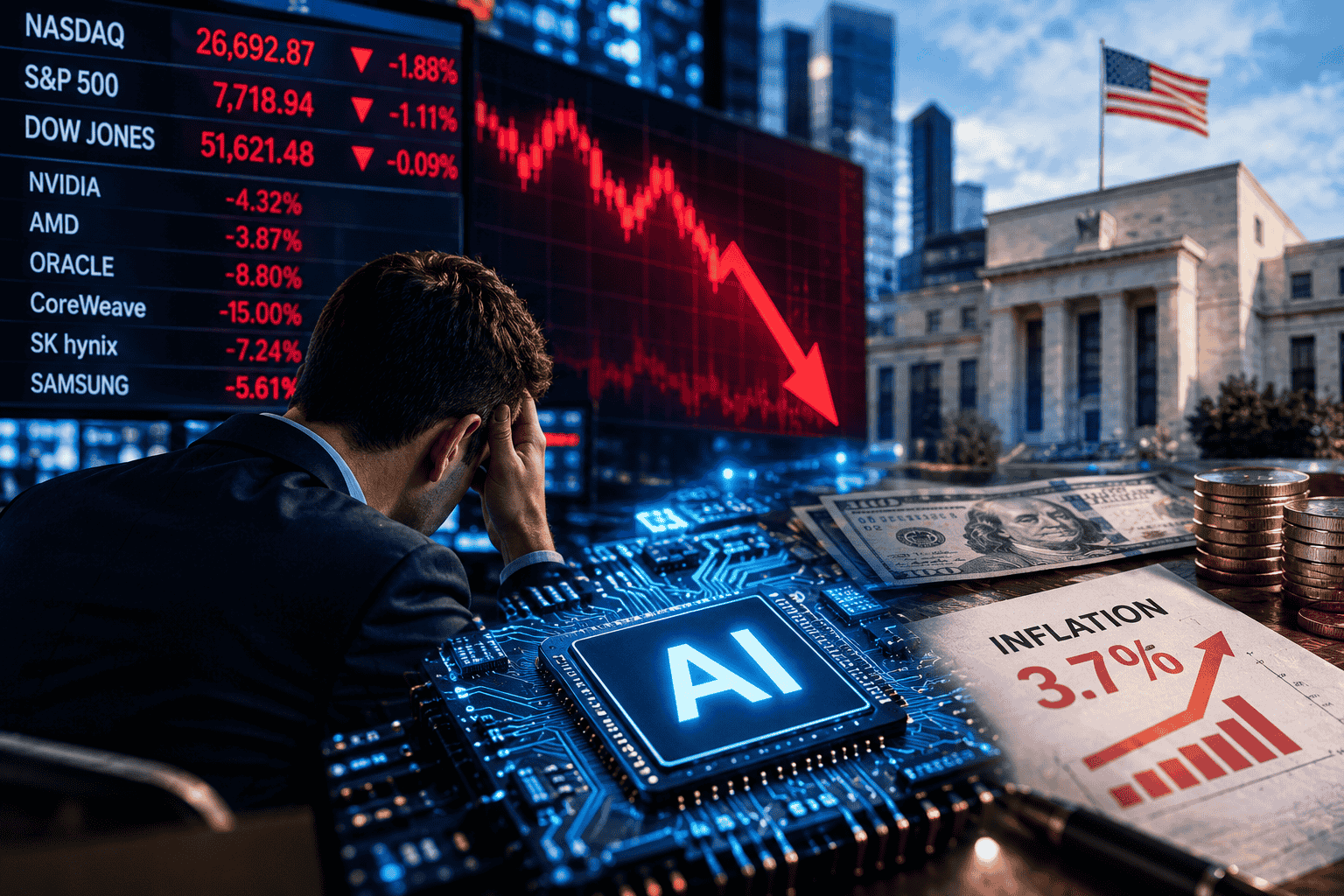
The latest inflation report showed that U.S. consumer prices increased by 3.7% year over year in September, compared with 3.4% in August. The unexpected acceleration has strengthened concerns that the Federal Reserve may need to maintain restrictive monetary policy or consider additional interest rate increases.
For investors, the combination of higher borrowing costs, expensive AI infrastructure, and elevated technology stock valuations presents a significant challenge. The key question is whether AI companies can deliver enough revenue and profit growth to justify their investments while financial conditions become less favorable.
Why Are AI Stocks Falling in October 2026?
The recent technology sell-off reflects a combination of inflation concerns, changing interest rate expectations, and growing scrutiny of AI-related spending.
1. Rising Inflation Creates Pressure on Technology Stocks
Inflation remains one of the most important factors influencing financial markets. When consumer prices rise faster than expected, investors often reconsider the timing of potential interest rate cuts and the possibility of further monetary tightening.
The September 2026 U.S. inflation report showed a 3.7% annual increase in the Consumer Price Index. Higher gasoline prices contributed to the acceleration, while price pressures extended beyond energy.
For technology companies, the consequences can be substantial. Many AI businesses depend on large investments in computing infrastructure, specialized chips, cloud services, and data centers. Higher interest rates can make these projects more expensive and reduce their expected returns.
Investors may consequently become less willing to pay premium prices for companies whose profits depend on strong growth over several years.
2. Wall Street’s Major Indexes Experience a Sharp Decline
The October 14 trading session highlighted the sensitivity of technology stocks to changing economic expectations.
The Nasdaq Composite declined 1.88% to 26,692.87, while the S&P 500 fell 1.11% to 7,718.94. The Dow Jones Industrial Average slipped 0.09% to 51,621.48.
AI infrastructure companies experienced particularly heavy selling. Oracle fell 8.8%, CoreWeave declined approximately 15%, and Nebius lost around 10%. Semiconductor stocks also faced pressure as investors reassessed the outlook for AI-related demand and capital expenditure.
These declines demonstrate how quickly sentiment can change when investors believe borrowing costs may remain higher for longer.
However, a single trading session does not establish that a long-term bear market has begun. The direction of future markets will depend on earnings, inflation, monetary policy, and corporate investment decisions.
3. The Cost of Building AI Infrastructure Is Increasing
The AI industry requires substantial capital investment. Technology companies are spending billions on data centers, advanced processors, networking equipment, cooling systems, and electricity infrastructure.
These investments are intended to support future demand for generative AI, enterprise automation, AI agents, and cloud computing. Yet the financial returns may take years to materialize.
Higher interest rates can increase financing expenses for companies that borrow to fund expansion. They can also reduce the present value of future earnings, making high-growth stocks less attractive under traditional valuation models.
Investors are increasingly examining whether AI spending is generating sustainable revenue or simply expanding the industry’s cost base.
The companies best positioned to withstand this environment may be those with strong balance sheets, recurring customer revenue, efficient operations, and disciplined investment strategies.
Is the AI Boom Turning Into a Financial Bubble?
The recent sell-off has revived debate about whether AI stocks have become overvalued.
The AI industry has genuine economic potential. Businesses are adopting AI for software development, customer support, medical research, financial analysis, manufacturing, and supply-chain management. These applications could improve productivity and create new sources of revenue.
Nevertheless, technological progress does not automatically translate into attractive investment returns.
A company may develop a valuable AI product but still struggle to generate sufficient profits because of intense competition, high computing costs, or expensive customer acquisition.
Investors should distinguish between three important concepts:
- AI adoption: How quickly businesses and consumers are using AI tools.
- AI profitability: Whether companies can generate sustainable profits from these products and services.
- AI stock valuations: Whether current share prices reasonably reflect expected future earnings.
These factors are connected but not identical. AI adoption could continue to expand even if many AI stocks experience substantial corrections.
The more important question for financial markets is whether corporate earnings can keep pace with the expectations already reflected in stock prices.
How Higher Interest Rates Could Affect AI Investments
Interest rates influence the cost of capital across the economy. When borrowing becomes more expensive, businesses may delay major investments, consumers may reduce spending, and investors may demand stronger returns before committing money to risky assets.
For AI infrastructure companies, these pressures could affect expansion plans.
A data center requires significant upfront spending before it can generate revenue. If financing costs rise or customer demand grows more slowly than expected, the investment may take longer to become profitable.
Higher interest rates can also affect technology valuations because a larger share of their expected earnings may lie far in the future.
For example, investors evaluating an AI company expecting rapid growth over the next decade must consider how interest rates, competition, and operating costs affect the present value of those projected earnings.
This does not mean that higher rates will automatically stop AI development. Large technology companies with strong cash reserves may continue investing, while smaller infrastructure providers may face greater financing pressure.
Global Impact: What the AI Sell-Off Means for Different Regions
The consequences of the AI stock correction extend beyond the United States. Technology supply chains, investment portfolios, and corporate spending connect financial markets across the world.
United States: Inflation and Federal Reserve Policy
The United States remains the center of many major AI investment projects, with large technology companies, semiconductor suppliers, and cloud computing providers driving global spending.
Higher inflation creates a difficult environment for the Federal Reserve. If price pressures remain persistent, policymakers may have less room to lower interest rates.
For U.S. investors, this could mean continued volatility in technology stocks and greater scrutiny of corporate earnings. Companies with high valuations and substantial financing requirements may be particularly sensitive to changes in interest rate expectations.
Businesses also need to prepare for uncertainty in borrowing costs, hiring plans, and customer demand.
China: Semiconductor Competition and AI Expansion
China is continuing to develop its domestic semiconductor and artificial intelligence industries. Competition in advanced computing, memory chips, and AI infrastructure could influence the profitability of established international suppliers.
A global slowdown in AI spending could create additional pressure on semiconductor manufacturers, while stronger domestic demand in China could support selected local companies.
However, the effects will vary by business. Manufacturing capabilities, access to advanced equipment, software ecosystems, and international trade restrictions will remain important competitive factors.
Europe: Technology Investment and Industrial Productivity
European companies face exposure to the global technology market through semiconductor equipment, industrial automation, cloud computing, and financial investments.
A prolonged AI infrastructure slowdown could affect suppliers serving international data-center projects. On the other hand, European businesses that use AI to improve manufacturing efficiency, logistics, and customer service may continue to benefit from adoption.
For European policymakers and business leaders, the challenge is to encourage productive AI investment while managing energy costs, financing conditions, and competitiveness.
Asia: Semiconductor Supply Chains Under Pressure
South Korea, Taiwan, and Japan play important roles in the global semiconductor ecosystem. Their companies supply memory chips, advanced manufacturing equipment, electronic components, and other technologies needed by AI developers.
When investors reduce exposure to AI infrastructure, semiconductor stocks can face selling pressure across the region.
For Asian economies, the outlook will depend on global chip demand, corporate investment plans, export performance, and the pace of AI adoption.
Pakistan: Currency, Investment, and Business Opportunities
For Pakistan, international technology market volatility can influence investor confidence, foreign investment sentiment, and the cost of imported technology.
A stronger U.S. dollar or higher global financing costs could increase pressure on businesses that depend on imported equipment and software. Companies seeking international financing may also face more demanding investment conditions.
However, the AI transition creates opportunities for Pakistani software companies, freelancers, IT exporters, and businesses adopting affordable AI tools.
Organizations that use AI to automate routine tasks, improve customer service, and increase productivity may benefit without needing to build expensive infrastructure themselves.
For Pakistani businesses, a practical strategy is to focus on measurable returns from AI adoption rather than making large technology commitments based solely on market enthusiasm.
What Investors Should Watch During the AI Market Correction
Market volatility can create opportunities, but it can also expose weaknesses in companies whose valuations depend on optimistic assumptions.
Investors should monitor several indicators as the market responds to inflation and changing monetary policy.
Corporate earnings: Strong revenue and profit growth could help support technology valuations. Disappointing results may increase selling pressure.
Capital expenditure: Investors should examine whether AI spending is producing measurable commercial returns and whether companies are adjusting their investment plans.
Free cash flow: A company generating strong operating cash flow after capital expenditure may be better positioned to manage higher financing costs.
Interest rate expectations: Further changes in Federal Reserve policy could affect borrowing costs and valuations across technology and other growth sectors.
Customer demand: Continued adoption of AI services is important, but businesses must demonstrate that customers are willing to pay enough to support sustainable profitability.
Diversification also remains important. Portfolios heavily concentrated in a small number of AI stocks can be vulnerable to sudden changes in sentiment.
Investors should evaluate individual companies on their financial fundamentals, competitive advantages, and valuations instead of assuming that every AI-related business will benefit equally.
Could the AI Stock Market Recover?
A recovery remains possible if inflation begins to moderate, interest rate expectations stabilize, and technology companies demonstrate stronger earnings.
Positive corporate guidance, evidence of profitable AI adoption, and continued demand for computing infrastructure could restore confidence.
However, a more difficult scenario could emerge if inflation remains elevated and financing costs rise while AI companies struggle to justify their spending. Under those conditions, investors could continue shifting money toward businesses with stronger cash flow, lower debt, or more predictable earnings.
The outlook will not necessarily be the same for every technology company. Established businesses with diversified revenue sources may respond differently from companies that rely heavily on external financing or a narrow group of AI customers.
For that reason, investors should avoid treating the entire AI sector as a single investment category.
Frequently Asked Questions
Why are AI stocks falling in October 2026?
AI stocks are under pressure because U.S. inflation accelerated to 3.7% in September, raising concerns about interest rates and the cost of financing AI infrastructure. Investors are also reassessing valuations and future profitability.
How did the U.S. stock market perform on October 14, 2026?
The Nasdaq Composite fell 1.88%, the S&P 500 declined 1.11%, and the Dow Jones Industrial Average slipped 0.09% during the session.
Will higher interest rates hurt artificial intelligence companies?
Higher interest rates can increase borrowing costs, make data-center projects more expensive, and reduce the present value of future earnings. The impact will depend on each company’s debt, cash reserves, revenue growth, and business model.
Is the AI boom over?
Not necessarily. AI adoption may continue to grow even if stock prices decline. The central investment question is whether individual companies can turn technological progress into sustainable profits.
What does the AI sell-off mean for Pakistan?
Pakistan may face indirect effects through currency movements, financing conditions, and the cost of imported technology. At the same time, local IT exporters and businesses using AI for productivity improvements may find new opportunities.
What should investors watch next?
Investors should monitor U.S. inflation, Federal Reserve decisions, corporate earnings, AI capital expenditure, free cash flow, and evidence of sustained customer demand.
Conclusion: AI Growth Faces a New Financial Reality
The October 2026 stock market sell-off highlights the growing connection between inflation, interest rates, and the global artificial intelligence industry.
Rising consumer prices have increased uncertainty about monetary policy, while declining technology shares demonstrate how sensitive AI investments can be to changes in financing costs and market expectations.
The long-term potential of AI remains significant, but investors are becoming more focused on whether companies can convert technological innovation into sustainable earnings and cash flow.
For business leaders, the lesson is to invest in AI with clear objectives and measurable returns. For investors, it is to evaluate valuations, financial strength, and competitive advantages rather than relying on market excitement alone.
The next phase of the AI boom may reward companies that combine innovation with financial discipline—and challenge those that cannot turn rapid expansion into lasting profitability.